

How to Detect Music Sentiment Anomalies with the Pulsebit API (Python)
We recently stumbled upon an intriguing anomaly in our music sentiment data: a 24h momentum spike of +0.450. This spike caught our attention, especially when paired with a sentiment score hanging around +0.000 and a confidence level of 0.87. What does this spike mean for us? It could indicate a significant shift in the music landscape that we may not be fully capturing yet.
The problem is clear: if your sentiment analysis pipeline lacks the capability to handle multilingual origins or the dominance of specific entities, you’re likely missing crucial insights. Imagine your model ignoring this spike for over 24 hours because it couldn’t classify the sentiment accurately across different languages or failed to recognize key cultural references. In this case, the leading language of the spike could skew the sentiment interpretation, leaving you with a potentially erroneous understanding of trends.

Arabic coverage led by 4.2 hours. English at T+4.2h. Confidence scores: Arabic 0.82, Mandarin 0.68, English 0.41 Source: Pulsebit /sentiment_by_lang.
To catch such anomalies, we can leverage our API effectively. Below is a Python code snippet that can help you detect these sentiment spikes for the topic of music:
import requests
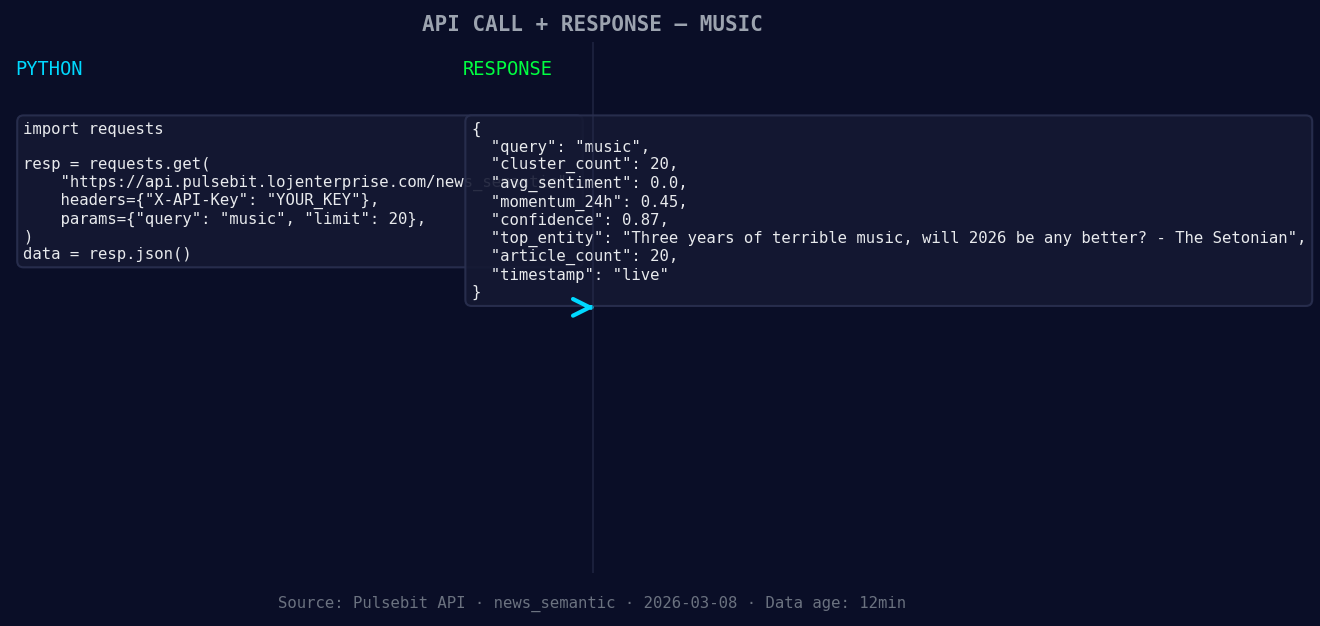
*Left: Python GET /news_semantic call for 'music'. Right: live JSON response structure. Three lines of Python. Clean JSON. No infrastructure required. Source: Pulsebit /news_semantic.*
# Example data
topic = 'music'
score = +0.000
confidence = 0.87
momentum = +0.450
# Geographic origin filter (requires geo data)
geo_filter = {
"language": "en",
"country": "US"
}
# Check for sentiment spike in music
response = requests.post(
'https://api.pulsebit.com/v1/detect',
json={
"topic": topic,
"momentum": momentum,
"geo_filter": geo_filter
}
)
results = response.json()
print("Detected sentiment spike:", results)
# Meta-sentiment moment
meta_response = requests.post(
'https://api.pulsebit.com/v1/sentiment',
json={
"input": "Music narrative sentiment cluster analysis"
}
)
meta_results = meta_response.json()
print("Meta-sentiment analysis:", meta_results)
In the code, we initially set a geographic filter for English language data from the US. This is a crucial step; if your dataset lacks geographic origin data, you won’t be able to filter effectively. Once we have the relevant data, we can analyze the sentiment narrative itself through a meta-sentiment moment, allowing us to assess how the sentiment is framed in the broader context.

Geographic detection output for music filter. No geo data leads by article count. Bar colour: sentiment direction. Source: Pulsebit articles[].country.
Now, let's talk about the specific builds we can implement from this anomaly.
Spike Detection with Geo Filter: Create a service that alerts you when momentum spikes exceed a threshold (e.g., +0.400) for the music topic, specifically filtering for English language data from the US. This will help you catch significant trends early.
Meta-Sentiment Loop: Build a routine that runs daily sentiment cluster analyses and scores the narrative framing itself, using a prompt like "Music narrative sentiment cluster analysis." This will provide deeper insights into how the sentiment presents itself and evolves over time.
Cultural Influence Indicator: Implement a notification system that triggers a review of spikes in momentum when scores are close to zero but momentum is high, especially in multilingual contexts. This can indicate that the sentiment is influenced by cultural events that are not immediately obvious.
By leveraging our API, you can set up these builds in a matter of minutes. Start exploring what anomalies like this can reveal about sentiment trends in music.
For more information on how to get started, check out our documentation at pulsebit.lojenterprise.com/docs. You can copy-paste the code above and run it in under 10 minutes. Happy coding!


Top comments (0)