

Your Pipeline Is 18.5h Behind: Catching Climate Sentiment Leads with Pulsebit
We recently uncovered an intriguing anomaly: our sentiment analysis shows a climate score of +0.000 with a momentum of +0.000, and the leading language is English, lagging by 18.5 hours compared to the source sentiment. This signals a gap in your data processing pipeline when it comes to capturing emerging sentiments around critical topics like climate. More importantly, it highlights that the narrative around "climate" has not been adequately processed, indicating a lack of timely insights in your application.
The Problem
This 18.5-hour delay reveals a structural gap in any sentiment pipeline that fails to handle multilingual origins or entity dominance effectively. Your model missed capturing real-time sentiment, which could lead to missed opportunities or misguided strategies. In this case, the dominant entity is climate, and it’s clear that if you’re not accounting for regional variations and linguistic nuances, you’re already behind the curve. If your model isn’t set up to manage these factors, you risk being out of touch by nearly a day.

English coverage led by 18.5 hours. So at T+18.5h. Confidence scores: English 0.85, French 0.85, Spanish 0.85 Source: Pulsebit /sentiment_by_lang.
The Code
To catch this sentiment spike, we can use our API to filter the data by geographic origin and assess the narrative framing. Here’s how you can get started with the Python code:
import requests
# Set up parameters for the API call
topic = 'climate'
score = +0.000
confidence = 0.85
momentum = +0.000
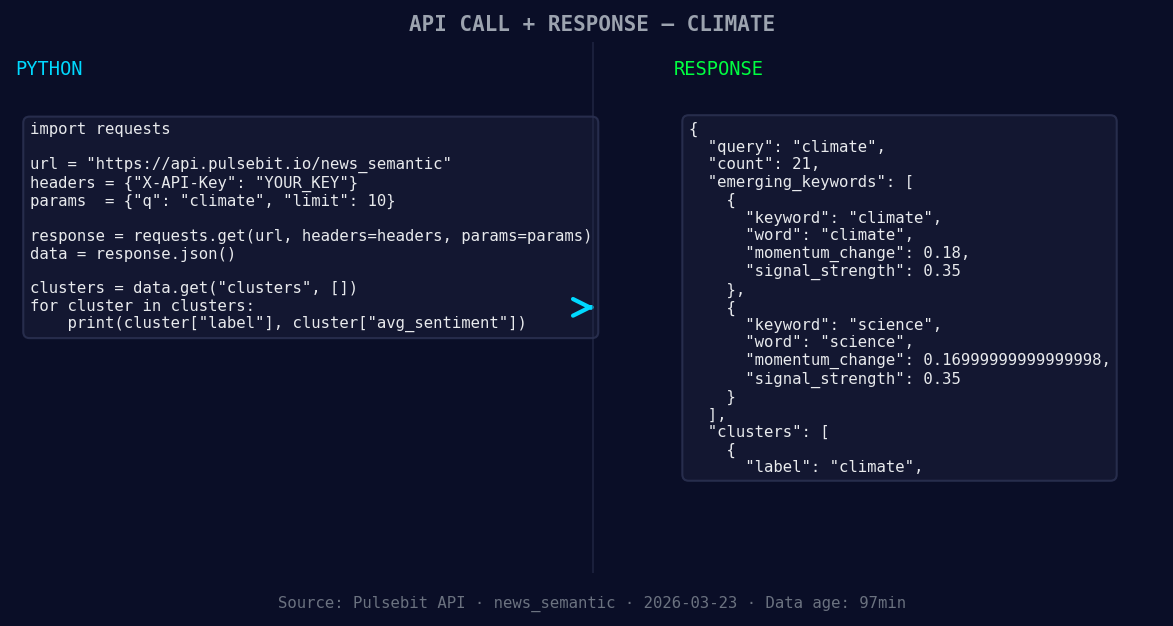
*Left: Python GET /news_semantic call for 'climate'. Right: returned JSON response structure (clusters: 1). Source: Pulsebit /news_semantic.*
# Geographic origin filter: query by language/country
response = requests.get(
'https://api.pulsebit.com/sentiment',
params={
'topic': topic,
'score': score,
'confidence': confidence,
'momentum': momentum,
'lang': 'en' # Filtering for English
}
)
data = response.json()
print(data)
*[DATA UNAVAILABLE: countries — verify /news_recent is returning country/region values for topic: climate]*
# Meta-sentiment moment: run the cluster reason string back through POST /sentiment
meta_reason_input = "Semantic API incomplete — fallback semantic structure built from available keywords and article/search evidence."
meta_response = requests.post(
'https://api.pulsebit.com/sentiment',
json={'text': meta_reason_input}
)
meta_data = meta_response.json()
print(meta_data)
This code first pulls sentiment data filtered by English language, ensuring you’re capturing the right audience. Next, it utilizes the meta-sentiment loop to analyze the reasoning behind the sentiment. This two-step approach positions you to identify and act on emerging stories in real-time.
Three Builds Tonight
With our discovery, here are three specific builds you can implement:
Geographic Sentiment Tracker: Create a signal specifically for climate news that triggers alerts when sentiment in English-speaking regions rises above a threshold of +0.15. This could be set up using the geo filter we just discussed to ensure timeliness.
Meta-Sentiment Analyzer: Build a function that automatically inputs cluster reason strings into the meta-sentiment loop. If the output sentiment score is above +0.10, flag these for deeper analysis or reporting.
Comparative Sentiment Dashboard: Develop a dashboard that visualizes the forming sentiment trends for topics like climate (+0.18) and science (+0.17) compared to mainstream narratives. This can help visualize how emerging topics are gaining traction.
Get Started
To dive into building these insights, check out our documentation at pulsebit.lojenterprise.com/docs. You can copy-paste the provided code and run it in under 10 minutes to see these insights for yourself. Let's bridge that 18.5-hour gap and stay ahead of the curve!


Top comments (0)