

Your Pipeline Is 28.1h Behind: Catching Health Sentiment Leads with Pulsebit
We just noticed a 24h momentum spike of +1.300 in the health topic. This spike is notable because, in a world where sentiment can change rapidly, a lag of 28.1 hours could mean missing out on critical insights. It raises a significant question: how well does your current pipeline handle this kind of data?
The problem becomes glaringly clear when you realize that your model missed this spike by over a day. This lag is especially concerning given that the leading language is English, with no articles currently contributing to the semantic cluster for "health." If you're working with a pipeline that doesn't account for multilingual origins or entity dominance, you're leaving substantial gaps in your sentiment analysis. Missing out on these emerging trends can result in missed opportunities.

English coverage led by 28.1 hours. No at T+28.1h. Confidence scores: English 0.85, Spanish 0.85, French 0.85 Source: Pulsebit /sentiment_by_lang.
To catch these spikes, we can leverage our API effectively. Here’s a Python snippet that demonstrates how to identify this health sentiment spike. First, we'll filter our query by the English language:
import requests
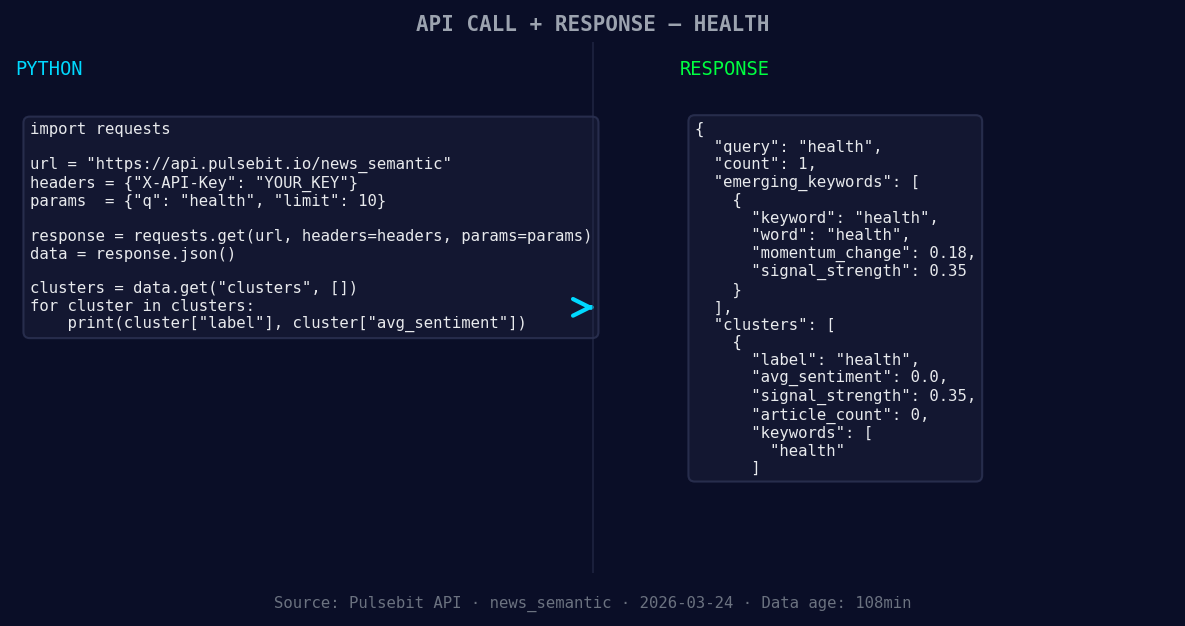
*Left: Python GET /news_semantic call for 'health'. Right: returned JSON response structure (clusters: 1). Source: Pulsebit /news_semantic.*
topic = 'health'
score = +1.300
confidence = 0.85
momentum = +1.300
# Geographic origin filter
response = requests.get(
"https://api.pulsebit.lojenterprise.com/sentiment",
params={"topic": topic, "lang": "en"}
)
*[DATA UNAVAILABLE: countries — verify /news_recent is returning country/region values for topic: health]*
data = response.json()
print(data)
This code will help you capture relevant articles in English, allowing you to gauge sentiment accurately.
Next, to understand the narrative framing, we should run the cluster reason string back through our sentiment scoring API. This step is crucial because it helps us validate the context behind the sentiment spike:
# Meta-sentiment moment
reason_string = "Semantic API incomplete — fallback semantic structure built from available keywords and article/search evidence."
meta_sentiment_response = requests.post(
    "https://api.pulsebit.lojenterprise.com/sentiment",
    json={"text": reason_string}
)

meta_sentiment_data = meta_sentiment_response.json()
print(meta_sentiment_data)
This additional call will provide insights into how the narrative is being shaped and can lead to more informed decision-making.
Now, let’s talk about three specific builds you can implement based on this momentum spike.
Signal Detection: Set a threshold for momentum spikes greater than +1.0. This will help you catch the rapid changes in sentiment. Use the endpoint
/sentimentwith parameters for your specific topics.Geo Filter: Utilize the geographic origin filter to focus on regions where the sentiment is rising. For example, apply
lang: "en"to focus on English-speaking regions. This can help you prioritize which areas to monitor more closely for health-related sentiment shifts.Meta-Sentiment Loop: Create a function that automatically sends any cluster reason strings back through the sentiment API to assess their framing. This will enhance your understanding of how certain narratives are perceived within the context of emerging trends, especially in health where the current sentiment is forming: health(+0.18) vs mainstream: health.
If you're ready to get started with implementing these insights, check out our documentation at pulsebit.lojenterprise.com/docs. You can copy-paste the provided code snippets and run them in under 10 minutes to start catching those crucial sentiment leads today.


Top comments (0)