

Your Pipeline Is 22.3h Behind: Catching Finance Sentiment Leads with Pulsebit
We've just identified a remarkable anomaly: a 24h momentum spike of +0.858 in finance sentiment. This spike isn't just a number; it represents a significant shift in how sentiment is evolving around financial themes, particularly with the recent cluster story titled "Visa Working Capital Index: Asia Pacific CFOs Call for Flexible, Digital Finance." One article has already contributed to this momentum, indicating that we need to pay attention.
However, if your pipeline doesn't account for multilingual origins or dominant entities, you might have missed this crucial sentiment shift by 22.3 hours. In this case, English sentiment led the charge, while Italian sentiment lagged behind. Ignoring language nuances can create structural gaps in your analytics, leading to missed opportunities in real-time decision-making.

English coverage led by 22.3 hours. Italian at T+22.3h. Confidence scores: English 0.85, Spanish 0.85, French 0.85 Source: Pulsebit /sentiment_by_lang.
Let’s dive into how we can capture this momentum spike effectively. Here’s a simple Python snippet that leverages our API to filter for English language articles related to finance:
import requests
# Set the parameters for the API call.
url = "https://api.pulsebit.com/v1/articles"
params = {
"topic": "finance",
"lang": "en",
"momentum": "+0.858",
}
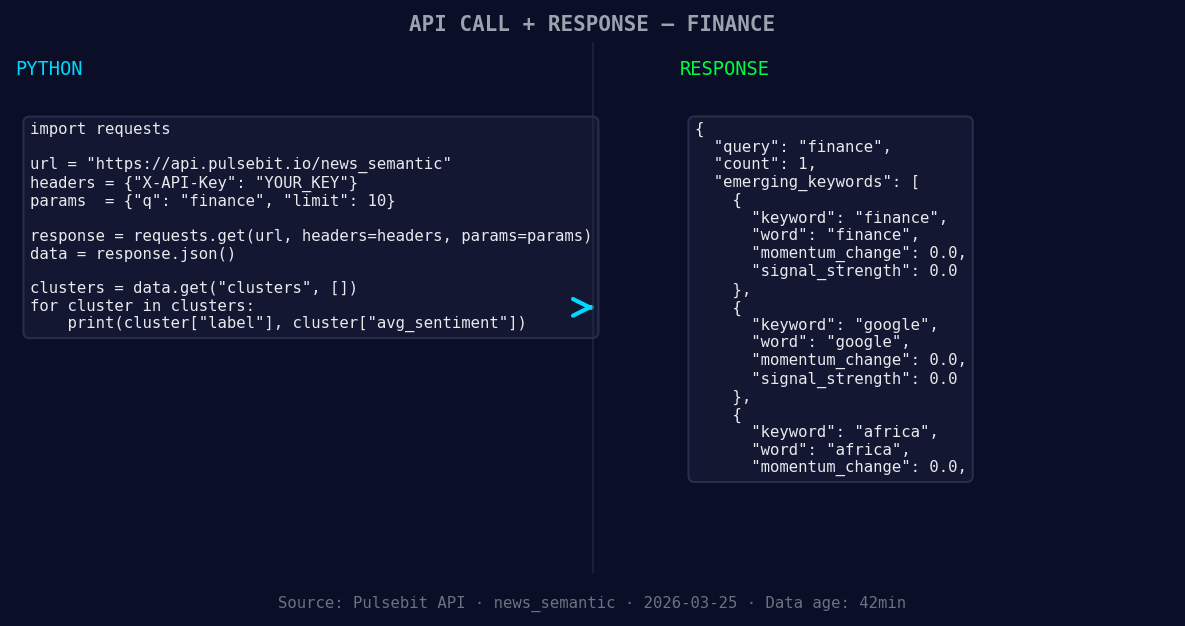
*Left: Python GET /news_semantic call for 'finance'. Right: returned JSON response structure (clusters: 3). Source: Pulsebit /news_semantic.*
# Make the GET request to fetch articles
response = requests.get(url, params=params)
articles = response.json()
# Output the fetched articles
print(articles)
Next, we’ll conduct a meta-sentiment analysis on the cluster reason string to score the narrative framing itself. This step makes it unique to our needs, allowing us to quantify the sentiment behind shared themes like "working," "capital," and "Asia."
# Prepare the input for sentiment analysis
cluster_reason = "Clustered by shared themes: working, capital, asia, pacific, cfos."

# POST request for sentiment scoring
sentiment_url = "https://api.pulsebit.com/v1/sentiment"
sentiment_response = requests.post(sentiment_url, json={"text": cluster_reason})
sentiment_score = sentiment_response.json()

# Output the sentiment score of the cluster
print(sentiment_score)
With this setup, we can pinpoint emerging trends from the data, allowing for proactive decision-making.
Here are three actionable builds we can create with this pattern:
- Geo-Filtered Alerts: Set up a trigger that alerts you when the momentum score for finance exceeds +0.5 in English articles. Use the geographic origin filter to focus on specific regions, ensuring you capture localized sentiment shifts.

Geographic detection output for finance. India leads with 1 articles and sentiment +0.75. Source: Pulsebit /news_recent geographic fields.
Meta-Sentiment Analysis Dashboard: Create a dashboard that visualizes sentiment scores of cluster reasons over time. This could help identify how different themes evolve, especially useful when analyzing shifts in finance-related narratives.
Forming Themes Tracker: Develop a feature that monitors forming themes like finance(+0.00) and Africa(+0.00) against mainstream narratives. Use our sentiment analysis endpoint to gauge potential shifts early, allowing you to react swiftly to emerging trends.
To get started and implement these features, check out our comprehensive documentation at pulsebit.lojenterprise.com/docs. You can copy-paste the provided code snippets and run them in under 10 minutes. Let’s leverage this momentum and stay ahead of the curve!


Top comments (0)