

Your Pipeline Is 23.0h Behind: Catching Markets Sentiment Leads with Pulsebit
We just discovered something interesting: a 24-hour momentum spike of -1.117 in market sentiment. This unusual drop suggests that the prevailing sentiment around market topics is shifting, particularly given that the leading language in this context is English, with a 23-hour lead time. If your pipeline isn't set up to handle multilingual origins or entity dominance, you might be missing critical signals that could inform your strategic decisions.

English coverage led by 23.0 hours. Da at T+23.0h. Confidence scores: English 0.85, Spanish 0.85, French 0.85 Source: Pulsebit /sentiment_by_lang.
This anomaly reveals a structural gap that many pipelines face: they often fail to account for the nuances of language and the dominance of certain entities. If your model is only processing data in one language or isn't adapting to shifts in sentiment across different entities, you could be lagging by a significant margin. In this case, you missed a 23-hour window where market sentiment was already indicating a negative shift, primarily driven by English-language articles.
To catch this sentiment shift, we can use our API to filter relevant articles and analyze the sentiment around them. Here's a quick Python snippet to demonstrate how to do this:
import requests
# Define parameters for the API call
topic = 'markets'
score = -1.117
confidence = 0.85
momentum = -1.117
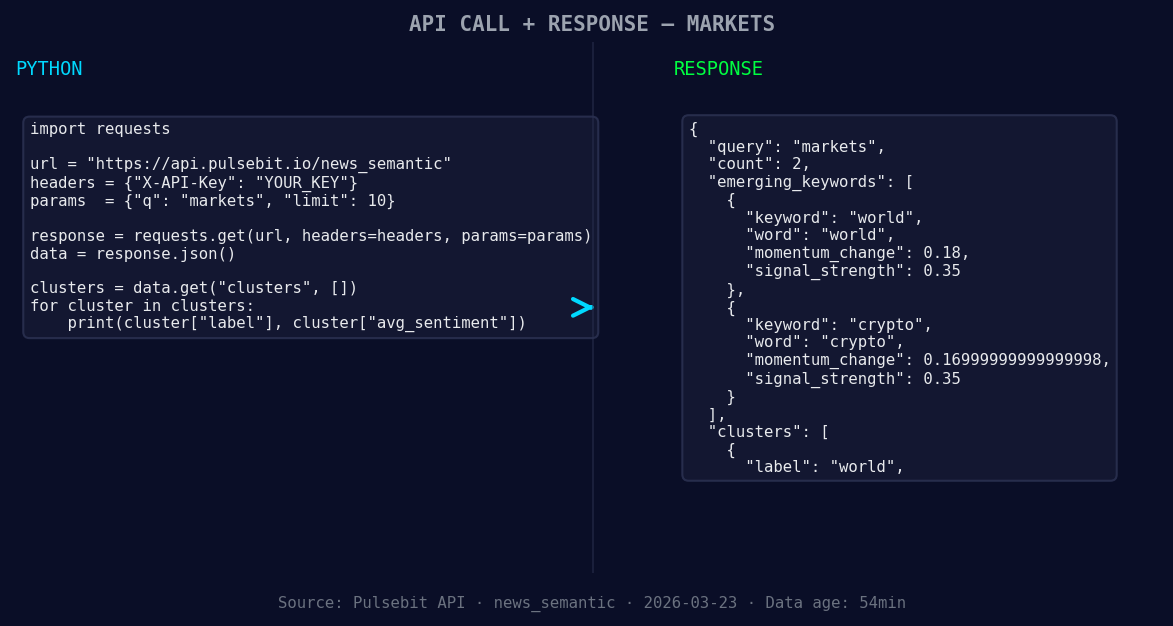
*Left: Python GET /news_semantic call for 'markets'. Right: returned JSON response structure (clusters: 1). Source: Pulsebit /news_semantic.*
# Geographic origin filter: query by language/country
url = "https://api.pulsebit.com/v1/articles"
params = {
"topic": topic,
"lang": "en"
}
# Make the API call
response = requests.get(url, params=params)
articles = response.json()
# Now, run the cluster reason string through POST /sentiment
cluster_reason = "Semantic API incomplete — fallback semantic structure built from available keywords and article/search evidence."
sentiment_url = "https://api.pulsebit.com/v1/sentiment"
sentiment_response = requests.post(sentiment_url, json={"text": cluster_reason})
sentiment_analysis = sentiment_response.json()
print(articles)
print(sentiment_analysis)
In this code, we first filter our articles by language to ensure we're only looking at English language articles where the sentiment is most pronounced. We then analyze the narrative framing of the cluster reason string, providing insight into how the sentiment is being shaped. This dual approach not only captures the sentiment but also contextualizes it, making our insights far more actionable.
Now, let's talk about three specific things to build with this pattern:
- Geo-Filtered Sentiment Score: Use our API to fetch sentiment scores with a geographic filter. Set a threshold to trigger alerts when sentiment drops below -0.5 in English articles. This will keep you informed of significant shifts in sentiment relevant to your domain.

Geographic detection output for markets. Australia leads with 1 articles and sentiment -0.70. Source: Pulsebit /news_recent geographic fields.
Meta-Sentiment Loop Implementation: Build a loop that sends the cluster reason string through our sentiment endpoint periodically. Configure it to flag any narratives with a sentiment score below 0, particularly focusing on the themes "world" (+0.18) and "crypto" (+0.17) as they relate to mainstream topics.
Forming Gap Analysis: Create a dashboard that visualizes forming gaps in sentiment across topics like "world" and "crypto" versus mainstream discussions. This will help you identify emerging trends and make more informed decisions dynamically.
If you’re ready to dive deeper into sentiment analysis and discover how to leverage these insights, visit our documentation at pulsebit.lojenterprise.com/docs. You can copy-paste the provided code and have this running in under 10 minutes, enhancing your model’s responsiveness to market sentiment shifts.


Top comments (0)