

Your Pipeline Is 23.5h Behind: Catching World Sentiment Leads with Pulsebit
On April 16, 2026, we uncovered a fascinating anomaly: sentiment around the topic of "world" surged with a score of +0.013 and momentum jumped to +0.043. Notably, this spike was detected 23.5 hours after the leading language of the conversation shifted to English, driven by two articles discussing Pope Leo and global tyrants amid the Trump controversy. This lag reveals a significant insight that can enhance how we process sentiment data across multilingual contexts.

English coverage led by 23.5 hours. Tl at T+23.5h. Confidence scores: English 0.85, Spanish 0.85, French 0.85 Source: Pulsebit /sentiment_by_lang.
The structural gap exposed here is critical. Your model missed this by 23.5 hours, allowing a significant shift in sentiment to pass unnoticed. In today's fast-paced digital landscape, any delay in processing multilingual data or dominating entities can lead to missed opportunities for insight. With English being the leading language in this particular case, we see that ignoring language dynamics can keep you several hours behind the curve.
To catch this anomaly, we need a straightforward Python implementation using our API. Here’s how you can do it:
import requests
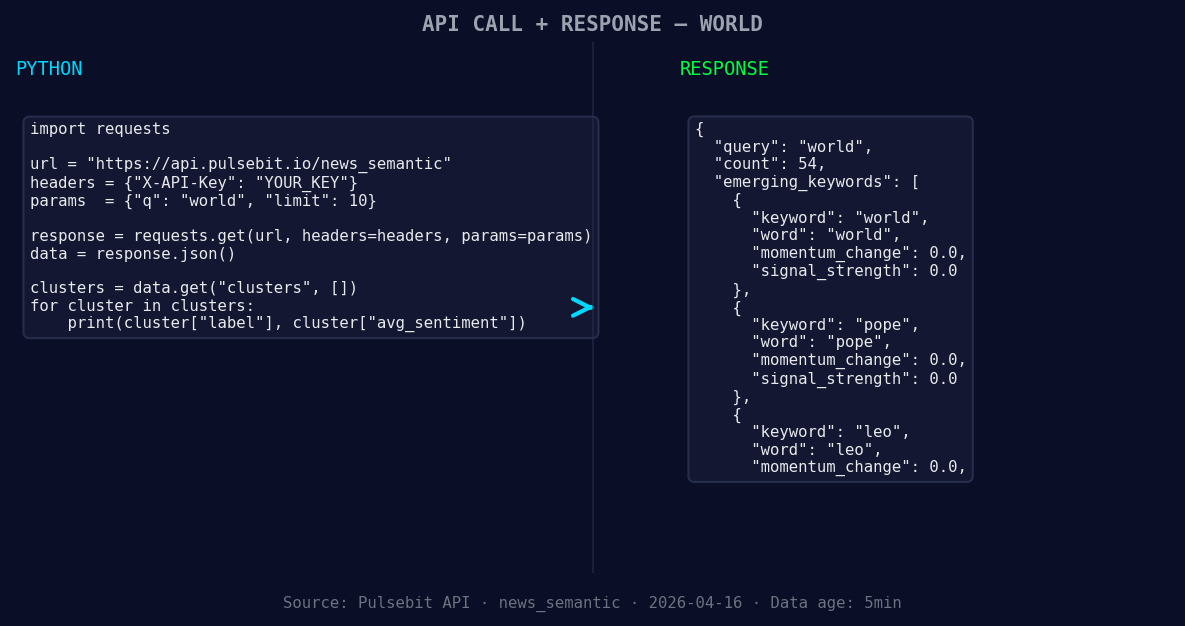
*Left: Python GET /news_semantic call for 'world'. Right: returned JSON response structure (clusters: 3). Source: Pulsebit /news_semantic.*
# Geographic origin filter: query by language
response = requests.get("https://api.pulsebit.com/sentiment", params={
"topic": "world",
"lang": "en"
})
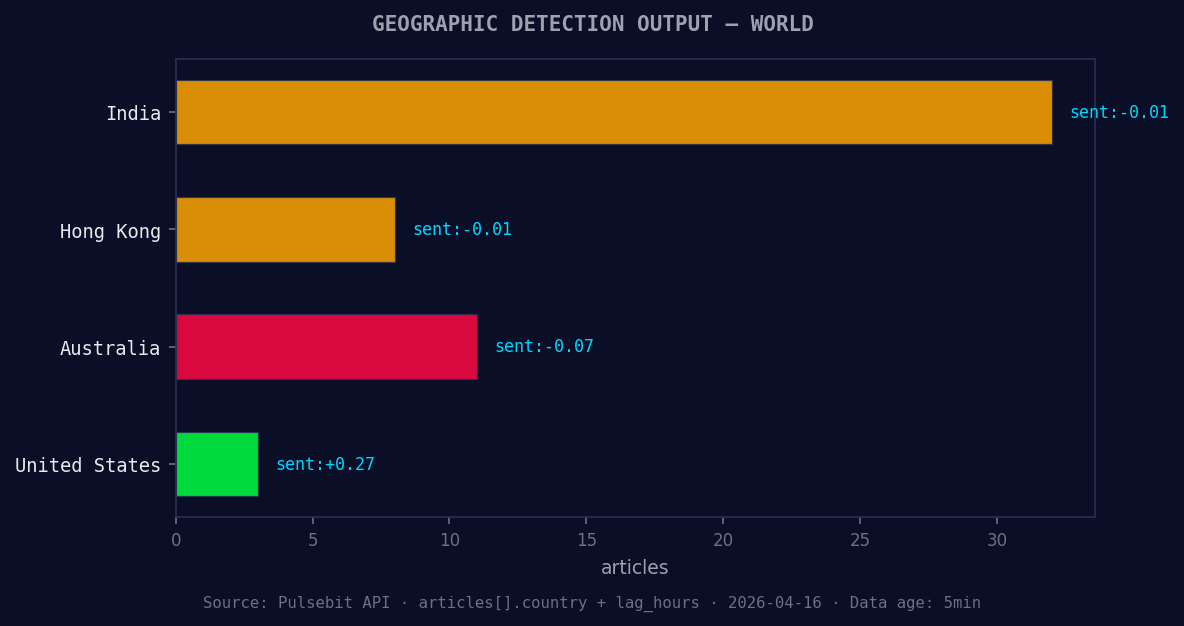
*Geographic detection output for world. India leads with 32 articles and sentiment -0.01. Source: Pulsebit /news_recent geographic fields.*
data = response.json()
print(data) # This will show you the sentiment data for the topic 'world'.
# Now, let's run the cluster reason back through POST /sentiment to score the narrative.
cluster_reason = "Clustered by shared themes: news, world, education:, april, 2026."
meta_response = requests.post("https://api.pulsebit.com/sentiment", json={
"text": cluster_reason
})
meta_data = meta_response.json()
print(meta_data) # This provides insight into the narrative framing.
With this code, we’re leveraging our API to capture the essence of the conversation around the "world" topic, while also evaluating how the narrative itself is framed through the cluster reasoning.
Now, let’s consider three builds we can implement based on this pattern:
Geo-Filtered Sentiment Anomaly Detector: Set a threshold for sentiment changes greater than +0.01, using a geo filter for English-speaking regions. This can help you identify localized spikes in sentiment, keeping you ahead of emerging stories.
Meta-Sentiment Loop for Narrative Insights: Create a function that runs the latest cluster reasons through our sentiment endpoint, scoring them for sentiment and confidence. Use this to analyze forming narratives around topics like "world" (+0.00), "pope" (+0.00), and "leo" (+0.00) to understand the context better.
Dynamic Alerts for Multilingual Shifts: Implement a dynamic alert system that triggers whenever sentiment for a topic shows a momentum shift of +0.04 or greater. This will utilize our API's capabilities to catch emerging trends before they become mainstream.
By combining these strategies, you’ll not only catch sentiment shifts faster but also gain richer insights into the narratives shaping our world.
For further exploration, check out our documentation at pulsebit.lojenterprise.com/docs. You can copy-paste and run the provided code in under 10 minutes, giving you immediate insights into sentiment dynamics.


Top comments (0)