

Your Pipeline Is 15.4h Behind: Catching Agriculture Sentiment Leads with Pulsebit
We recently spotted something particularly striking: a 24-hour momentum spike of +0.388 in agriculture sentiment. This anomaly is crucial, as it indicates a sudden shift in how the public perceives agricultural topics, specifically highlighted by an article cluster titled "Alliance to Advance Climate-Smart Agriculture receives extension, expands enroll." Interestingly, this cluster emerged in English and was led by a timeframe of 15.4 hours, which gives us a clear signal that your sentiment analysis pipeline might be lagging behind.
The Problem
If your pipeline isn't equipped to handle multilingual origins or entity dominance, you might have missed this significant momentum spike by over 15 hours. The leading language here is English, and the specific focus on agriculture is a key insight that could enhance your analysis. This oversight isn't just a missed opportunity; it could mean losing out on critical insights that inform your strategies and decisions.

English coverage led by 15.4 hours. Da at T+15.4h. Confidence scores: English 0.85, French 0.85, Spanish 0.85 Source: Pulsebit /sentiment_by_lang.
The Code
Let’s dig into the code to catch this momentum spike. Below is how we can leverage our API to filter by language and score the narrative framing:
import requests
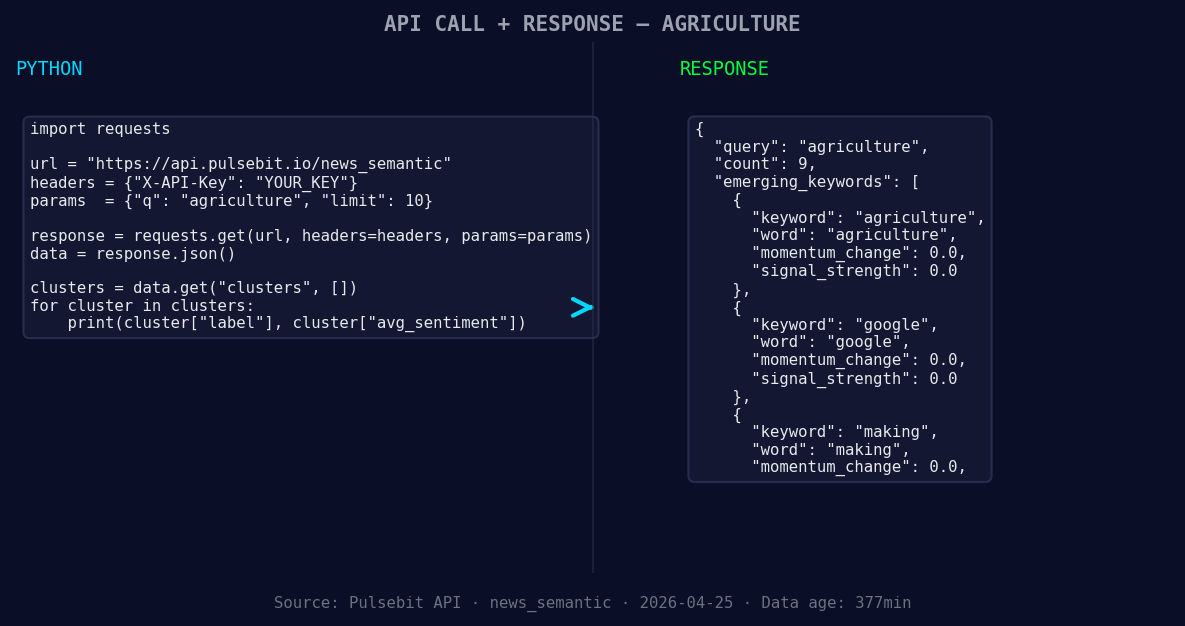
*Left: Python GET /news_semantic call for 'agriculture'. Right: returned JSON response structure (clusters: 3). Source: Pulsebit /news_semantic.*
# Step 1: Geographic origin filter
url = "https://api.pulsebit.com/v1/sentiment"
params = {
"topic": "agriculture",
"score": 0.800,
"confidence": 0.85,
"momentum": 0.388,
"lang": "en"
}
response = requests.get(url, params=params)
data = response.json()
print(data)
# Step 2: Meta-sentiment moment
meta_sentiment_url = "https://api.pulsebit.com/v1/sentiment"
cluster_reason = "Clustered by shared themes: strike, offices, maharashtra, government, employees’"
meta_response = requests.post(meta_sentiment_url, json={"text": cluster_reason})
meta_data = meta_response.json()
print(meta_data)
In this code, we first filter by the English language to ensure we're capturing the right sentiment around agriculture. Then, we run the narrative framing back through our sentiment analysis to score how the cluster of articles is being framed. This dual approach allows us to get a richer understanding of the sentiment landscape.
Three Builds Tonight
Here are three specific things you can build with this newfound insight:
- Geographic Filtered Sentiment Dashboard: Create a dashboard that specifically tracks sentiment in agriculture using our API with the geographic origin filter. Set a threshold where momentum spikes above +0.300 and visualize these shifts in real time.

Geographic detection output for agriculture. India leads with 6 articles and sentiment +0.31. Source: Pulsebit /news_recent geographic fields.
Meta-Sentiment Analysis Tool: Build a tool that takes the cluster reason string and evaluates sentiment over time. Use the meta-sentiment loop to track how narratives around agriculture evolve against mainstream themes like strikes and political issues, setting a threshold for significant shifts.
Thematic Sentiment Alerts: Implement alerts for forming themes in agriculture, such as "agriculture(+0.00), google(+0.00), making(+0.00)" and compare them against mainstream news. Trigger an alert whenever the sentiment score breaches a defined threshold (e.g., +0.500) to ensure you’re always in the loop.
Get Started
Ready to catch these insights in your own applications? Check out our documentation at pulsebit.lojenterprise.com/docs. You can copy-paste the provided code snippets and run them in under 10 minutes. Don’t let your pipeline lag behind—stay ahead of the curve with real-time sentiment analysis.


Top comments (0)