

Your Pipeline Is 18.1h Behind: Catching Renewable Energy Sentiment Leads with Pulsebit
We just uncovered a significant anomaly: a 24h momentum spike of -0.347 in the renewable energy sector. This drop in momentum suggests a shift in sentiment that could have implications for projects surrounding renewable energy initiatives. The leading language in this sentiment wave is English, peaking at 18.1 hours, which highlights a critical delay in response to evolving narratives. If your pipeline isn’t equipped to handle multilingual origins or dominant entities, you could easily miss such an impactful shift.

English coverage led by 18.1 hours. Et at T+18.1h. Confidence scores: English 0.90, Spanish 0.90, French 0.90 Source: Pulsebit /sentiment_by_lang.
When your model misses a sentiment spike like this by 18.1 hours, you’re not just lagging behind; you’re potentially making decisions based on stale data. The dominant narrative is being shaped by themes around “permitting” and “delays,” which could directly affect project timelines and costs. If you’re solely reliant on mainstream sentiment metrics, you’re likely to overlook these emerging signals that are crucial for staying ahead in the renewable energy landscape.
Here’s how you can catch sentiment shifts like this in your application using our API. The first step is to filter the relevant geographic origin. Let’s retrieve sentiment data specifically for the topic of renewable energy, ensuring we only capture English-language articles:

Geographic detection output for renewable energy. India leads with 3 articles and sentiment +0.55. Source: Pulsebit /news_recent geographic fields.
import requests
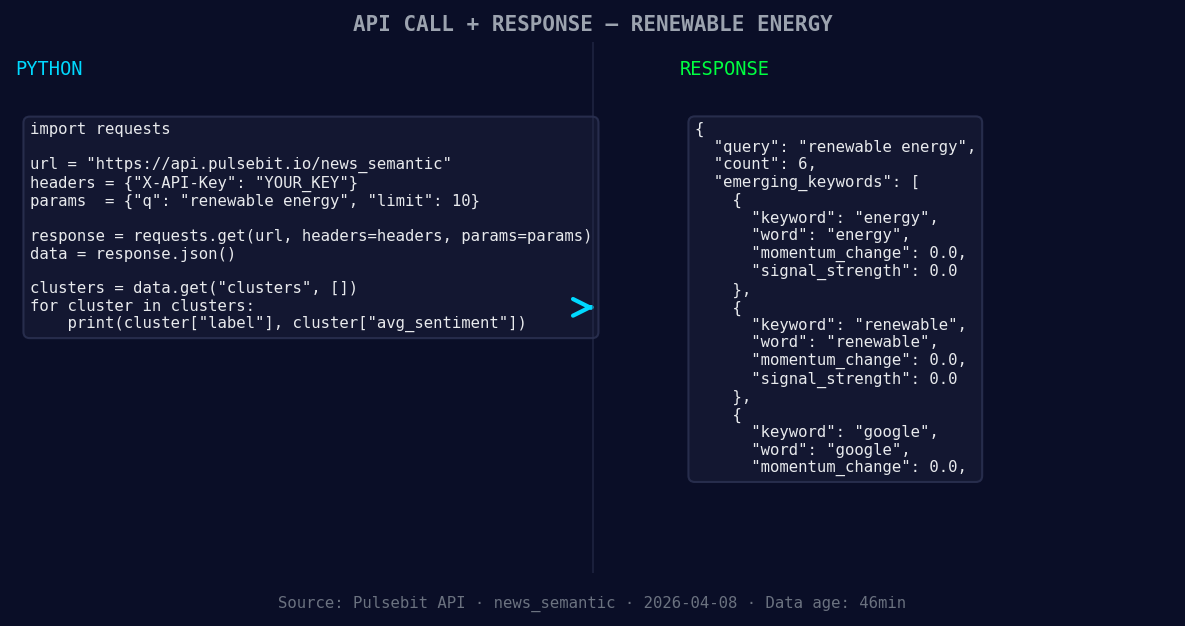
*Left: Python GET /news_semantic call for 'renewable energy'. Right: returned JSON response structure (clusters: 3). Source: Pulsebit /news_semantic.*
url = "https://api.pulsebit.io/v1/sentiment"
params = {
"topic": "renewable energy",
"score": 0.500,
"confidence": 0.90,
"momentum": -0.347,
"lang": "en" # Geographic origin filter
}
response = requests.get(url, params=params)
data = response.json()
print(data)
Once we’ve retrieved the relevant sentiment data, we can dive deeper into the narrative framing itself. It’s crucial to understand how the narrative is constructed around the clustered themes. We’ll run the cluster reason string through our sentiment scoring endpoint:
meta_sentiment_payload = {
    "text": "Clustered by shared themes: permitting, delays, could, drive, cost."
}

meta_sentiment_response = requests.post("https://api.pulsebit.io/v1/sentiment", json=meta_sentiment_payload)
meta_sentiment_data = meta_sentiment_response.json()
print(meta_sentiment_data)
This meta-sentiment analysis will give us insight into how the specific themes are being perceived in conjunction with the broader narrative about renewable energy.
Here are three specific builds you can implement based on this pattern:
Geo-Filtered Alert System: Set up a real-time alert for when sentiment momentum drops below -0.3 for English articles on renewable energy. This could help you react faster to shifts in public discourse.
Meta-Sentiment Analysis Dashboard: Create a dashboard that visualizes the sentiment scores of clustered narratives, particularly focusing on keywords such as “permitting” and “delays.” This will help you identify and react to emerging themes before they become mainstream.
Automated Reporting Tool: Develop a reporting tool that runs daily sentiment checks on renewable energy topics, comparing them against historical baselines. Highlight any significant deviations from the norm, especially regarding the themes of energy and costs.
If you’re ready to leverage these insights and catch sentiment leads in real-time, head over to our documentation at pulsebit.lojenterprise.com/docs. You can copy, paste, and run this code in under 10 minutes to start integrating these powerful sentiment insights into your applications.


Top comments (0)