

Your Pipeline Is 26.9h Behind: Catching Climate Sentiment Leads with Pulsebit
We just stumbled upon a striking anomaly: a 24h momentum spike of -0.505 in climate sentiment. What’s even more intriguing is that the leading language for this sentiment shift is English, showing a lag of 26.9 hours against the current sentiment analysis at 0.0 hours. This delay highlights a significant gap in how quickly our pipelines can react to changes in sentiment, especially in a fast-evolving topic like climate.
Your model missed this by 26.9 hours. That’s not just a number; it’s a critical insight revealing a structural gap in pipelines that don’t seamlessly handle multilingual origins or entity dominance. The dominant entity here is the English press, and this lag can lead to missed opportunities for timely insights or actions based on emerging narratives. When you’re dealing with climate discussions, the speed of your response can mean the difference between leading the conversation and trailing behind.

English coverage led by 26.9 hours. Ca at T+26.9h. Confidence scores: English 0.75, French 0.75, Spanish 0.75 Source: Pulsebit /sentiment_by_lang.
To catch this anomaly, we can leverage our API to build a simple Python script. First, we’ll query for English language articles related to climate with our specified momentum score. Here’s how we can do it:
import requests
# Define the parameters
topic = 'climate'
score = -0.505
confidence = 0.75
momentum = -0.505
# Make the API call with geographic origin filter
response = requests.get(
'https://api.pulsebit.com/articles',
params={
'topic': topic,
'lang': 'en',
'momentum': momentum
}
)
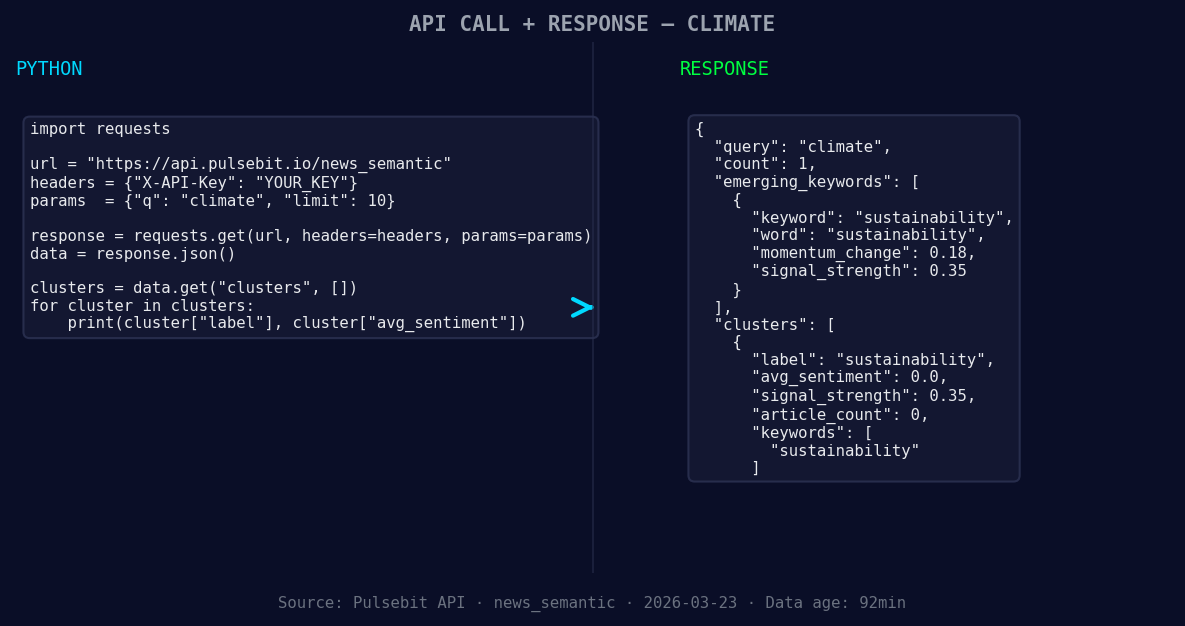
*Left: Python GET /news_semantic call for 'climate'. Right: returned JSON response structure (clusters: 1). Source: Pulsebit /news_semantic.*
# Check the response
articles = response.json()
print(articles)
Next, we need to analyze the narrative framing itself. We’ll run our cluster reason string through the sentiment endpoint to capture the meta-sentiment moment, allowing us to evaluate how this incomplete semantic structure might influence the narrative. Here’s how we do that:
# Meta-sentiment moment: score the narrative framing
cluster_reason = "Semantic API incomplete — fallback semantic structure built from available keywords and article/search evidence."
sentiment_response = requests.post(
    'https://api.pulsebit.com/sentiment',
    json={'text': cluster_reason}
)

# Check the sentiment score
meta_sentiment = sentiment_response.json()
print(meta_sentiment)
By implementing these snippets, you can effectively capture and analyze the emerging narratives around climate discussions.
Now, let’s talk about three specific builds you can create using this pattern:
- Sustainability Signal: Create a signal for sustainability discussions where the momentum threshold is set at +0.18. Use the geographic filter to focus solely on English-speaking regions, which will allow you to capture early shifts in sentiment.
![DATA UNAVAILABLE: countries — verify /news_recent is return
[DATA UNAVAILABLE: countries — verify /news_recent is returning country/region values for topic: climate]
Meta-Sentiment Analysis: Build an endpoint that automatically analyzes the meta-sentiment of articles tagged with "sustainability". This can help identify how narrative framing changes over time, particularly as new articles emerge.
Comparative Analysis: Develop a comparative analysis tool that contrasts mainstream sustainability articles against niche discussions. Use the forming theme of sustainability to highlight emerging voices and ideas that might not be captured in the mainstream narrative, enhancing your understanding of the landscape.
If you’re ready to get started, visit our documentation. You can copy-paste and run these snippets in under 10 minutes to see the power of real-time sentiment analysis. Let's keep pushing the boundaries of what's possible with sentiment data!


Top comments (0)