

Your Pipeline Is 21.5h Behind: Catching Law Sentiment Leads with Pulsebit
We just spotted a remarkable anomaly: a 24h momentum spike of +0.199. This spike indicates a sudden shift in sentiment related to legal discussions, particularly around a bill to amend trans rights law. The press coverage has been predominantly in English, leading by 21.5 hours. This presents a significant opportunity to capture emerging sentiment trends in legal matters.
What does this mean for your pipeline? If your model isn’t capable of handling multilingual origins or entity dominance, it likely missed this critical development by over 21 hours. The English language coverage, which is currently dominant, highlights a gap in timely sentiment detection. You could be left playing catch-up while trends unfold elsewhere, especially in sensitive topics like trans rights legislation.

English coverage led by 21.5 hours. Italian at T+21.5h. Confidence scores: English 0.75, Spanish 0.75, French 0.75 Source: Pulsebit /sentiment_by_lang.
To demonstrate how to capitalize on this insight, let’s dive into the code. First, we want to filter articles by language to ensure we’re capturing the most relevant sentiment data.
import requests
# Set parameters for the API call
params = {
"topic": "law",
"lang": "en", # Filtering by English language
"score": -0.350,
"confidence": 0.75,
"momentum": +0.199
}
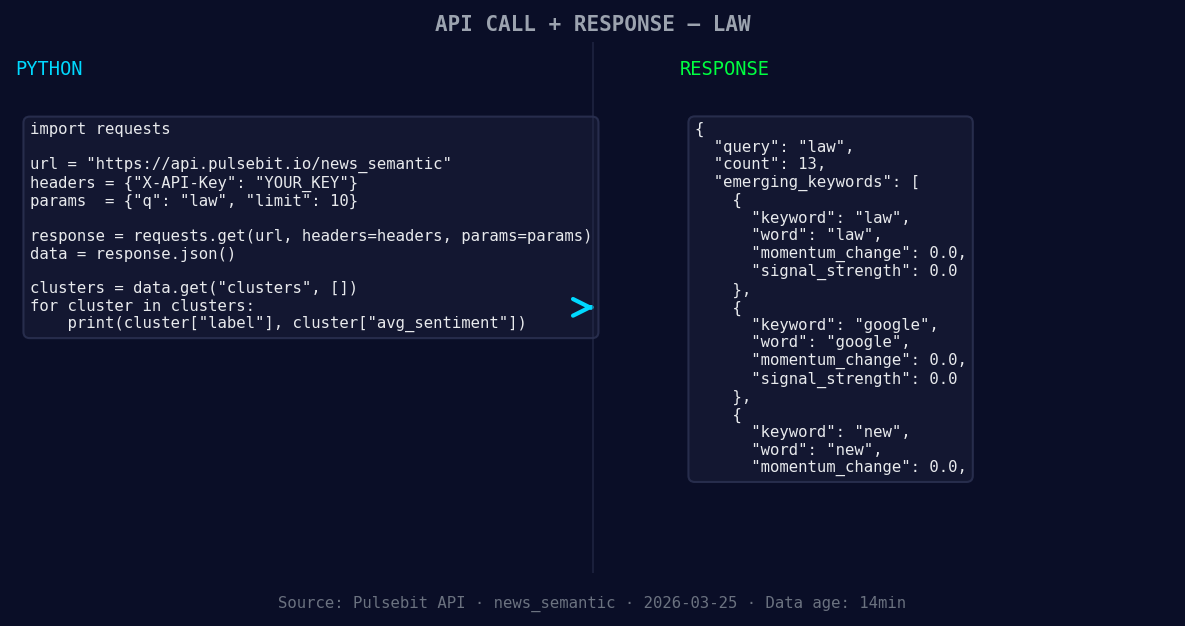
*Left: Python GET /news_semantic call for 'law'. Right: returned JSON response structure (clusters: 3). Source: Pulsebit /news_semantic.*
# Make the API call to fetch data
response = requests.get("https://api.pulsebit.com/v1/sentiment", params=params)
data = response.json()
print(data)
Now, we need to analyze the narrative framing of the clustered articles. We’ll run the cluster reason string back through our sentiment API to understand how the story is being perceived.
# Define the cluster reason string
cluster_reason = "Clustered by shared themes: bill, transgender, amend, trans, rights."

# Make the API call to analyze sentiment of the cluster reason
sentiment_response = requests.post("https://api.pulsebit.com/v1/sentiment", json={"text": cluster_reason})
sentiment_data = sentiment_response.json()
print(sentiment_data)
This dual approach not only provides you with timely data but also helps you understand the broader context of the discussions surrounding the bill.
To harness this pattern effectively, consider building the following three signals:
- Geo-Filtered Sentiment Score: Use the geographic origin filter to monitor sentiment shifts specifically in regions where the bill is being discussed. Set a threshold momentum of +0.150 to trigger alerts when sentiment spikes.

Geographic detection output for law. India leads with 6 articles and sentiment +0.00. Source: Pulsebit /news_recent geographic fields.
Meta-Sentiment Loop: Implement a system that continuously checks the sentiment around narrative clusters. Set up a recurring job that analyzes the cluster reason string and raises alerts if sentiment scores fall below -0.200, indicating a need for further investigation.
Forming Themes Tracker: Create a real-time tracker for forming themes. Monitor the terms "law", "google", and "new" alongside mainstream terms like "bill", "transgender", and "amend". Use a composite score that triggers reporting when the combined sentiment momentum exceeds +0.100.
By integrating these specific signals into your pipeline, you can stay ahead of critical discussions and respond proactively to changes in sentiment.
If you’re ready to dive in and explore further, check out our documentation at pulsebit.lojenterprise.com/docs. You can copy-paste and run these examples in under 10 minutes to start capturing sentiment shifts like a pro.


Top comments (0)