

Your Pipeline Is 12.1h Behind: Catching Investing Sentiment Leads with Pulsebit
We recently uncovered a striking anomaly: a 24-hour momentum spike of -0.226 in sentiment surrounding the topic of investing. This data indicates a significant shift in how sentiment is evolving, with the potential to influence investment decisions. The leading language driving this spike is English, with a noteworthy 12.1-hour lead time. We can’t stress enough how critical it is to recognize these early signals in your data pipeline.
The Problem
Imagine this: your model missed this opportunity by 12.1 hours. That’s the time it took for the English press to pivot on the investing narrative, while your pipeline remained dormant. If your system doesn’t account for multilingual origins or entity dominance, you risk lagging behind critical insights. In this case, the dominant entity is VYMI, and the missed sentiment could have significant implications for investment strategies.

English coverage led by 12.1 hours. Af at T+12.1h. Confidence scores: English 0.75, Spanish 0.75, French 0.75 Source: Pulsebit /sentiment_by_lang.
The Code
To help you catch these early signals, here’s a Python snippet that leverages our API effectively. We start by filtering by language to ensure we're processing the relevant sentiment from English sources:
import requests
# Define the parameters
topic = 'investing'
momentum = -0.226
score = +0.800
confidence = 0.75
# API call to filter articles based on language
response = requests.get(
'https://api.pulsebit.com/articles',
params={
'topic': topic,
'lang': 'en'
}
)
articles = response.json()
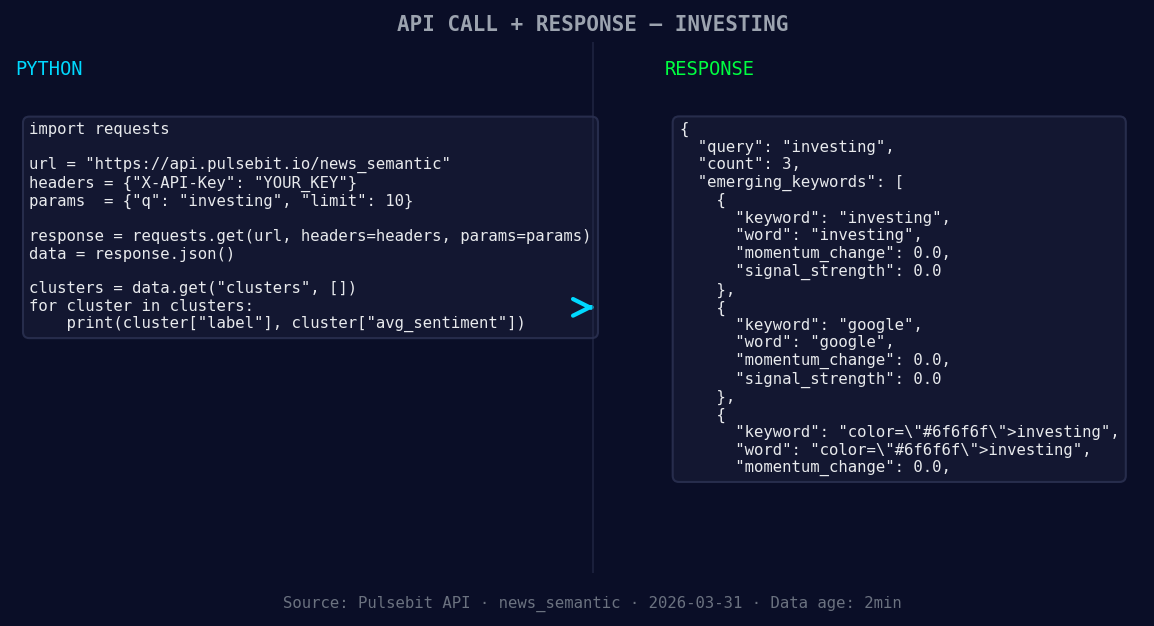
*Left: Python GET /news_semantic call for 'investing'. Right: returned JSON response structure (clusters: 3). Source: Pulsebit /news_semantic.*
# Now, let's score the narrative framing using the meta-sentiment loop
cluster_reason = "Clustered by shared themes: investing, $10, 000, vymi, make."
sentiment_response = requests.post(
'https://api.pulsebit.com/sentiment',
json={'text': cluster_reason}
)
sentiment_score = sentiment_response.json()
print(f"Articles processed: {len(articles)}")
print(f"Meta-sentiment score: {sentiment_score['score']}, Confidence: {sentiment_score['confidence']}")
This snippet retrieves articles on investing in English and runs the cluster reason through our sentiment analysis endpoint. It’s a straightforward way to catch the nuances of how narratives are forming and shifting.
Three Builds Tonight
Based on this anomaly, here are three specific projects we think you can build tonight:
- Geo-Filtered Sentiment Dashboard: Create a dashboard that tracks sentiment with the geographic origin filter, specifically focusing on English articles. Set a threshold where any sentiment score above +0.75 triggers a notification. This allows you to catch spikes in sentiment as they evolve.

Geographic detection output for investing. Hong Kong leads with 1 articles and sentiment +0.00. Source: Pulsebit /news_recent geographic fields.
Meta-Sentiment Analysis Tool: Build a tool that automatically runs cluster reason strings through the sentiment endpoint. Establish a rule that if a narrative’s score dips below +0.5, an alert is generated for further investigation. This helps you maintain a grasp on the narratives that are failing to resonate.
Investment Opportunity Scanner: Develop a script that scans for forming themes like "investing," "vymi," and "make." Use a sentiment score threshold of +0.8 and a momentum spike threshold of -0.226 to flag potential investment opportunities. This could help in identifying emerging narratives before they gain traction.
Get Started
For more details on how to implement these ideas, check our documentation at pulsebit.lojenterprise.com/docs. You can copy-paste this code and run it in under 10 minutes. Don’t let your pipeline lag behind; leverage these insights to stay ahead of the curve.


Top comments (0)