

Your Pipeline Is 26.0h Behind: Catching Energy Sentiment Leads with Pulsebit
We stumbled upon a striking anomaly: sentiment is currently at +0.017 with momentum also rising at +0.017, yet there's a glaring delay of 26.0 hours in the leading Spanish press coverage on the topic of energy. This lag in sentiment reporting raises an eyebrow, especially when we consider that the sentiment around energy is forming a gap of +0.18 compared to mainstream discussions.
The Problem
If your pipeline doesn't account for multilingual origins or entity dominance, you might find yourself missing critical insights like this one. Your model missed this by a full 26 hours, leaving you blind to the evolving sentiment landscape. With the leading language being Spanish, it’s evident that your pipeline needs to be equipped to handle diverse linguistic inputs and prioritize dominant entities effectively.

Spanish coverage led by 26.0 hours. Da at T+26.0h. Confidence scores: Spanish 0.85, English 0.85, Id 0.85 Source: Pulsebit /sentiment_by_lang.
The Code
To catch this anomaly, we can leverage our API effectively. Here’s how you can do it in Python:
import requests
# Define the parameters
topic = 'energy'
score = +0.017
confidence = 0.85
momentum = +0.017
# Step 1: Geographic origin filter
url = "https://api.pulsebit.lojenterprise.com/v1/sentiment"
params = {
"topic": topic,
"lang": "sp" # Focusing on Spanish-language data
}
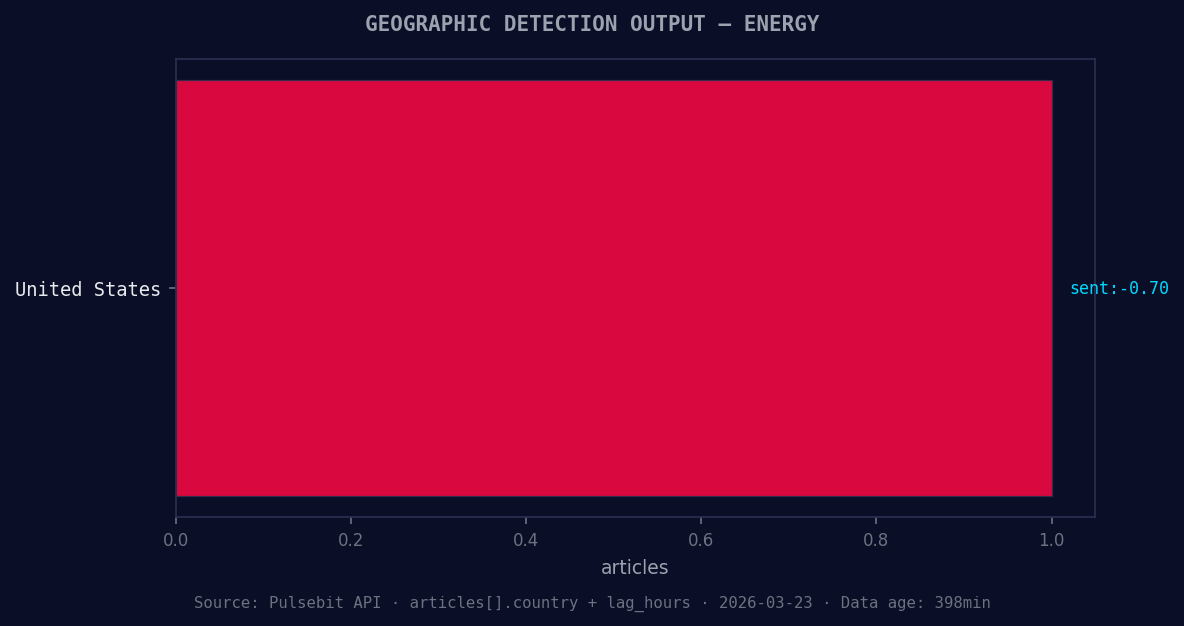
*Geographic detection output for energy. United States leads with 1 articles and sentiment -0.70. Source: Pulsebit /news_recent geographic fields.*
response = requests.get(url, params=params)
data = response.json()
# Output the data retrieved
print(data)
# Step 2: Meta-sentiment moment
meta_reason = "Semantic API incomplete — fallback semantic structure built from available keywords and article/search evidence."
meta_response = requests.post(url, json={"text": meta_reason})
meta_data = meta_response.json()
# Output the meta-sentiment score
print(meta_data)
In this code, we first filter sentiment data by the Spanish language using the lang parameter. This ensures we’re capturing the relevant articles and sentiment scores that could impact our understanding of energy sentiment in the Spanish-speaking press. Next, we run the narrative framing string through the /sentiment endpoint to evaluate the quality and context of the data we are working with.
Three Builds Tonight
We can build upon this discovery in several ways:
-
Sentiment Dashboard: Create a dashboard that filters sentiment by geographic origin, focusing on Spanish-language articles. Utilize the API call with the
langparameter set to "sp" to visualize sentiment trends specifically for energy.

Left: Python GET /news_semantic call for 'energy'. Right: returned JSON response structure (clusters: 1). Source: Pulsebit /news_semantic.
Meta-Sentiment Analysis: Build a feature that generates meta-sentiment scores for various clusters. Make API calls that utilize the narrative framing to assess how well our sentiment analysis reflects the conversation at hand.
Anomaly Alerts: Set up an alert system that triggers when sentiment gaps exceed a particular threshold—say, a sentiment delta of +0.15 compared to mainstream discourse. This will ensure you're notified when critical sentiment shifts occur, like the current energy sentiment forming a gap of +0.18.
Get Started
You can dive into our API right away at pulsebit.lojenterprise.com/docs. With the given code, you can copy-paste and run this in under 10 minutes, allowing you to catch those critical sentiment leads as they develop. Don't miss out on the next big opportunity!


Top comments (0)