

Your pipeline just missed a significant 24h momentum spike of +0.237 relating to discussions around "Trans Women and Internet Culture." This spike isn't just a number; it represents a shift in sentiment that you need to be aware of. With English press leading the charge at 23.1h, any model that doesn't account for multilingual origins or dominant entities could leave you lagging behind. Your model missed this by a staggering 23.1 hours, failing to capture the nuances of this emerging discourse. The relevance of this topic, clustered around themes of women, virality, and internet conversations, should not be overlooked.

English coverage led by 23.1 hours. Sv at T+23.1h. Confidence scores: English 0.90, Spanish 0.90, French 0.90 Source: Pulsebit /sentiment_by_lang.
The structural gap in your pipeline becomes evident when you realize that sentiment can vary dramatically across languages and cultures. If your model is only tuned for a specific language or fails to recognize the dominant entities shaping conversations, you risk missing crucial insights. The leading language in this case is English, but ignoring global discussions could mean you are unaware of evolving narratives that are crucial for decision-making.
Here’s a quick Python snippet to catch that momentum spike using our API. The first step is to query the sentiment data with a geographic origin filter:

Geographic detection output for culture. India leads with 3 articles and sentiment +0.78. Source: Pulsebit /news_recent geographic fields.
import requests
# Define the API endpoint and parameters
endpoint = "https://api.pulsebit.com/v1/sentiment"
params = {
"topic": "culture",
"lang": "en", # Geographic origin filter
"momentum": "+0.237"
}
# Make the API call
response = requests.get(endpoint, params=params)
data = response.json()
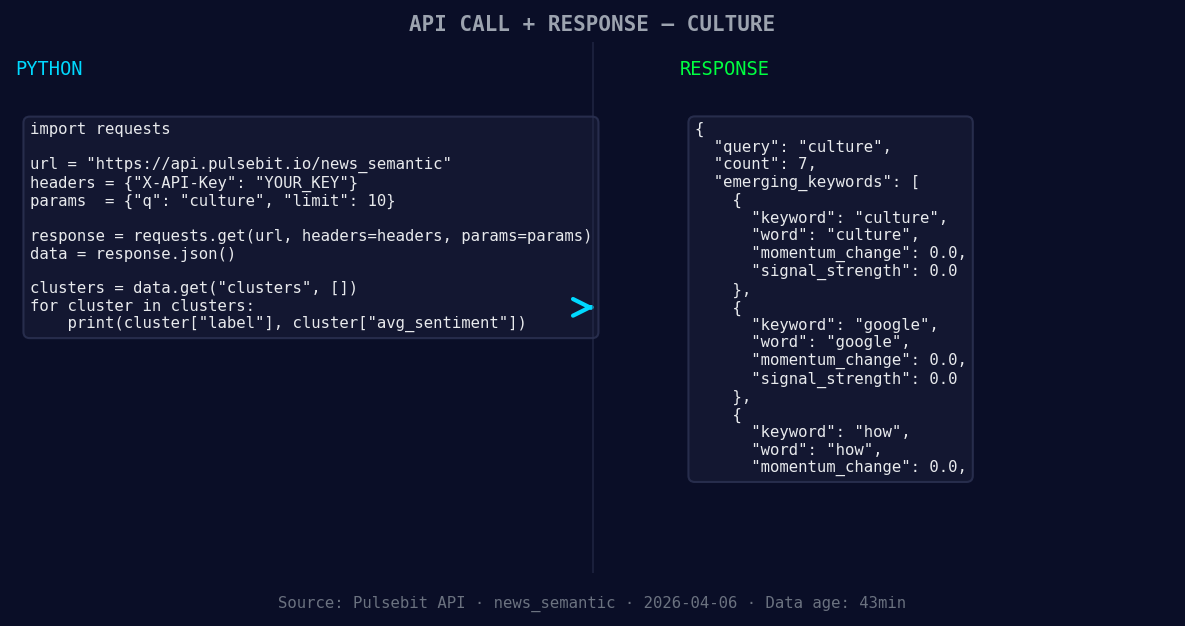
*Left: Python GET /news_semantic call for 'culture'. Right: returned JSON response structure (clusters: 3). Source: Pulsebit /news_semantic.*
print(data)
Next, we need to score the narrative framing itself using the cluster reason string. This will give us deeper insights into how the themes are resonating:
# Now let's run the cluster reason string through the sentiment endpoint
cluster_reason = "Clustered by shared themes: women, viral, trans, conversation, internet."
sentiment_response = requests.post(endpoint, json={"text": cluster_reason})

# Get the sentiment score for the narrative
sentiment_data = sentiment_response.json()

print(sentiment_data)
From our findings, we can build three specific insights based on this momentum spike. First, you might want to set a threshold for sentiment scores above +0.595. This can help you identify when cultural narratives are gaining traction. Second, consider using a geo filter for articles discussing "how" cultural themes like "women" and "viral" are evolving. This will help capture local nuances in sentiment. Finally, leverage our meta-sentiment loop to continuously refine your understanding of emerging trends. By querying for "culture" and analyzing the sentiment around the leading themes of women, viral content, and trans discussions, you can stay ahead of the curve.
If you're looking to get started, our documentation is available at pulsebit.lojenterprise.com/docs. With just a few minutes of setup, you can copy-paste and run this code to start capturing these important sentiment trends. Don't let your pipeline remain stagnant; adapt and evolve with the conversations that matter.


Top comments (0)