

Your Pipeline Is 10.7h Behind: Catching Defence Sentiment Leads with Pulsebit
We recently detected a significant anomaly: a 24h momentum spike of -0.701 in the defence topic. This is indicative of a sharp decline in sentiment that could signal emerging risks or shifts in public perception surrounding defence issues. Notably, this spike occurred while English-language articles were leading the conversation, with a lag of 10.7 hours. If your model isn't accounting for this, you’re missing critical insights that could impact your strategy.
The core problem here is the structural gap in sentiment pipelines that fail to accommodate multilingual origins or entity dominance. Your model missed this crucial shift by 10.7 hours, relying solely on the dominant English language narrative. The lack of a comprehensive view means you may miss vital contextual information that could inform better decisions. As we all know, timing is everything in this game, and a delay like this can lead to missed opportunities or worse, unintended consequences.

English coverage led by 10.7 hours. Id at T+10.7h. Confidence scores: English 0.75, Spanish 0.75, French 0.75 Source: Pulsebit /sentiment_by_lang.
Here’s how we can catch this anomaly using Python and our API. First, let’s set up a geographic origin filter to focus on English-language content. We’ll leverage the GET /articles endpoint to pull relevant data:

Geographic detection output for defence. India leads with 2 articles and sentiment +0.05. Source: Pulsebit /news_recent geographic fields.
import requests
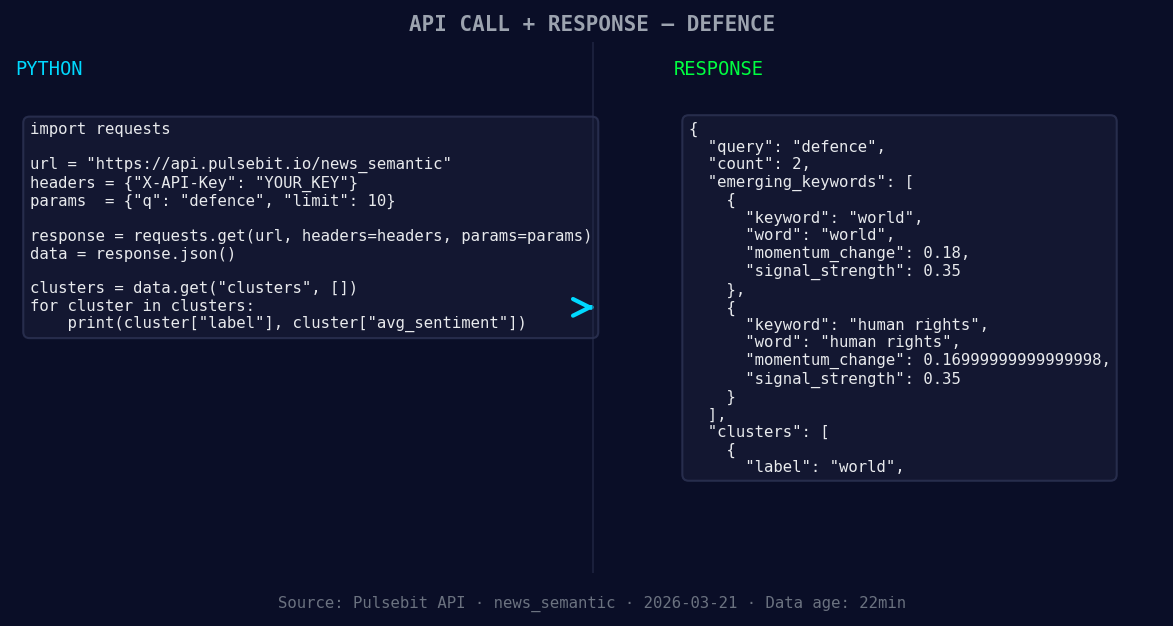
*Left: Python GET /news_semantic call for 'defence'. Right: returned JSON response structure (clusters: 1). Source: Pulsebit /news_semantic.*
topic = 'defence'
momentum = -0.701
lang = 'en'
response = requests.get(f"https://api.pulsebit.com/articles?topic={topic}&lang={lang}")
data = response.json()
print(data)
Next, we need to examine the meta-sentiment moment. This is where we take the reason string from the semantic clusters and run it back through our sentiment analysis to score the narrative framing itself. This is particularly useful when dealing with incomplete semantic structures. Here's how we do that:
meta_reason = "Semantic API incomplete — fallback semantic structure built from available keywords and article/search evidence."
sentiment_response = requests.post("https://api.pulsebit.com/sentiment", json={"text": meta_reason})
sentiment_data = sentiment_response.json()
print(sentiment_data)
By implementing these two steps, you can better understand the narrative shaping around defence topics.
Now, let's discuss three concrete builds we can create using this pattern:
Signal Detection for Defence: Set a threshold at momentum < -0.5 and use the geographic origin filter. This will enable you to catch any sudden shifts in sentiment around defence topics early, allowing for timely interventions.
Meta-Sentiment Analysis: Run the
POST /sentimentloop on varying narrative structures to see how they score against your key themes. For instance, test the framing around "human rights" or "world" to see if they align with your expectations or if there's a divergence indicating a need for further investigation.Cluster Story Analysis: Since we're seeing a forming gap with "world(+0.18)" and "human rights(+0.17)" against mainstream narratives, set up a monitoring endpoint for these clusters. This will help you identify when topics shift in public perception and can guide your content strategy accordingly.
If you’re ready to dive in and explore these insights, check out our documentation at pulsebit.lojenterprise.com/docs. You can copy-paste this code and run it in under 10 minutes to start catching valuable leads in your sentiment analysis.


Top comments (0)