

Your Pipeline Is 11.9h Behind: Catching Banking Sentiment Leads with Pulsebit
We recently observed a striking anomaly: a 24h momentum spike of +0.293 in the sentiment around banking. What makes this spike particularly noteworthy is its emergence amid a backdrop of sentiment dominance from the English-speaking press, with a leading language lag of just 11.9 hours. This is a critical insight that reveals how quickly shifts in sentiment can occur—an insight your current pipeline might be missing.

English coverage led by 11.9 hours. So at T+11.9h. Confidence scores: English 0.70, Spanish 0.70, Ca 0.70 Source: Pulsebit /sentiment_by_lang.
When your pipeline doesn’t account for multilingual origins or entity dominance, you risk missing out on timely insights like this one. Your model missed this banking sentiment spike by 11.9 hours, blind to the narratives shaping the market. The leading narrative, clustered around the theme of "Warsh Clears an Early Hurdle on Path to Fed Chair," may have passed you by, leaving you trailing behind as others capitalize on emerging trends.
Here’s how you can catch up using our API. First, we’ll filter by language and country to focus on the relevant English-speaking sentiment. The following Python code snippet demonstrates how to query the API for banking sentiment:
import requests
# Set parameters for the API call
params = {
"topic": "banking",
"lang": "en" # Geographic origin filter
}
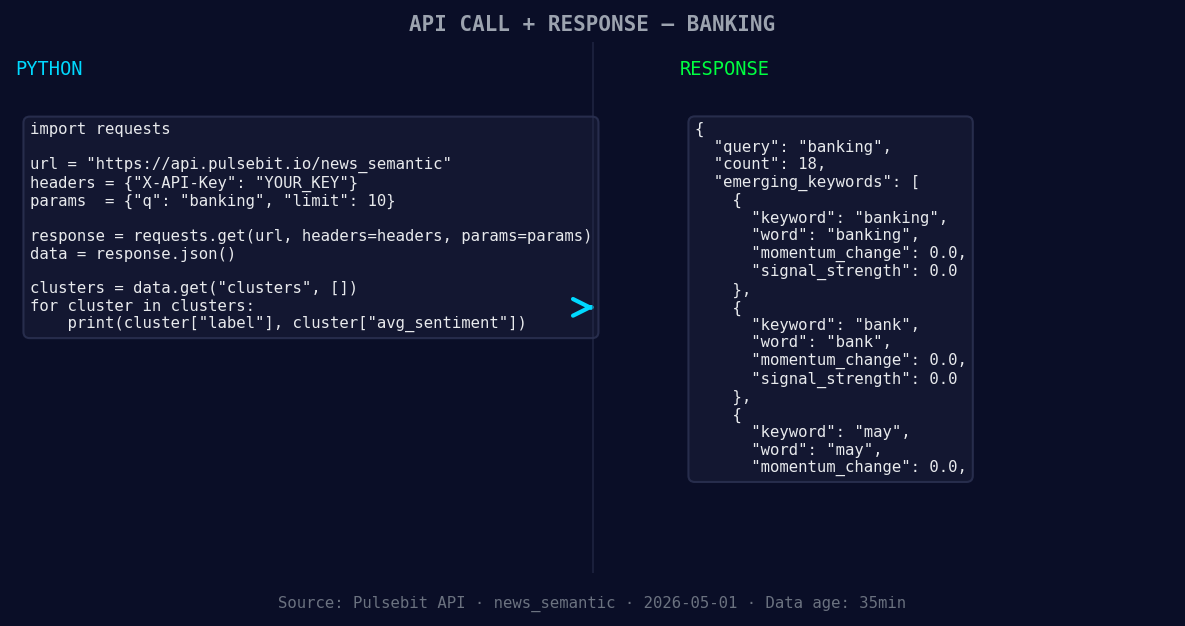
*Left: Python GET /news_semantic call for 'banking'. Right: returned JSON response structure (clusters: 3). Source: Pulsebit /news_semantic.*
# Make the API call
response = requests.get('https://api.pulsebit.com/sentiment', params=params)
data = response.json()
# Output the relevant data
print(data)
Once you’ve got the relevant sentiment data, it’s essential to understand the narrative framing itself. We’ll use the cluster reason string to run a meta-sentiment check through another API call. Here’s how to do that:
# Cluster reason string to analyze
cluster_reason = "Clustered by shared themes: fed, chair, warsh, clears, early."

# Make the POST request for meta-sentiment analysis
response_meta = requests.post('https://api.pulsebit.com/sentiment', json={"text": cluster_reason})
meta_data = response_meta.json()

# Output the meta-sentiment results
print(meta_data)
Now, what can we build with this pattern? Here are three specific implementations to consider:
-
English Sentiment Alerting: Create a real-time alert system that triggers when the momentum score for banking sentiment exceeds a threshold of +0.25. Use the geographic filter to ensure relevancy:
lang="en".

Geographic detection output for banking. India leads with 8 articles and sentiment -0.06. Source: Pulsebit /news_recent geographic fields.
Narrative Framing Analysis: Build a dashboard that visualizes the sentiment around key themes like "fed" and "banking." Use the meta-sentiment loop to score the narrative and display it alongside the sentiment scores.
Comparative Sentiment Tracker: Implement a feature that compares sentiment spikes in banking against mainstream themes, such as “china,” “these,” and “key.” Set up an endpoint that highlights when banking sentiment diverges sharply from these mainstream topics.
By leveraging the insights gained from our API and focusing on the timely banking sentiment, you can position your analysis further ahead. You can get started with our API at pulsebit.lojenterprise.com/docs. This example can be copy-pasted and run in under 10 minutes. Don’t let your pipeline lag behind—act on the insights while they’re fresh.


Top comments (0)