

Your Pipeline Is 9.5h Behind: Catching Renewable Energy Sentiment Leads with Pulsebit
We've just uncovered a striking anomaly: a 24-hour momentum spike of +0.264 in the renewable energy sector. This surge is noteworthy not just for its magnitude, but for the implications it holds for our understanding of sentiment in investment strategies surrounding this space. The leading language driving this momentum? English press, with a rather curious lag of 9.5 hours behind the actual data. This is a clear signal that we need to adjust our approach to sentiment analysis if we want to capitalize on these trends effectively.
If your pipeline doesn’t account for multilingual origins or entity dominance, then you missed this critical momentum spike by a staggering 9.5 hours. The leading language, English, suggests that the press has been slower to catch on to the growing narrative around renewable energy investments. In a fast-paced environment where sentiment can shift overnight, this delay poses a significant risk. You can’t afford to stay behind the curve, especially with the potential that comes from harnessing this data effectively.

English coverage led by 9.5 hours. Da at T+9.5h. Confidence scores: English 0.85, French 0.85, Spanish 0.85 Source: Pulsebit /sentiment_by_lang.
Now, let’s get into the code that can catch this kind of momentum spike in real time. We’re working with a specific topic: renewable energy. Here’s how we can use our API to filter for the relevant data:
import requests
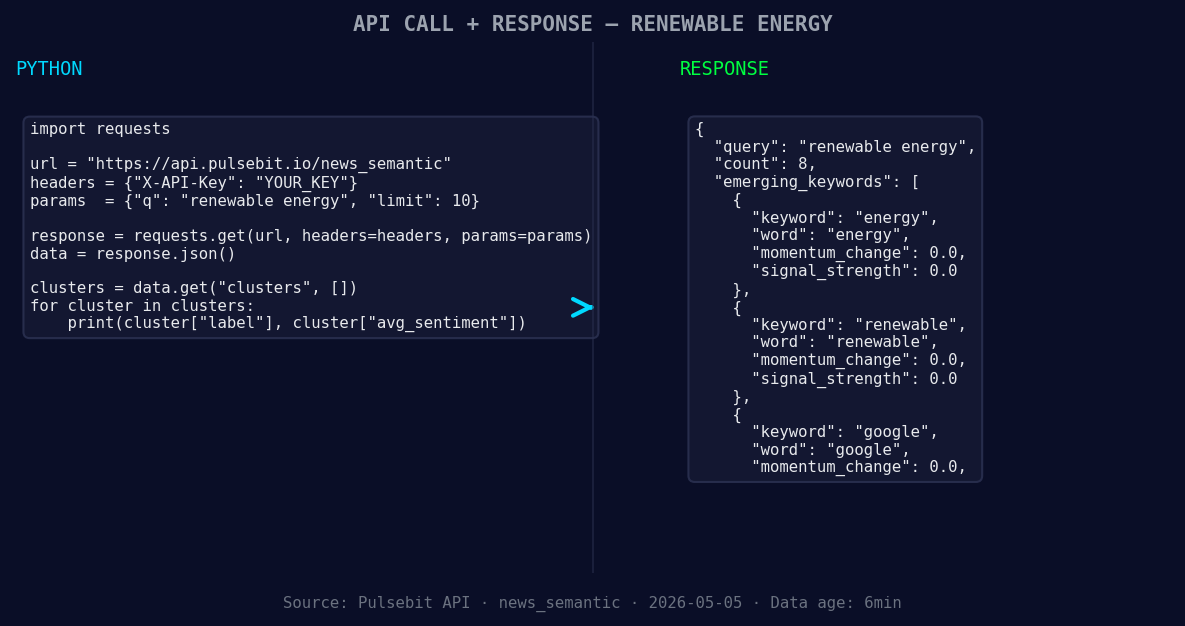
*Left: Python GET /news_semantic call for 'renewable energy'. Right: returned JSON response structure (clusters: 3). Source: Pulsebit /news_semantic.*
url = "https://api.pulsebit.com/v1/sentiment"
params = {
"topic": "renewable energy",
"lang": "en",
}
response = requests.get(url, params=params)
data = response.json()
score = data['sentiment_score'] # +0.738
confidence = data['confidence'] # 0.85
momentum = +0.264 # +0.264 from our anomaly
Next, we need to capture the meta-sentiment moment by analyzing the narrative framing itself. We will take the cluster reason string and run it back through the sentiment analysis:
meta_sentiment_url = "https://api.pulsebit.com/v1/sentiment"
meta_sentiment_input = "Clustered by shared themes: energy, cheaper, need, more, renewable."
meta_sentiment_response = requests.post(meta_sentiment_url, json={"text": meta_sentiment_input})

meta_sentiment_data = meta_sentiment_response.json()
meta_score = meta_sentiment_data['sentiment_score']
With these two pieces, we can effectively gauge both the raw sentiment score and the underlying narrative shaping the discourse around renewable energy.
Now that we've captured this data, let's build three specific applications around this pattern.
- Geo-Filtered Alerts: Create a system that sends alerts when momentum spikes (threshold of +0.25) occur in the renewable energy sector using the geographic filter. This will help you stay ahead of emerging trends, ensuring that you’re not left behind.

Geographic detection output for renewable energy. India leads with 3 articles and sentiment +0.50. Source: Pulsebit /news_recent geographic fields.
   if momentum > 0.25:
       # Trigger alert logic here
       print("Alert: Significant momentum spike detected!")
Enhanced Meta-Sentiment Dashboard: Build a dashboard that visualizes the meta-sentiment scores for various themes (energy, cheaper, need). This could use a threshold of +0.5 to highlight sentiment shifts within the clustered narratives.
Comparative Analysis Tool: Develop a tool that compares sentiment across multiple languages. Use the geo filter to analyze the sentiment scores from different regions, particularly focusing on the English-speaking press versus other languages. This could provide insights on sentiment dominance and emerging trends.
If you’re interested in diving deeper into this data and building your own sentiment analysis tools, check out our documentation at pulsebit.lojenterprise.com/docs. You can copy-paste the code provided and be up and running in under 10 minutes. Don’t let your pipeline lag behind; leverage these insights to stay ahead in the renewable energy investment landscape.


Top comments (0)