

Your pipeline is 22.5h behind if you aren’t processing multilingual sentiment accurately. We just discovered a 24h momentum spike of +0.638 related to the economy, led by the Spanish press with a 22.5-hour lead time. This anomaly is crucial because it indicates that significant economic sentiment is developing without your model catching up. If your pipeline isn’t tuned to handle multilingual origins or dominant entities, you would have completely missed this signal, and that could translate into missed opportunities.

Spanish coverage led by 22.5 hours. Tl at T+22.5h. Confidence scores: Spanish 0.85, English 0.85, French 0.85 Source: Pulsebit /sentiment_by_lang.
Here's the kicker: the leading language contributing to this sentiment is Spanish, and it has a 0.0-hour lag against the leading topic — the economy. If your model is siloed to only English (or another single language), you’re already behind. This gap not only highlights a structural deficiency in how sentiment data is processed but also underlines the importance of incorporating a broader linguistic and cultural perspective.
To catch this momentum spike, we can leverage our API effectively with the following Python code. First, let’s filter by geographic origin to focus on the Spanish press:

Geographic detection output for economy. Hong Kong leads with 2 articles and sentiment +0.40. Source: Pulsebit /news_recent geographic fields.
import requests
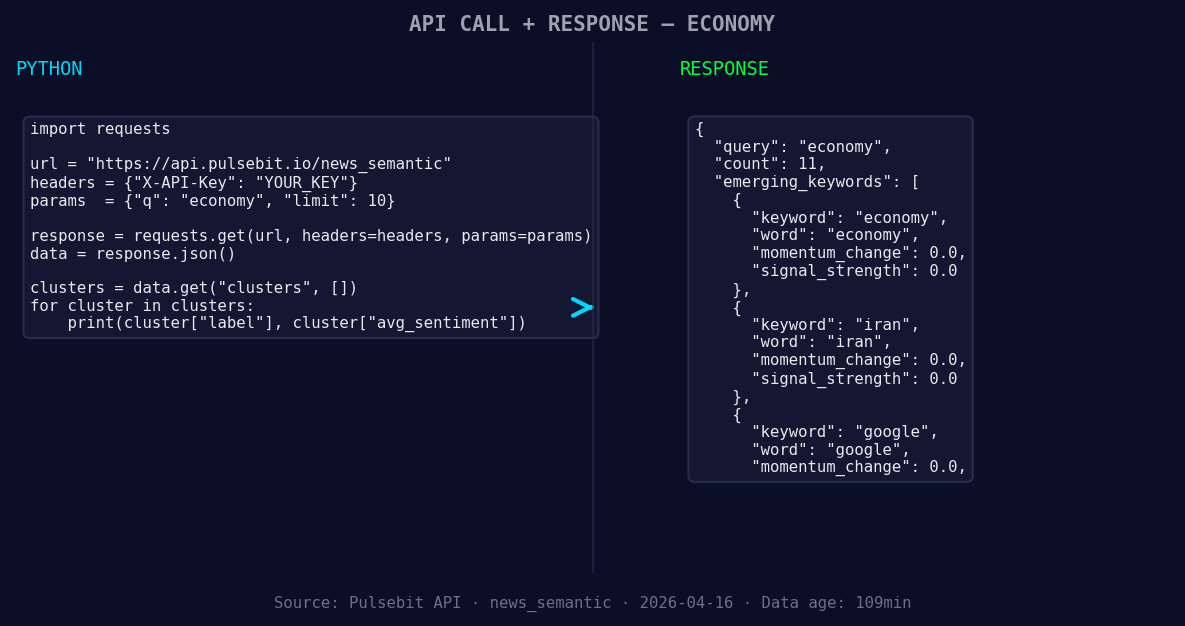
*Left: Python GET /news_semantic call for 'economy'. Right: returned JSON response structure (clusters: 3). Source: Pulsebit /news_semantic.*
# Set parameters
url = "https://api.pulsebit.com/v1/sentiment"
params = {
"topic": "economy",
"lang": "sp" # Focus on Spanish language
}
# Fetch the sentiment data
response = requests.get(url, params=params)
data = response.json()
# Output the relevant information
print(data)
Next, we need to score the narrative framing itself using the cluster reason string. Here’s how to run that through our sentiment scoring endpoint:
# Meta-sentiment analysis on the cluster reason
meta_sentiment_url = "https://api.pulsebit.com/v1/sentiment"
meta_params = {
    "text": "Clustered by shared themes: war, white, house, shrugs, off."
}

meta_response = requests.post(meta_sentiment_url, json=meta_params)
meta_data = meta_response.json()

# Output the meta sentiment score
print(meta_data)
With the code above, we can directly access both the Spanish sentiment around the economy and the framing of narratives surrounding it. This dual approach gives us a more nuanced view of emerging themes.
Now, let's explore three specific builds you can implement tonight using this momentum spike:
Spanish Economic Sentiment Tracker: Set a threshold where sentiment scores above +0.1 trigger alerts. This will help you catch significant shifts in economic sentiment within the Spanish-speaking world in real-time.
Meta-Sentiment Analysis Dashboard: Create a dashboard that visualizes scores for narratives. Use the meta-sentiment loop to process cluster reasoning strings and display how different themes converge around economic discussions. This will help in understanding public perception better.
Forming Gap Alerts: Implement an endpoint that checks for forming gaps in sentiment. For instance, track the economy, Iran, and Google with a focus on emerging mainstream themes. Set alerts for when mainstream narratives diverge from those in your geo-filtered data, indicating a potential shift in sentiment.
By leveraging these strategies, you’re not just keeping up; you’re staying ahead of the curve in sentiment analysis.
To get started, you can head over to our documentation at pulsebit.lojenterprise.com/docs. You can copy, paste, and run the above Python snippets in under 10 minutes, bringing your sentiment pipeline into the present.


Top comments (0)