

Your Pipeline Is 14.9h Behind: Catching Commodities Sentiment Leads with Pulsebit
We recently discovered a striking anomaly: a 24h momentum spike of +0.317. This surge in sentiment around commodities is significant, especially in a context where the leading news was in English, and articles were clustered around the theme "Investors Shift Focus to Safe Assets Amid Market Volatility". This is a clear signal that something is shifting in sentiment, and if your pipeline isn't tuned to catch these nuances, you could be missing out on critical insights.
The problem is clear: without a robust pipeline that accommodates multilingual origins and entity dominance, you risk being 14.9 hours behind the curve. In this case, the dominant English press led the charge, but if your model is only processing data in a single language or not considering the context of dominant entities, you could easily miss significant shifts. This gap can lead to missed opportunities in a rapidly evolving market landscape.

English coverage led by 14.9 hours. Et at T+14.9h. Confidence scores: English 0.85, Spanish 0.85, French 0.85 Source: Pulsebit /sentiment_by_lang.
Here’s how we can catch that critical momentum spike using our API. We’ll start by pulling sentiment data specifically for commodities, filtering by the English language to ensure we capture the right context.
import requests
# Set your endpoint and parameters
endpoint = "https://api.pulsebit.lojenterprise.com/sentiment"
params = {
"topic": "commodities",
"lang": "en"
}
# Perform the API call to get sentiment data
response = requests.get(endpoint, params=params)
data = response.json()
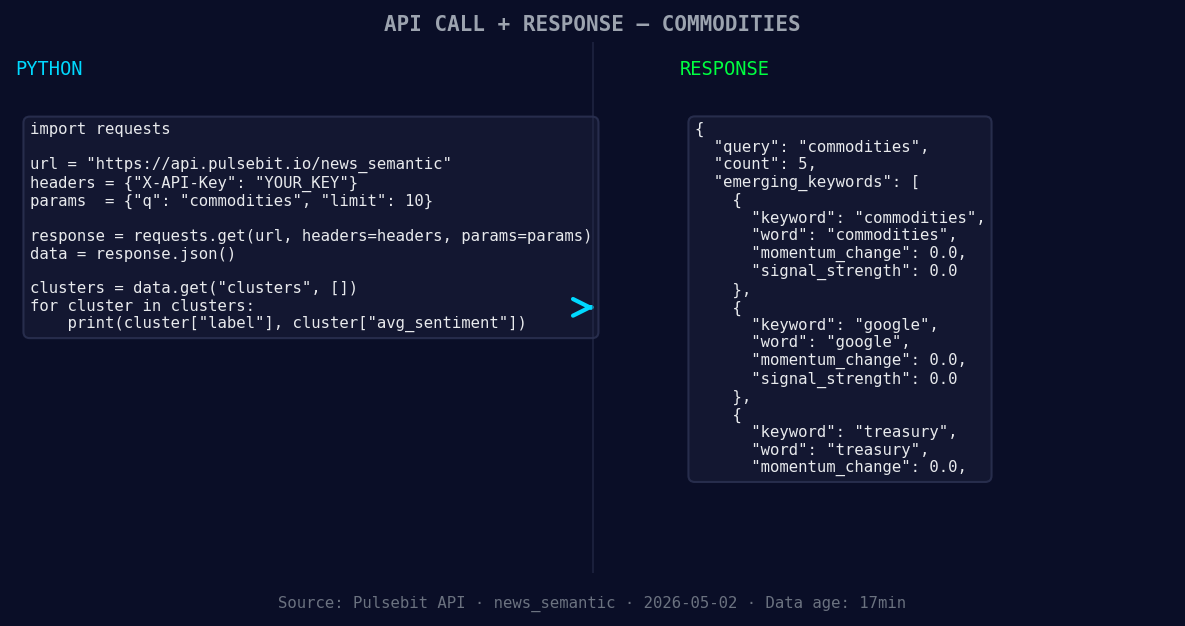
*Left: Python GET /news_semantic call for 'commodities'. Right: returned JSON response structure (clusters: 3). Source: Pulsebit /news_semantic.*
# Check the response
print(data)
Next, we want to analyze the narrative framing around the sentiment spike. We’ll input the cluster reason back through our sentiment scoring endpoint to assess how the themes are resonating.
# Set the cluster reason string
cluster_reason = "Clustered by shared themes: amid, market, volatility, investors, turn."

# Call the sentiment scoring endpoint
sentiment_response = requests.post(f"{endpoint}/sentiment", json={"text": cluster_reason})
sentiment_data = sentiment_response.json()

# Check the sentiment analysis result
print(sentiment_data)
By using this dual approach — first to filter by language and then to analyze the meta-sentiment of the narrative — we can gain a deeper understanding of the themes driving the momentum spike.
Now, let’s explore three specific ways to build on this pattern:
Geo-Filtered Sentiment Analysis: Create a pipeline that triggers alerts when momentum spikes exceed a specific threshold for commodities. Set the signal threshold at +0.3 to capture significant shifts, using the geo filter to focus on the English-speaking world.
Meta-Sentiment Evaluation: Implement a scoring mechanism that processes cluster reasons and flags those with a sentiment score lower than -0.2. This allows us to identify narratives that could be misleading or not supported by the underlying data.
Cross-Asset Correlation Tracker: Build an endpoint that correlates the momentum signals of commodities with other assets, like Google and Treasury, using the forming themes. Monitor shifts in sentiment across these categories to identify potential investment opportunities.
For developers ready to dive in, check out our documentation at pulsebit.lojenterprise.com/docs. You can copy-paste the provided code snippets and run this in under 10 minutes. Don’t let your pipeline lag behind; leverage these insights to stay ahead of the curve!

Geographic detection output for commodities. India leads with 3 articles and sentiment -0.47. Source: Pulsebit /news_recent geographic fields.


Top comments (0)