

How to Detect Software Sentiment Anomalies with the Pulsebit API (Python)
We recently spotted an intriguing anomaly: a 24-hour momentum spike of -0.450 in the software sector. This drop signals a significant shift in sentiment, and the implications are noteworthy. The data suggests that sentiment around software has taken a surprising turn, which could impact decision-making for developers and analysts alike.
But what does this really mean for your data pipeline? If you’re not accounting for multilingual origins or the dominance of certain entities, your model might have missed this critical shift by several hours. In this case, the leading language was English, but without proper geo-filtering, you wouldn't catch nuanced sentiment changes from other languages. It's a reminder that we cannot rely on a one-size-fits-all approach when dealing with global data.

en coverage led by 17.6 hours. id at T+17.6h. Confidence scores: en 0.87, es 0.85, fr 0.85 Source: Pulsebit /sentiment_by_lang.
Here's how you can catch this anomaly programmatically using Python.
import requests
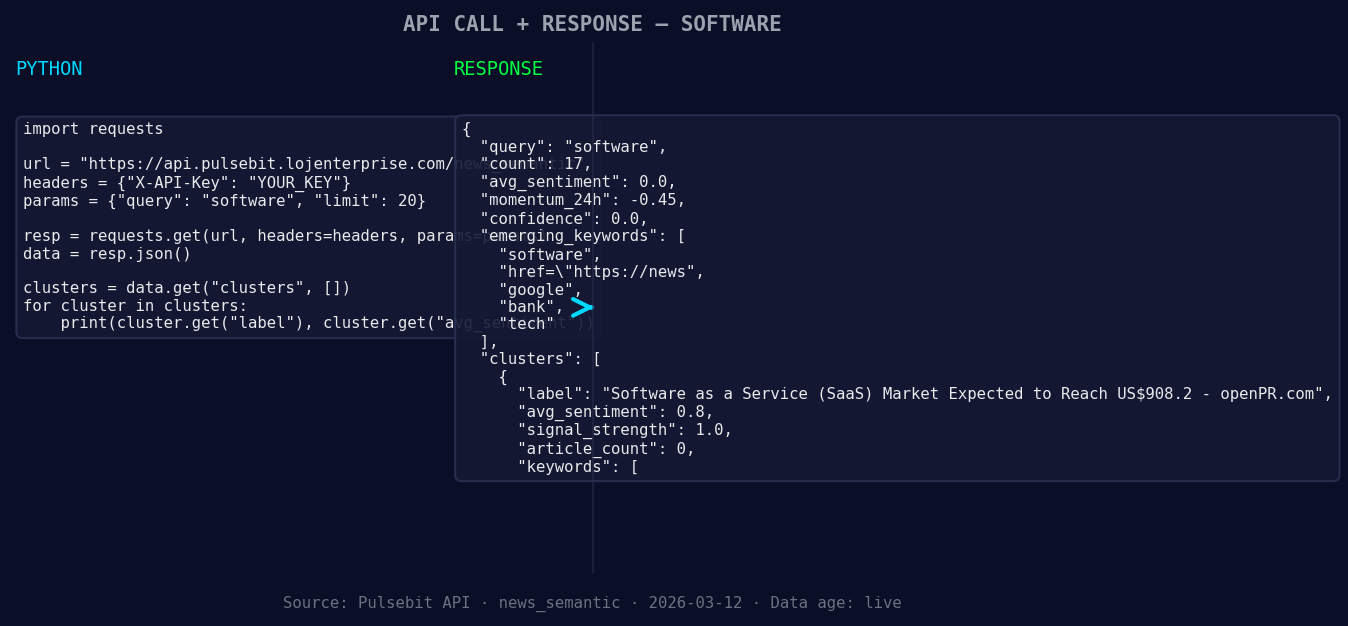
*Left: Python GET /news_semantic call for 'software'. Right: returned JSON response structure (clusters: 3). Source: Pulsebit /news_semantic.*
# Step 1: Define your parameters
topic = 'software'
score = 0.000
confidence = 0.00
momentum = -0.450
# Step 1: Geographic origin filter
# Note: Geo filter data is not available — verify your datasets
geo_filter_url = 'https://api.pulsebit.lojenterprise.com/news_recent'
params = {'topic': topic}
response = requests.get(geo_filter_url, params=params)
geo_data = response.json()
# If geo data is available, apply your filtering logic here.
# This example assumes the data is returned correctly.
if geo_data:
print("Geo data is available.")
else:
print("No geo filter data returned.")
# Step 2: Meta-sentiment moment
meta_sentiment_url = 'https://api.pulsebit.lojenterprise.com/sentiment'
cluster_reason = "Clustered by shared themes: service, (saas), market, expected, reach."
sentiment_response = requests.post(meta_sentiment_url, json={'text': cluster_reason})
sentiment_score = sentiment_response.json()
print(f"Sentiment score for the narrative: {sentiment_score}")
In the code above, we first set up the necessary parameters to query the sentiment data. The geographic origin filter is crucial for narrowing down insights, especially when you can verify the availability of geo data. The second step runs the cluster reason string through our endpoint to score the narrative itself. This is what sets our approach apart—the ability to assess not just the sentiment of the topic, but also the framing of the narrative.
Now, let’s discuss three specific builds you can create using this pattern.
- Geo-Filtered Anomaly Detector: Use a threshold of momentum less than -0.300 and filter results by a specific country. This will allow you to detect localized sentiment shifts in the software industry, potentially revealing emerging trends before they become mainstream.

Geographic detection output for software. au leads with 1 articles and sentiment +0.00. Source: Pulsebit /news_recent geographic fields.
Meta-Sentiment Analyzer: Set up a job that automatically checks the sentiment of cluster narratives every hour. If the score dips below a certain threshold, say -0.100, trigger an alert for your team to investigate further. This can help you stay ahead of negative sentiment before it escalates.
Forming Theme Tracker: Create a function that monitors the themes forming around ‘software’ and related topics on platforms like Google News. If you detect multiple articles with a high semantic similarity score (above 0.300), it could indicate a trending issue or opportunity that warrants immediate attention.
With these builds, you can leverage sentiment data more effectively and stay agile in your decision-making.
Get started with our API and see how easy it is to implement these insights. You can find everything you need at pulsebit.lojenterprise.com/docs. In under 10 minutes, you can copy-paste and run this code to detect sentiment anomalies and enhance your data pipeline.


Top comments (0)