

Your Pipeline Is 16.0h Behind: Catching Economy Sentiment Leads with Pulsebit
We recently uncovered a striking 24-hour momentum spike of +0.289 in our data, highlighting a significant shift in economic sentiment. This spike coincides with the backdrop of ongoing geopolitical tensions, particularly regarding war and the economy. We found three articles clustering around the theme "US Economic Growth Amid War Uncertainty," which raises important questions about how sentiment data is processed and analyzed in real-time.
If your pipeline doesn't account for multilingual origin or entity dominance, you might have missed this critical insight by a staggering 16 hours. The leading language was English, and the economic implications were overshadowed by mainstream topics such as LPG, food, and price hikes. The gap between emerging narratives and your model's response time could lead to missed opportunities or misguided strategies.

English coverage led by 16.0 hours. So at T+16.0h. Confidence scores: English 0.75, Spanish 0.75, French 0.75 Source: Pulsebit /sentiment_by_lang.
To illustrate how to catch these shifts in sentiment, let's dive into some practical code. We can leverage our API to filter news articles by language and analyze their sentiments effectively.
Here's how we can filter for English-language articles about the economy:
import requests
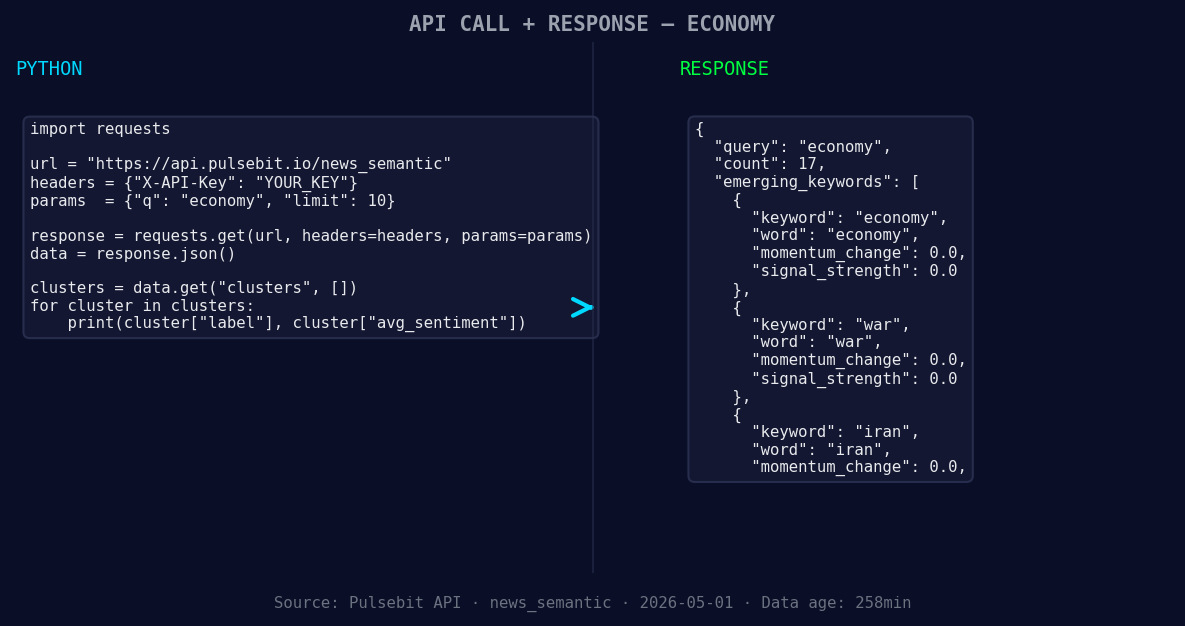
*Left: Python GET /news_semantic call for 'economy'. Right: returned JSON response structure (clusters: 3). Source: Pulsebit /news_semantic.*
url = "https://api.pulsebit.lojenterprise.com/v1/articles"
params = {
"topic": "economy",
"lang": "en"
}
response = requests.get(url, params=params)
data = response.json()
Now that we have filtered articles, let’s run a meta-sentiment analysis on the narrative framing. We will feed the cluster reason string back into our sentiment analysis endpoint to evaluate the underlying themes that are driving this sentiment.
url = "https://api.pulsebit.lojenterprise.com/v1/sentiment"
payload = {
    "text": "Clustered by shared themes: economy, iran, war, percent, first."
}
response = requests.post(url, json=payload)
meta_sentiment = response.json()
These two segments of code are crucial for identifying shifts in sentiment that may not be evident at first glance. By filtering the articles based on language and evaluating their sentiment, we can make more informed decisions about our strategies.
Now, let's explore three specific builds based on this newfound data pattern:
Geo-Filtered Economic Alert: Create a webhook that triggers an alert if the momentum for the topic "economy" exceeds a threshold of +0.250 within the last 24 hours for articles in English. This ensures you remain updated on significant shifts in economic sentiment.
Meta-Sentiment Dashboard: Develop a dashboard that visualizes the sentiment scores derived from cluster narratives. Use the meta-sentiment analysis results to highlight trending themes like "war" or "Iran" against mainstream topics like "LPG" and "food," allowing for a nuanced understanding of the landscape.
Anomaly Detection System: Implement an anomaly detection system that flags any articles where the sentiment score dips below -0.500 but shows a rising momentum score above +0.250. This indicates a potential disconnect between sentiment and emerging economic narratives.
By understanding how to leverage the nuances of sentiment data, especially when filtered through geographic or thematic lenses, we position ourselves to respond proactively to changing economic landscapes.

Geographic detection output for economy. Hong Kong leads with 4 articles and sentiment -0.12. Source: Pulsebit /news_recent geographic fields.
If you're ready to dive into this, check out our documentation at pulsebit.lojenterprise.com/docs. You can copy, paste, and run the above examples in under 10 minutes. Let’s start catching those sentiment leads!


Top comments (0)