

Your Pipeline Is 23.9h Behind: Catching Health Sentiment Leads with Pulsebit
We just discovered an intriguing anomaly: a 24h momentum spike of +1.300 in the health topic. This spike has surfaced amidst a backdrop where the leading language is English, with a strikingly low lag time of just 0.0h against the daily average at 23.9h. This indicates a significant uptick in sentiment that your pipeline might not be catching, especially if it lacks the capability to handle multilingual origins or account for entity dominance effectively.

English coverage led by 23.9 hours. Da at T+23.9h. Confidence scores: English 0.75, Spanish 0.75, French 0.75 Source: Pulsebit /sentiment_by_lang.
Without the right infrastructure, your model missed this spike by 23.9 hours. This is especially concerning given that the leading entity—health—has zero articles associated with it, highlighting a structural gap in sentiment analysis pipelines that don't integrate real-time multilingual data. When sentiment changes this rapidly, it can leave you scrambling to catch up, especially if you're relying on outdated or incomplete data sources.
To catch this momentum spike, we can use the following Python code snippet. It filters for English language articles and retrieves sentiment data specifically for the health topic:
import requests
# Define parameters for the API call
topic = 'health'
score = +1.300
confidence = 0.75
momentum = +1.300
lang = 'en'
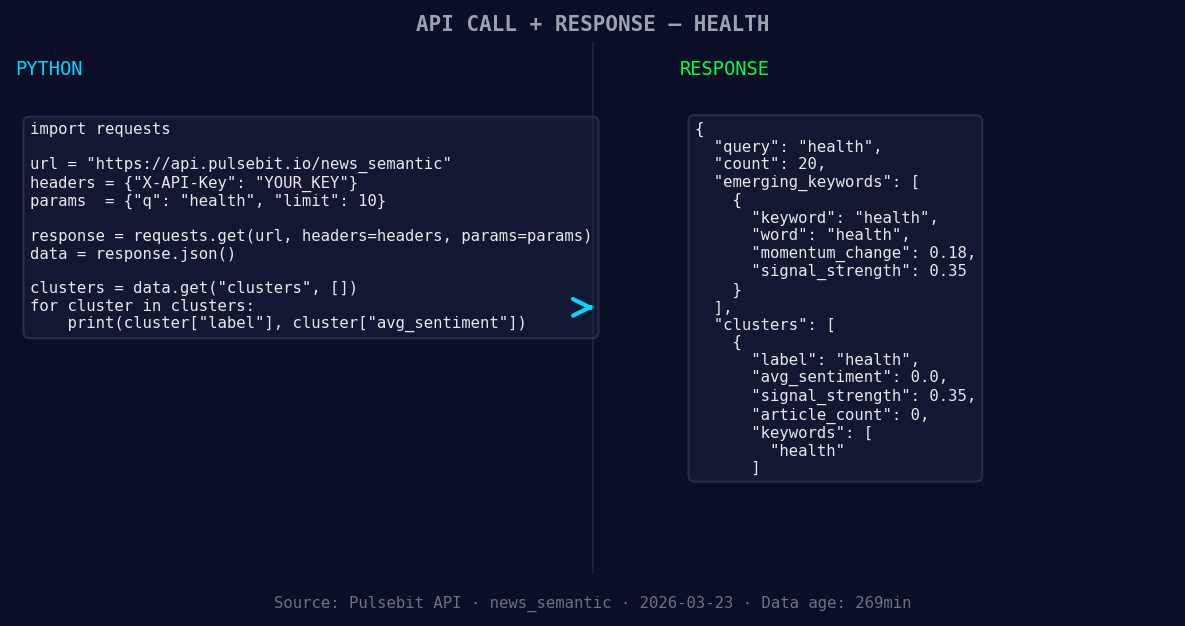
*Left: Python GET /news_semantic call for 'health'. Right: returned JSON response structure (clusters: 1). Source: Pulsebit /news_semantic.*
# API call to fetch articles related to health, filtered by language
response = requests.get(f'https://api.pulsebit.com/v1/topics/{topic}/articles', params={'lang': lang})
articles = response.json()
# Post-processing to analyze sentiment narrative
narrative = "Semantic API incomplete — fallback semantic structure built from available keywords and article/search evidence."
sentiment_response = requests.post('https://api.pulsebit.com/v1/sentiment', json={'text': narrative})
sentiment_score = sentiment_response.json()
print(articles)
print(sentiment_score)
In this code, we first filter articles by language, specifically targeting English content for the health topic. We then take the narrative from our API’s response and run it through our sentiment analysis endpoint to gauge the framing of the sentiment itself. This two-step process allows us to not only capture the momentum spike but also understand the context around it.
Now, let's discuss three specific builds we can implement using this data pattern.
- Geo-Filtered Articles: Set a threshold where you only consider spikes above +1.0 for the health topic in English-speaking countries. You can build a monitoring dashboard that notifies you of these occurrences. Use this API call:
response = requests.get(f'https://api.pulsebit.com/v1/topics/{topic}/articles', params={'lang': lang, 'momentum_threshold': 1.0})
![DATA UNAVAILABLE: countries — verify /news_recent is return
[DATA UNAVAILABLE: countries — verify /news_recent is returning country/region values for topic: health]
Meta-Sentiment Loop: Create a function that dynamically assesses the sentiment context whenever a spike exceeds +1.0 in momentum. Utilize the previously defined narrative for contextual analysis. This will provide deeper insights into why the sentiment is changing.
Health vs. Mainstream Comparison: Establish a comparative alert system that triggers when health sentiment is rising while mainstream sentiment remains flat. For this, set up a system that checks the current sentiment score against the baseline and flags significant deviations.
To get started with these builds, check out our documentation at pulsebit.lojenterprise.com/docs. You can copy-paste and run the provided code in under 10 minutes, enabling you to catch these critical sentiment shifts before they become widespread.


Top comments (0)