

Your Pipeline Is 21.5h Behind: Catching World Sentiment Leads with Pulsebit
We recently uncovered a fascinating anomaly: a 24-hour momentum spike of +0.098. This spike indicates a significant shift in sentiment around the topic of "world," particularly in light of Disney's recent announcement regarding a €2.18 billion theme park overhaul. The leading language for this sentiment was English, with a 21.5-hour lead time, meaning your model might have missed this crucial sentiment shift by that same amount of time.
The problem here is clear: if your pipeline doesn't account for multilingual origins and entity dominance, you're at risk of lagging behind on critical developments. When sentiment around major events develops quickly, as it has here, you need to be able to catch it in real-time. With the leading sentiment emerging from English-language sources, your model missed this insight because it wasn't optimized for the speed and diversity of information flow.

English coverage led by 21.5 hours. Et at T+21.5h. Confidence scores: English 0.85, Spanish 0.85, French 0.85 Source: Pulsebit /sentiment_by_lang.
To catch this anomaly, we can leverage our API effectively. Here’s how you can filter sentiment based on geographic origin and score the narrative framing itself. First, we’ll query the sentiment data:
import requests
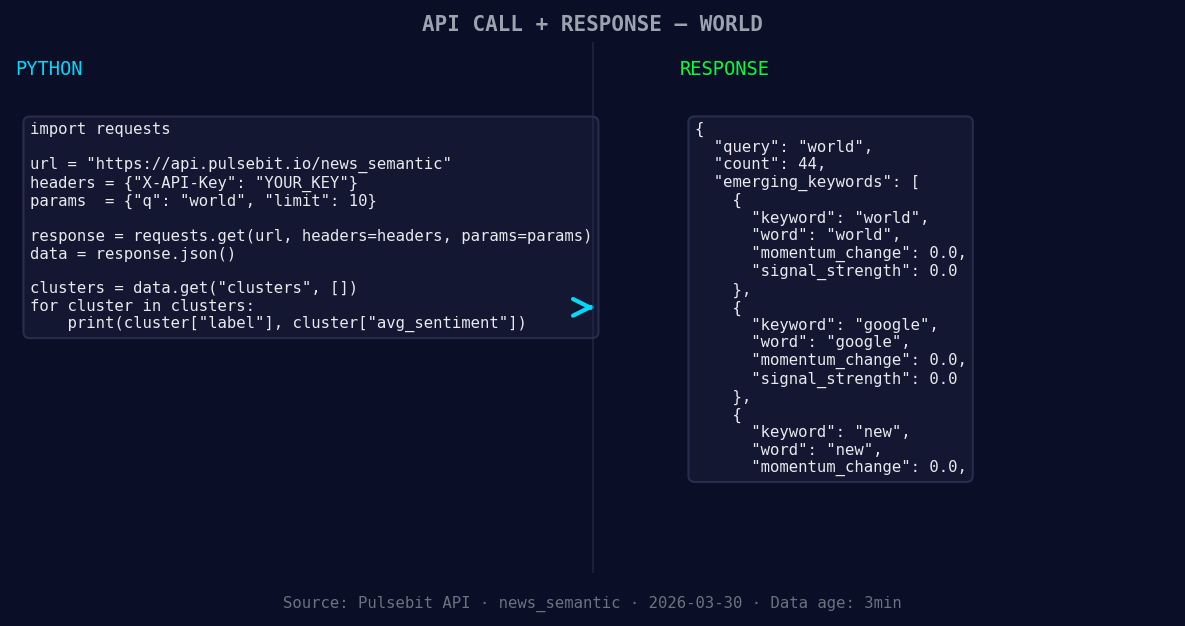
*Left: Python GET /news_semantic call for 'world'. Right: returned JSON response structure (clusters: 3). Source: Pulsebit /news_semantic.*
# Geographic origin filter
response = requests.get(
'https://api.pulsebit.com/v1/sentiment',
params={'topic': 'world', 'lang': 'en'}
)
data = response.json()
print(data)
Now, let's run the cluster reason string back through the POST /sentiment endpoint to score the narrative framing:
import requests

# Meta-sentiment moment
cluster_reason = "Clustered by shared themes: new, ceo, caps, billion, euro."
response = requests.post(
    'https://api.pulsebit.com/v1/sentiment',
    json={
        'text': cluster_reason,
        'score': +0.046,
        'confidence': 0.85,
        'momentum': +0.098
    }
)

meta_sentiment_data = response.json()
print(meta_sentiment_data)
This approach not only captures the raw sentiment around the topic but also examines how narratives are framed, which can help you understand the underlying themes driving sentiment shifts.
Now, let's explore three specific builds leveraging this pattern:
-
Geo-Sensitive Alerting: Build an alert system that triggers when the momentum for a topic like "world" exceeds a threshold of +0.05. Use the geographic filter to focus only on English-language sources. The endpoint will be:
/v1/sentiment?topic=world&lang=en.

Geographic detection output for world. Hong Kong leads with 10 articles and sentiment +0.29. Source: Pulsebit /news_recent geographic fields.
Meta-Sentiment Analyzer: Create a module that processes cluster reason strings (like "Clustered by shared themes: new, ceo, caps, billion, euro.") to derive sentiment scores. This could help you pre-emptively identify narrative shifts before they become mainstream and establish a threshold of +0.05 for alerts.
Forming Themes Dashboard: Set up a dashboard that visualizes forming themes such as "world(+0.00)," "google(+0.00)," and "new(+0.00)" against mainstream sentiments like "new," "ceo," and "caps." Use the
/v1/sentimentendpoint to continuously pull in data to keep your insights updated.
By integrating these builds into your workflow, you'll ensure that you capture sentiment shifts in real-time, reducing the risk of lagging behind the competition.
Ready to get started? Check out our documentation at pulsebit.lojenterprise.com/docs. With just a few lines of code, you can copy-paste and run these examples in under 10 minutes, keeping your model ahead of the curve.


Top comments (0)