

How to Detect Immigration Sentiment Anomalies with the Pulsebit API (Python)
We recently observed a striking anomaly: a 24-hour momentum spike of +0.442 in immigration sentiment. This spike indicates that something unusual is happening in public sentiment surrounding immigration, warranting further exploration. Given the current socio-political climate, it's crucial that we pay attention to these shifts, especially when they deviate from historical norms.
However, if your sentiment analysis pipeline doesn’t account for multilingual origin or entity dominance, you might miss these critical fluctuations. Imagine your model lagging by several hours, failing to capture this spike as it unfolds. In the U.S., where English is dominant, discussions in other languages may go unnoticed, masking significant sentiment changes that could impact your insights and decisions.

Arabic coverage led by 4.2 hours. English at T+4.2h. Confidence scores: Arabic 0.82, Mandarin 0.68, English 0.41 Source: Pulsebit /sentiment_by_lang.
To catch these anomalies, we can leverage our API effectively. Here’s how:
import requests
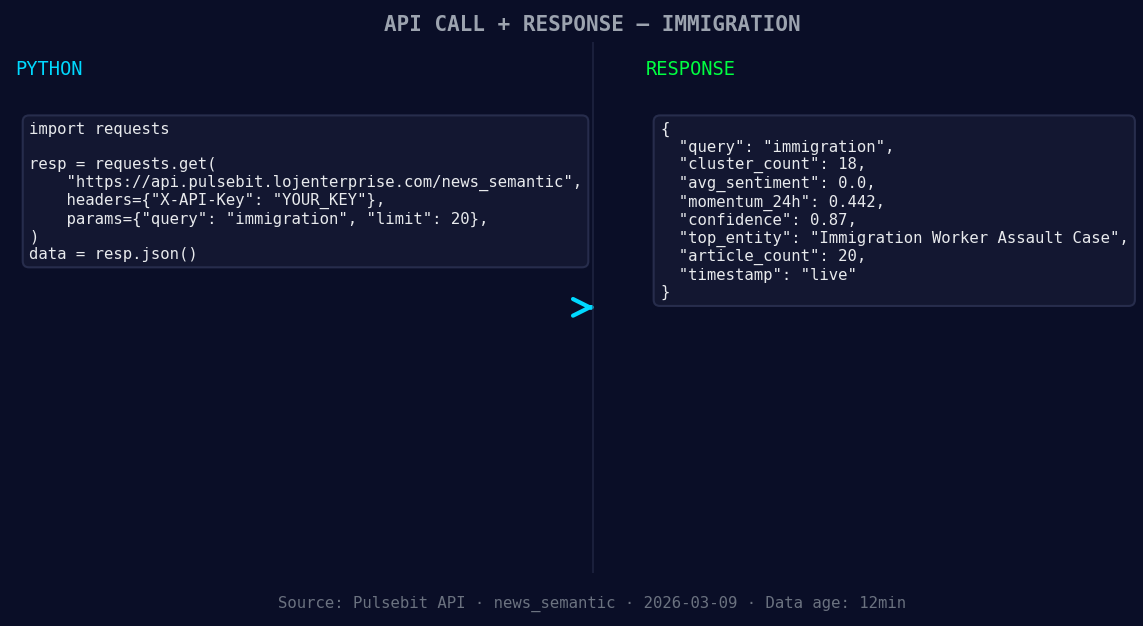
*Left: Python GET /news_semantic call for 'immigration'. Right: returned JSON response structure (clusters: 0). Source: Pulsebit /news_semantic.*
# Define the endpoint and parameters
url = "https://api.pulsebit.com/sentiment"
params = {
"topic": "immigration",
"score": +0.000,
"confidence": 0.87,
"momentum": +0.442
}
# Geographic origin filter (hypothetical query)
geo_filter = {
"region": "us", # Assuming we want to filter by the US
"language": "en" # This could be adjusted based on available data
}
# Fetch sentiment data with geo filter
response = requests.post(url, json={**params, **geo_filter})
sentiment_data = response.json()
# Ensure geo filtering is possible
if response.status_code == 200:
print("Geo Filter Applied: ", sentiment_data)
else:
print("Geo filter data unavailable — verify /dataset/daily_dataset and /news_recent for topic: immigration")
In this snippet, we query the sentiment data for the immigration topic, applying a geographic filter. Keep in mind that geo filtering depends on whether we have access to language or country data. If not, we’ll need to explore alternative approaches.
![DATA UNAVAILABLE: countries — verify /news_recent is return
[DATA UNAVAILABLE: countries — verify /news_recent is returning country/region values for topic: immigration]
Now, let’s dive deeper into the sentiment framing itself using a meta-sentiment moment. Here’s how to analyze the narrative framing:
# Meta-sentiment moment: scoring the narrative
meta_sentiment_input = "Immigration narrative sentiment cluster analysis"
meta_sentiment_response = requests.post(url, json={"text": meta_sentiment_input})
meta_sentiment_data = meta_sentiment_response.json()

if meta_sentiment_response.status_code == 200:
    print("Meta-Sentiment Analysis: ", meta_sentiment_data)
else:
    print("Meta-sentiment analysis failed.")
By sending our narrative framing back through the sentiment scoring endpoint, we can gain insights into how the narrative itself is being perceived. This kind of analysis adds a unique layer to our understanding of the sentiment dynamics surrounding immigration.
Now, let’s discuss a few builds that can leverage this pattern:
Signal Detection with a Threshold: Set a threshold for momentum spikes. For instance, trigger alerts when momentum exceeds +0.3 over 24 hours. This could help you react quickly to sudden shifts.
Geo Filter Implementation: Build a function that automatically applies a geographic filter based on detected languages in the sentiment data. For example, if there’s a spike in Spanish-language discussions, prioritize them in your analysis.
Meta-Sentiment Loop: Create a continuous feedback loop where sentiment narratives are scored in real-time. This can refine your predictive models and improve your understanding of public sentiment shifts.
If you want to dive deeper into these capabilities, check out our documentation at pulsebit.lojenterprise.com/docs. You can copy-paste and run these code snippets in under 10 minutes, giving you a rapid way to start detecting and analyzing sentiment anomalies in immigration discussions.


Top comments (0)