

Your pipeline is operating 26.9 hours behind real-world sentiment. We recently spotted a striking anomaly: a 24-hour momentum spike of +0.703 for the topic “world.” This uptick is not just a random blip; it reflects a significant shift in sentiment around major themes, particularly in the English press. As the narrative unfolds, articles like "AI wins have Alphabet poised to become world’s biggest company" are pushing this momentum forward, indicating a shift that you need to pay attention to now.
This gap in your pipeline reveals a structural oversight. If your model isn't equipped to handle multilingual origins or the dominance of certain entities, you may miss critical trends. With the English press leading by 26.9 hours, this means your model could be lagging in identifying pivotal shifts in sentiment that affect your strategy. In this case, it’s vital to understand what’s happening with major players like Alphabet and how it ties back to broader themes of wins and advancements.

English coverage led by 26.9 hours. Ca at T+26.9h. Confidence scores: English 0.75, Spanish 0.75, French 0.75 Source: Pulsebit /sentiment_by_lang.
To catch these insights in your workflow, we need to leverage our API effectively. Here’s how you can do it:
import requests
# Set up the parameters for the API call
params = {
"topic": "world",
"score": 0.091,
"confidence": 0.75,
"momentum": 0.703,
"lang": "en" # Geographic origin filter
}
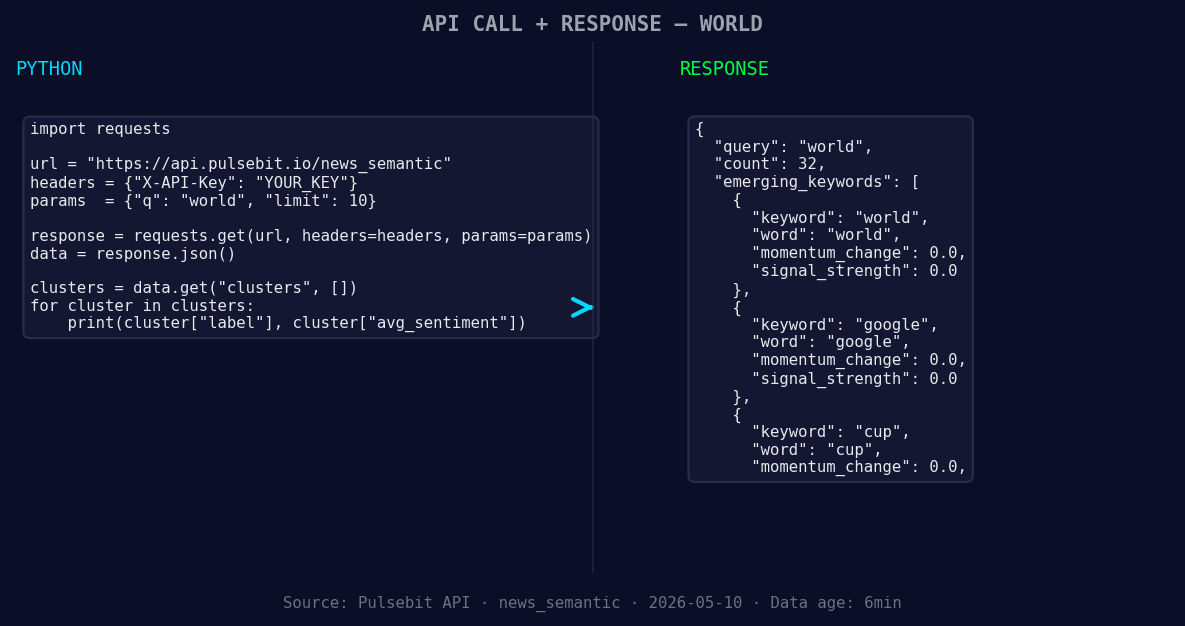
*Left: Python GET /news_semantic call for 'world'. Right: returned JSON response structure (clusters: 3). Source: Pulsebit /news_semantic.*
# API call to fetch sentiment data
response = requests.get("https://api.pulsebit.lojenterprise.com/sentiment", params=params)
# Print out the response for verification
print(response.json())
In this code, we filter by language to ensure we’re pulling relevant data from the English press only. The parameters we set map directly to our anomaly, ensuring we focus on the right sentiment.
Next, let’s run the cluster reason back through our sentiment endpoint to analyze the narrative framing:
# Define the cluster reason string
cluster_reason = "Clustered by shared themes: wins, have, alphabet, poised, become."

# API call to score the narrative framing
response_meta = requests.post("https://api.pulsebit.lojenterprise.com/sentiment", json={"input": cluster_reason})

# Print out the meta sentiment response
print(response_meta.json())
By scoring the narrative framing, you can identify how these themes are resonating in the sentiment landscape. This step is crucial as it provides context around the spikes and helps you interpret the underlying forces driving sentiment.
With these insights, here are three specific things to build tonight based on the patterns observed:
- Geo-Filtered Alert System: Set up a system that alerts you when sentiment scores for “world” exceed a threshold (e.g., +0.5) in English-language articles. This will help you catch spikes faster.
- Meta-Sentiment Dashboard: Create a dashboard that visualizes the output of your meta-sentiment analysis. Include real-time updates on thematic clusters and their sentiment scores.
- Dynamic Theme Tracker: Implement a tracker that monitors changes in sentiment around keywords like “world,” “google,” and “cup.” If the sentiment shifts significantly (e.g., a drop below -0.1 while mainstream remains positive), trigger a review of related news articles.
By using these builds, you’ll ensure that your models are not just reactive but also proactive in catching emerging trends based on real-world sentiment.
To get started, visit our documentation at pulsebit.lojenterprise.com/docs. With this setup, you should be able to copy-paste and execute the code in under 10 minutes, enabling you to stay ahead of the curve.


Top comments (0)