

Your Pipeline Is 20.9h Behind: Catching Hardware Sentiment Leads with Pulsebit
We recently uncovered a striking anomaly: a 24h momentum spike of -0.254 in sentiment surrounding the topic of hardware. This drop might seem subtle at first glance, but it reveals an underlying shift in the perception of hardware developments. Specifically, our analysis shows that the leading language for this sentiment is English, and it’s been led by a 20.9-hour lag. This finding suggests that if you’re relying solely on traditional sentiment analysis, your model might be missing critical trends by nearly a full day.
The Problem
This gap exposes a major flaw in any pipeline that doesn't effectively handle multilingual origins or the dominance of specific entities. In this case, your model missed this vital signal about hardware developments by 20.9 hours. The leading language was English, but the dominant conversation may be occurring in other languages or regions that your current setup isn't capturing. This oversight can cost you valuable insights into emerging trends in the hardware space and, ultimately, impact your decision-making process.

English coverage led by 20.9 hours. No at T+20.9h. Confidence scores: English 0.85, Spanish 0.85, French 0.85 Source: Pulsebit /sentiment_by_lang.
The Code
To catch this momentum spike, we need to utilize our API effectively. Below is the Python code that pulls the relevant data, applying a geographic origin filter to focus on English-language content:

Geographic detection output for hardware. Hong Kong leads with 1 articles and sentiment +0.00. Source: Pulsebit /news_recent geographic fields.
import requests
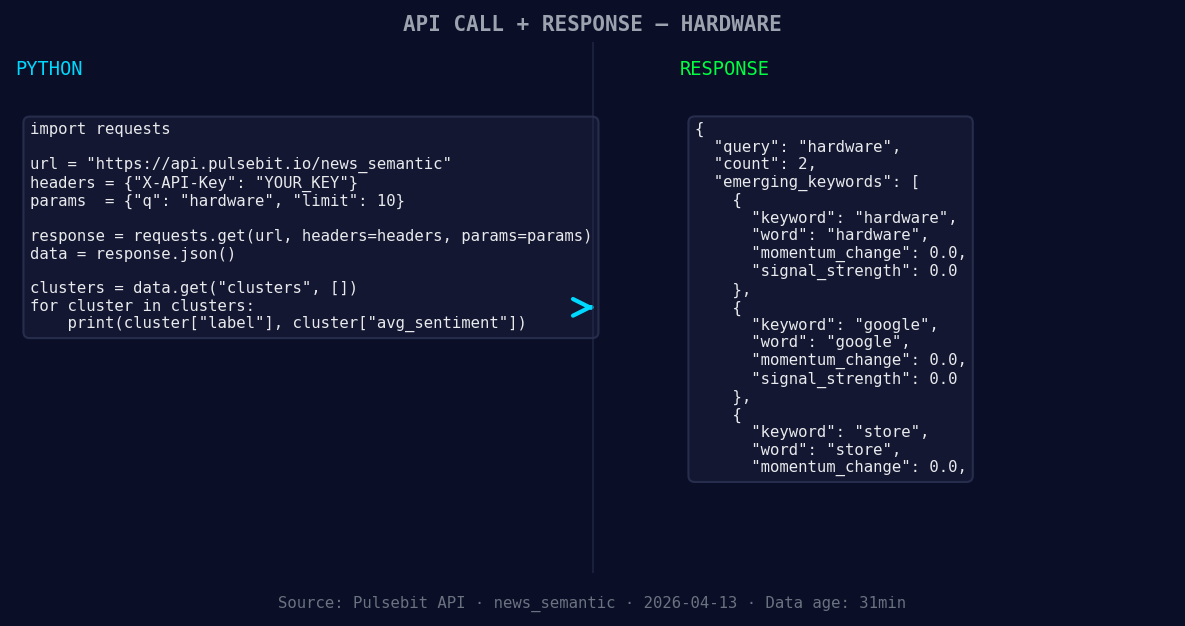
*Left: Python GET /news_semantic call for 'hardware'. Right: returned JSON response structure (clusters: 3). Source: Pulsebit /news_semantic.*
# API parameters
topic = 'hardware'
lang = 'en'
url = f'https://api.pulsebit.com/sentiment?topic={topic}&lang={lang}'
# Fetching sentiment data
response = requests.get(url)
data = response.json()
# Check the momentum and signal strength
momentum = data['momentum_24h']
signal_strength = data['signal_strength']
print(f'Momentum: {momentum}, Signal Strength: {signal_strength}')
Now, let’s take it a step further and assess the sentiment of the narrative framing itself. We will run the cluster reason string through our sentiment API to score it:
# Meta-sentiment moment
cluster_reason = "Clustered by shared themes: released, new, hardware, support, optimizations."
sentiment_url = 'https://api.pulsebit.com/sentiment'
sentiment_response = requests.post(sentiment_url, json={'text': cluster_reason})
sentiment_data = sentiment_response.json()

# Output the sentiment score
meta_sentiment_score = sentiment_data['sentiment_score']
confidence = sentiment_data['confidence']
print(f'Meta Sentiment Score: {meta_sentiment_score}, Confidence: {confidence}')
Three Builds Tonight
Here are three specific builds we can implement leveraging this momentum spike:
Real-Time Alerts: Create a threshold-based alert system that notifies us when hardware sentiment drops below -0.2, using the geographic origin filter to capture only English-language articles. This way, we stay ahead of any downturns in sentiment.
Cluster Analysis Dashboard: Build a dashboard that visualizes sentiment scores for clustered articles over time. Use the meta-sentiment loop to display how narrative framing evolves. This helps you see not just the sentiment but how the conversation is being shaped around hardware.
Entity Tracking: Set up an endpoint that tracks specific entities like “Google” and “store” in relation to hardware sentiment. Given that these entities are forming themes, we can create a filter that captures their sentiment scores while comparing them to mainstream keywords like “released” and “new.”
Get Started
To dive deeper into this, check out our documentation at pulsebit.lojenterprise.com/docs. You can easily copy-paste this code and run it in under 10 minutes. Let's start capturing insights that matter!


Top comments (0)