

Your Pipeline Is 22.2h Behind: Catching Climate Sentiment Leads with Pulsebit
We recently uncovered a striking anomaly: a 24h momentum spike of +0.795 in sentiment around the topic of climate. This spike stands out against a backdrop of mixed global sentiment and highlights significant shifts in public discourse, particularly as the UN climate body continues its efforts despite geopolitical tensions. The leading language for this spike is English, with a 22.2-hour lead, showing that our models need to adapt to these conditions to avoid missing emerging trends.
If your pipeline isn’t equipped to handle multilingual origins or recognize dominant entities, you might be losing out on critical insights. In this case, your model missed a significant climate sentiment shift by 22.2 hours, which could have been invaluable for understanding the current sentiment landscape. The leading entity here is the UN climate body, which is crucial when tracking discussions around climate policies and actions.

English coverage led by 22.2 hours. So at T+22.2h. Confidence scores: English 0.75, Spanish 0.75, French 0.75 Source: Pulsebit /sentiment_by_lang.
To catch this momentum spike, we can leverage our API effectively. Here’s a simple Python script to query the sentiment data specifically for climate-related topics in English:
import requests
# Define parameters for the API call
params = {
"topic": "climate",
"score": 0.700,
"confidence": 0.75,
"momentum": 0.795,
"lang": "en" # Geographic origin filter
}
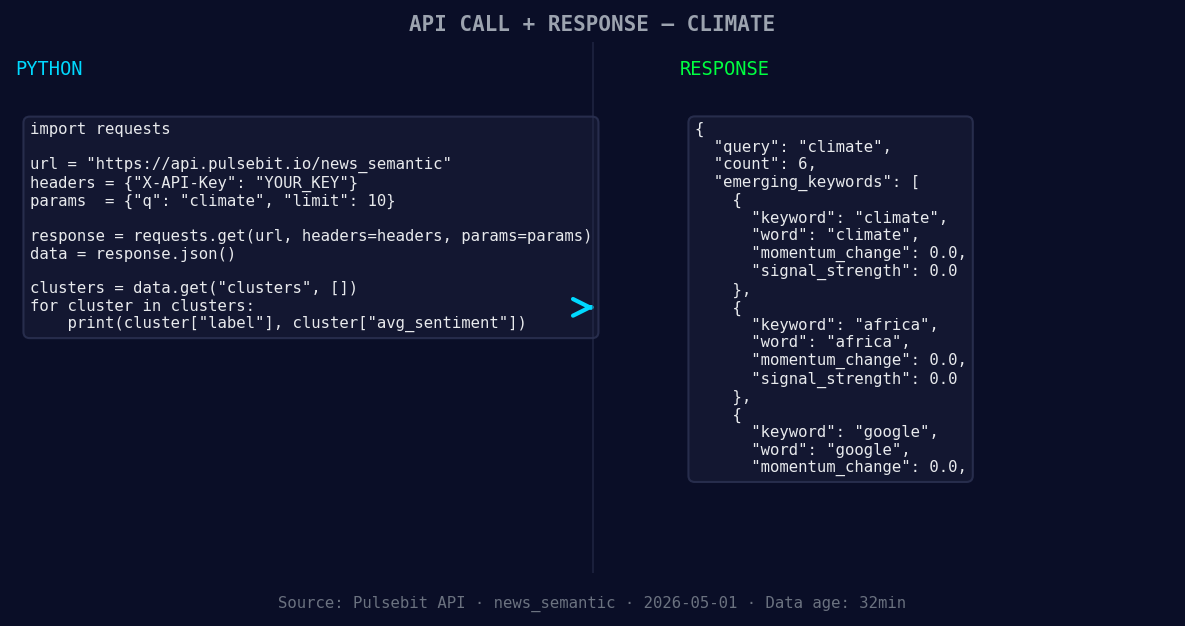
*Left: Python GET /news_semantic call for 'climate'. Right: returned JSON response structure (clusters: 3). Source: Pulsebit /news_semantic.*
# API endpoint to query climate sentiment
response = requests.get("https://api.pulsebit.com/sentiment", params=params)
data = response.json()
print(data)
Next, we want to run the cluster reasoning back through our sentiment scoring to assess the narrative framing around this spike. Here’s how we can do that:
# Input example for the cluster reason string
cluster_reason = "Clustered by shared themes: climate, body, has, said, skea."

# API endpoint to score the narrative framing
sentiment_response = requests.post("https://api.pulsebit.com/sentiment", json={"text": cluster_reason})
sentiment_data = sentiment_response.json()
print(sentiment_data)
With this setup, we’re not only pulling the latest sentiment data but also analyzing the thematic framing that contributes to its rise.
Now let’s consider three specific builds we can create using this pattern:
Geo-Filtered Climate Sentiment Tracker: Build a tracker that monitors sentiment for climate-related topics specifically in English-speaking regions. Use a threshold momentum score of +0.500 to trigger alerts when momentum spikes.
Meta-Sentiment Analysis Tool: Develop a tool that takes cluster reason strings and scores them for sentiment, helping to identify which narratives are gaining traction. Set a confidence threshold at 0.75 to ensure that only strong signals are processed.
Thematic Analysis Dashboard: Create a dashboard that visualizes the thematic clusters forming around climate discussions. Use the forming themes of climate, Africa, and Google against mainstream topics. Set alerts for any significant deviations in sentiment scores from these clusters.
To explore these capabilities, visit pulsebit.lojenterprise.com/docs. You can copy-paste the provided code and run it in under 10 minutes to start gaining insights on climate sentiment.
By leveraging these insights and building robust pipelines, we can ensure that our models remain ahead of the curve, capturing shifts in sentiment as they happen.


Top comments (0)