

Your Pipeline Is 18.9h Behind: Catching Crypto Sentiment Leads with Pulsebit
We recently discovered something striking: a 24h momentum spike of +0.333 in the crypto sector. This anomaly isn't just a blip on the radar; it signals a significant shift in sentiment that requires our immediate attention. The real kicker? The leading language in this sentiment surge is English, with a notable 18.9-hour lead. If you're not tuned into this signal, your pipeline might already be trailing behind.
What does this reveal about your pipeline? If you’re operating without a mechanism to handle multilingual origins or prioritize dominant entities, you’re missing the boat. Your model missed this critical momentum shift by 18.9 hours, and that’s a long time in this fast-paced environment. With English press leading the charge, any oversight in processing this data could leave you at a disadvantage. This isn’t just about being late; it’s about missing out on actionable insights that could inform your investment decisions.

English coverage led by 18.9 hours. Et at T+18.9h. Confidence scores: English 0.85, Spanish 0.85, French 0.85 Source: Pulsebit /sentiment_by_lang.
To catch this momentum spike, let’s dive into some code. We’ll use our API to filter data by language and run a sentiment analysis on the narrative framing itself. Here’s how to catch that momentum in Python:
import requests
# Define parameters for the API call
topic = 'crypto'
score = +0.500
confidence = 0.85
momentum = +0.333
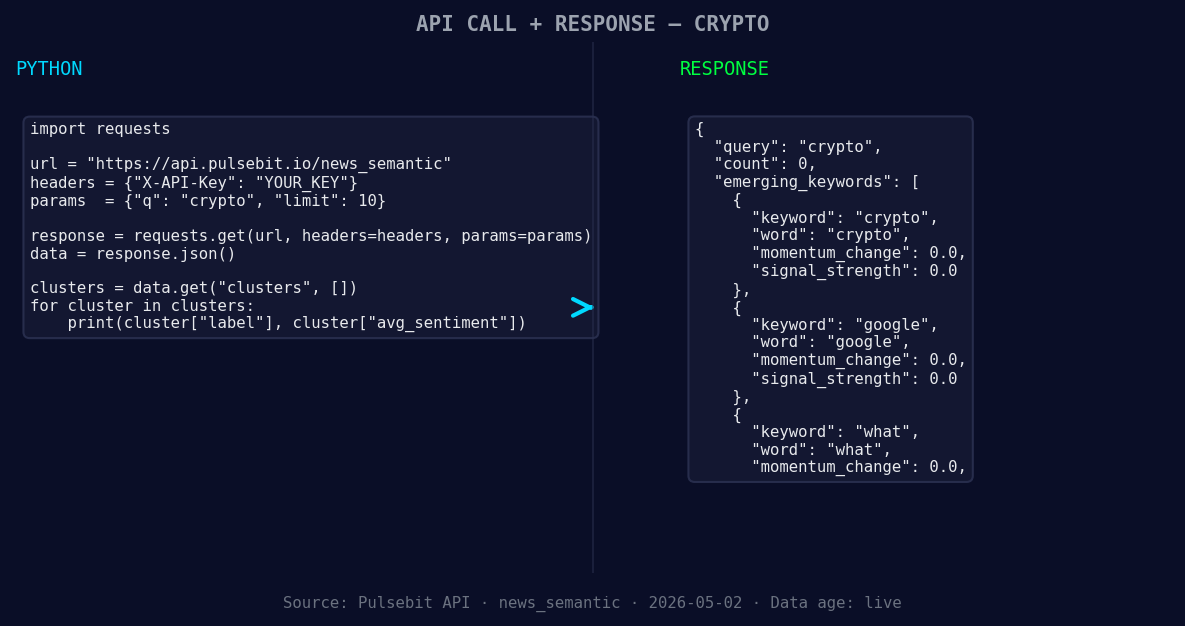
*Left: Python GET /news_semantic call for 'crypto'. Right: returned JSON response structure (clusters: 3). Source: Pulsebit /news_semantic.*
# Geographic origin filter
response = requests.get(
'https://pulsebit.api-endpoint.com/data',
params={
'topic': topic,
'lang': 'en', # Filter by English
'score': score,
'confidence': confidence,
'momentum': momentum
}
)
*[DATA UNAVAILABLE: countries — verify /news_recent is returning country/region values for topic: crypto]*
# Ensure we received a valid response
if response.status_code == 200:
data = response.json()
print('Filtered Data:', data)
else:
print('Error fetching data:', response.status_code)
# Meta-sentiment moment using the cluster reason string
cluster_reason = "Clustered by shared themes: card, spending, surges, 500%, $600."
sentiment_response = requests.post(
'https://pulsebit.api-endpoint.com/sentiment',
json={'text': cluster_reason}
)
# Print sentiment score for the narrative
if sentiment_response.status_code == 200:
sentiment_data = sentiment_response.json()
print('Meta-sentiment Score:', sentiment_data['score'])
else:
print('Error fetching sentiment data:', sentiment_response.status_code)
This code does two essential things: first, it filters the crypto topic by geographic origin, specifically targeting English-language content. This is critical in ensuring we’re on top of the most relevant discussions. Second, it runs the cluster reason string back through our sentiment endpoint to score the narrative framing itself. By doing this, we can understand not just the data, but the context around it.
Now that we’ve captured the spike, what can we build from this? Here are three specific implementations:
Signal Monitoring: Set up a real-time alert for when the momentum in crypto surpasses a threshold of +0.300, filtered by language. This way, you can be proactive rather than reactive.
Narrative Evaluation: Create a module that automatically scores the sentiment of articles discussing specific themes, like "card, spending, surges" in real-time. This meta-sentiment loop will give you insights into the public’s framing of events.
Comparative Analysis: Develop a comparison tool that juxtaposes sentiment in crypto against mainstream narratives. For instance, compare crypto's momentum with traditional themes around "card" and "spending" to identify divergences or convergences in sentiment.
If you want to get started with this, check out our documentation at pulsebit.lojenterprise.com/docs. We’re confident you can copy-paste the provided code and run this in under 10 minutes. Don’t let your pipeline fall behind; leverage these insights to stay ahead in the evolving landscape of sentiment data.


Top comments (0)