

Your pipeline just missed a significant anomaly: a 24-hour momentum spike of +0.258 in travel sentiment. This spike indicates a noteworthy shift in public sentiment, particularly around the theme of travel and tourism. With a leading language of English press emerging 11.1 hours ahead, it’s clear that something is brewing in the narrative landscape. The cluster story, "Travel & Tourism Sees Best Year Ever and Emerges as the World’s Fastest Growing," signals that this is more than just a blip. It’s a moment where sentiment is shifting, and we need to pay attention.
But here’s the kicker: if your pipeline doesn't account for multilingual origins or the dominance of specific entities, you might miss insights like this by over 11 hours. Your model is lagging behind, failing to catch the leading English sentiment, which is critical in a globalized landscape. In a world where every hour counts, letting such a gap persist can mean losing the edge in understanding and reacting to important trends.

English coverage led by 11.1 hours. Id at T+11.1h. Confidence scores: English 0.95, French 0.95, Spanish 0.95 Source: Pulsebit /sentiment_by_lang.
To help you catch these insights in real-time, we can leverage our API effectively. Here’s how you can identify this spike using a Python script. First, let’s filter the sentiment data by its geographic origin, focusing on English-language sources.
import requests
# Define the parameters for the query
params = {
"topic": "travel",
"lang": "en"
}
# Make the API call to fetch sentiment
response = requests.get("https://api.pulsebit.com/sentiment", params=params)
data = response.json()
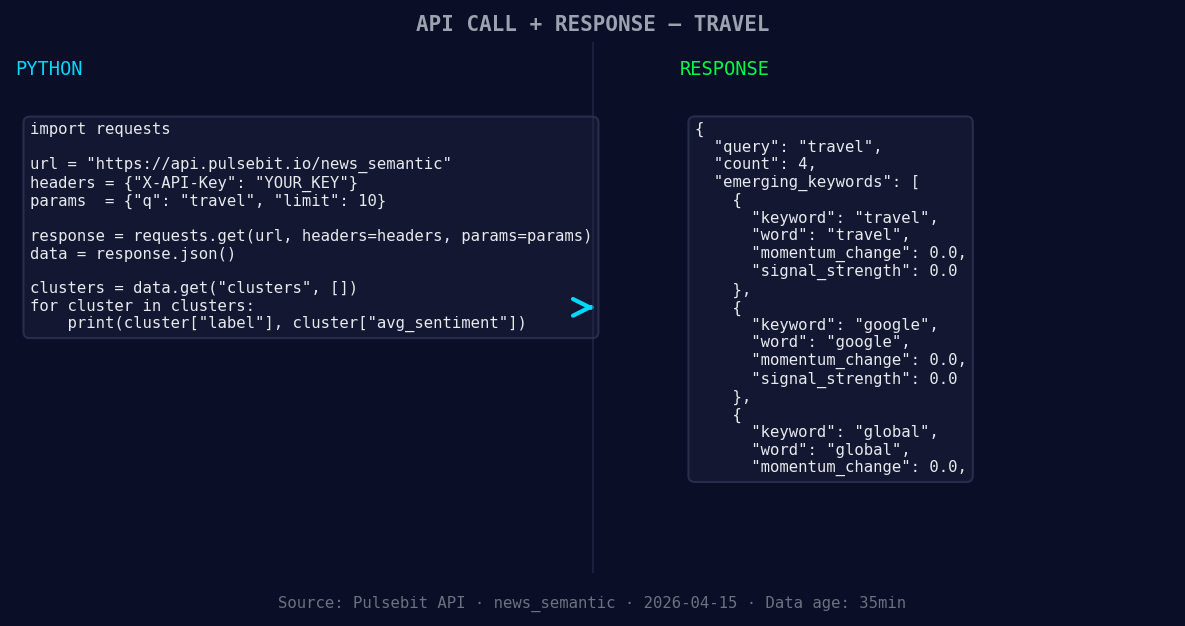
*Left: Python GET /news_semantic call for 'travel'. Right: returned JSON response structure (clusters: 3). Source: Pulsebit /news_semantic.*
# Check if the response is valid and has the necessary information
if data['momentum_24h'] > 0.25:
print(f"Momentum Spike Detected: {data['momentum_24h']}")
Next, we need to assess the narrative framing of the sentiment we’ve observed. We’ll take the cluster reason string and run it back through our sentiment endpoint to score the narrative itself.
# Define the meta-sentiment input
meta_sentiment_input = "Clustered by shared themes: tourism, travel, sees, best, year."

# Make the POST request to score the narrative framing
response_meta = requests.post("https://api.pulsebit.com/sentiment", json={"text": meta_sentiment_input})
meta_data = response_meta.json()

# Output the sentiment score for the narrative
print(f"Meta-Sentiment Score: {meta_data['sentiment_score']}, Confidence: {meta_data['confidence']}")
With these two steps, you’re not just pulling raw sentiment data; you’re actively analyzing how the narrative is constructed, which can guide your strategic decisions.
Now, let’s look at three specific builds you can create tonight based on this momentum spike:
- Geo-Filtered Insights Dashboard: Build a real-time dashboard that tracks sentiment spikes in travel by querying our API with the geographic filter. Set a threshold of +0.25 on momentum and update every hour. This will ensure you're always aware of emerging trends.

Geographic detection output for travel. Hong Kong leads with 3 articles and sentiment +0.35. Source: Pulsebit /news_recent geographic fields.
Meta-Sentiment Analysis Tool: Create a microservice that takes cluster reasons and runs them through the sentiment scoring endpoint in real-time. Use a threshold of +0.06 for sentiment score and integrate it to generate alerts for significant shifts in narrative framing.
Forming Themes Tracker: Develop a script that continuously monitors and logs forming themes, specifically targeting keywords like travel, google, and global. You can set an alert for any changes that deviate from the mainstream narratives, such as tourism, travel, and sees.
By focusing on these areas, we can bridge the gap created by delayed sentiment analysis and ensure we stay ahead of the curve when it comes to understanding public sentiment and its implications.
To get started with these builds, check out our documentation at pulsebit.lojenterprise.com/docs. You can copy-paste the snippets above and get this running in under 10 minutes. Let’s keep our pipelines tight and our insights sharp!


Top comments (0)