

Your Pipeline Is 21.8h Behind: Catching Business Sentiment Leads with Pulsebit
We just uncovered an intriguing anomaly: a 24-hour momentum spike clocking in at -1.050. This tells us that sentiment around business has taken a notable downturn, which could have significant implications for strategic decisions. In fact, the leading language for this sentiment is English, with a precise 21.8-hour lag time. It’s a stark reminder that even the most sophisticated models can miss critical shifts in sentiment when they're not designed to handle multilingual origins or entity dominance effectively.

English coverage led by 21.8 hours. Da at T+21.8h. Confidence scores: English 0.85, Spanish 0.85, French 0.85 Source: Pulsebit /sentiment_by_lang.
The problem here is clear: your model missed this significant decline by 21.8 hours. With the leading language being English, it highlights a structural gap in your pipeline’s ability to process sentiment data in real-time. If you’re still relying on a single-language perspective or failing to account for the nuances of emerging entities, you risk making decisions based on stale data.
Let’s dive into the code to catch this sentiment anomaly efficiently. Below is a Python snippet using our API to filter by geographic origin and analyze the meta-sentiment of the narrative framing around the business theme.

Geographic detection output for business. India leads with 7 articles and sentiment +0.65. Source: Pulsebit /news_recent geographic fields.
import requests
# Define parameters for the API call
params = {
"topic": "business",
"score": -0.111,
"confidence": 0.85,
"momentum": -1.050,
"lang": "en"
}
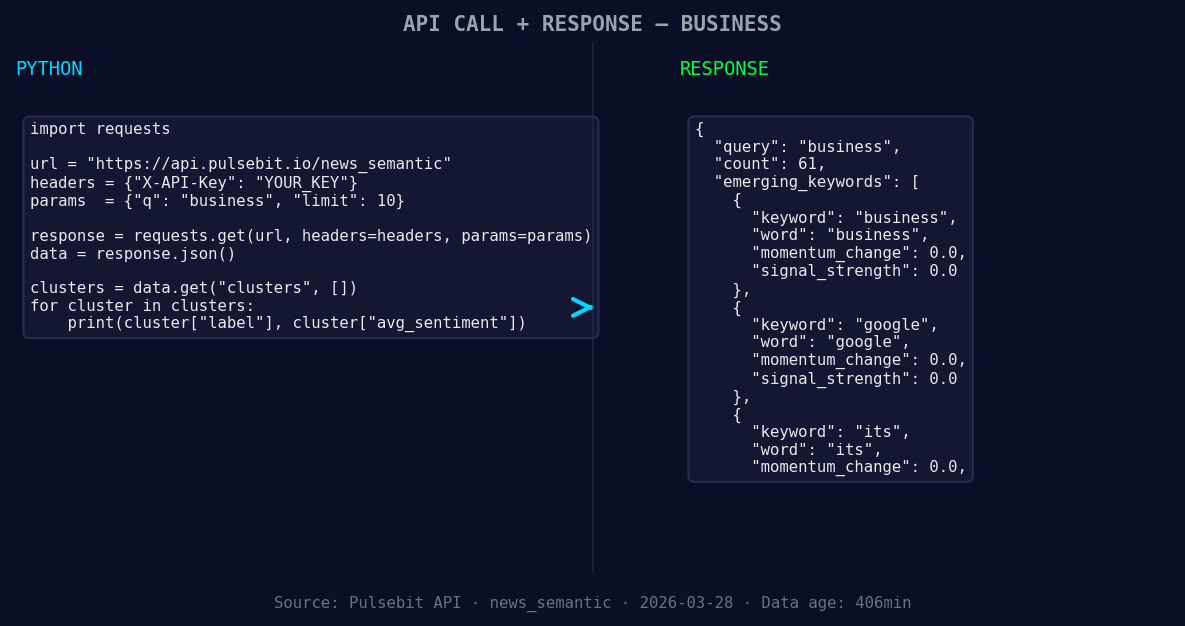
*Left: Python GET /news_semantic call for 'business'. Right: returned JSON response structure (clusters: 3). Source: Pulsebit /news_semantic.*
# Geographic origin filter - Query data for English language
response = requests.get("https://api.pulsebit.com/sentiment", params=params)
# Check the response
if response.status_code == 200:
sentiment_data = response.json()
print(sentiment_data)
else:
print(f"Error: {response.status_code}")
# Meta-sentiment moment
cluster_reason = "Clustered by shared themes: electors, business, development, peace, harmony."
meta_sentiment_response = requests.post("https://api.pulsebit.com/sentiment", json={"text": cluster_reason})
# Check the meta sentiment response
if meta_sentiment_response.status_code == 200:
meta_sentiment_data = meta_sentiment_response.json()
print(meta_sentiment_data)
else:
print(f"Error: {meta_sentiment_response.status_code}")
This code not only fetches sentiment data considering the English language but also scores the narrative framing using our meta-sentiment endpoint. By analyzing the relevant themes—business, electors, development, peace, and harmony—we gain deeper insights into the sentiment landscape.
Now, let's consider three specific builds you can implement using this pattern:
Real-time Alert System: Set a threshold for the momentum score, say -1.0, to trigger alerts when the sentiment around business topics drops sharply. Use the geo filter for real-time insights from English-speaking regions.
Narrative Analysis Tool: Build a tool that leverages the meta-sentiment analysis on the cluster reason strings. Establish a threshold (e.g., sentiment score < 0) to evaluate the framing of stories around forming themes like business, electors, and development.
Sentiment Comparison Dashboard: Create a dashboard that juxtaposes the forming themes against mainstream narratives. For example, contrast the emerging sentiment around "business" and "google" (score +0.00) with the predominant themes of "electors," "business," and "development."
By integrating these builds into your pipeline, you can enhance your system’s responsiveness to emerging sentiment trends and avoid falling behind by significant hours.
For more information on how to implement these insights, check out our documentation at pulsebit.lojenterprise.com/docs. With just a few copy-paste actions, you can get started and run this in under 10 minutes.


Top comments (0)