

Your Pipeline Is 29.0h Behind: Catching Film Sentiment Leads with Pulsebit
Anomaly revealed today: a 24-hour momentum spike of -0.294 for the film topic. This isn't just a random fluctuation; it points to a significant shift in sentiment, particularly around the film "Chand Mera Dil," which has been delayed again. The Spanish press is leading this narrative, with a 29-hour head start on the conversation, giving us a crucial insight into how sentiment is evolving in real-time. If your current setup isn't tuned to catch these shifts, you're missing key signals that could inform your strategies.
The Problem
Your model missed this by 29 hours. It's clear that traditional pipelines often struggle to handle multilingual origins or account for entity dominance. In this scenario, the dominant Spanish narrative surrounding Ananya Panday's film is gaining traction, while the rest of the pipeline remains oblivious. If you're not actively monitoring sentiment across languages and entities, you risk making decisions based on outdated or incomplete information.

Spanish coverage led by 29.0 hours. Nl at T+29.0h. Confidence scores: Spanish 0.75, English 0.75, French 0.75 Source: Pulsebit /sentiment_by_lang.
The Code
To catch this momentum spike effectively, we can utilize our API to filter sentiment data by language and run a meta-sentiment analysis on the clustered narrative. Here’s how you can do this in Python:
import requests
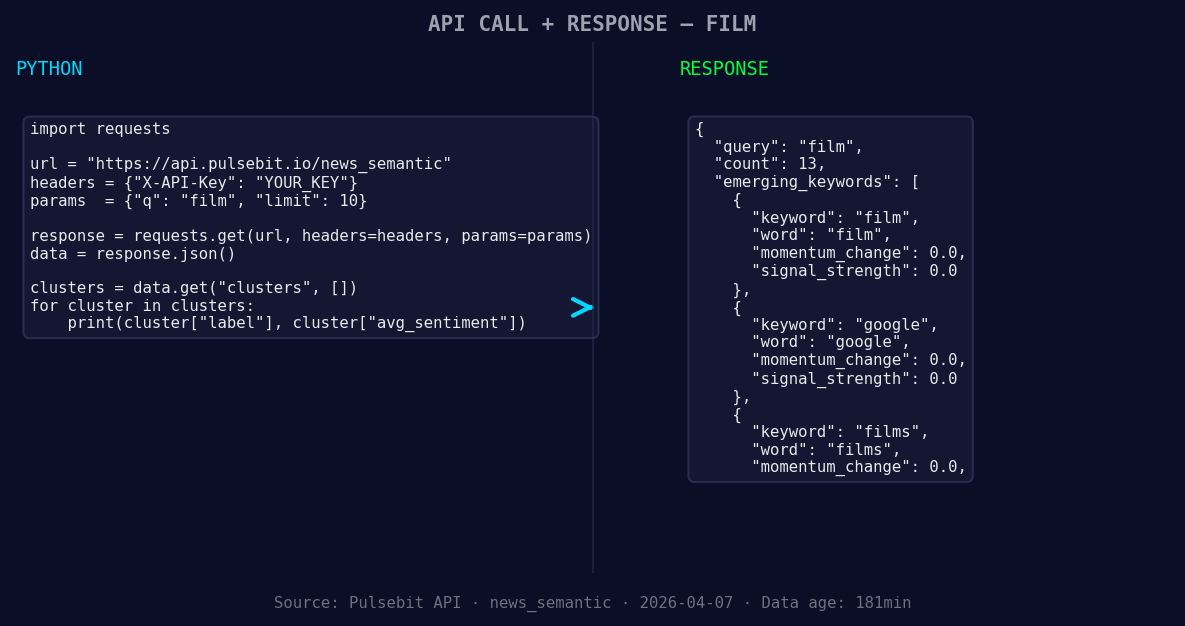
*Left: Python GET /news_semantic call for 'film'. Right: returned JSON response structure (clusters: 3). Source: Pulsebit /news_semantic.*
# Step 1: Geographic origin filter
response = requests.get("https://api.pulsebit.com/sentiment", params={
"topic": "film",
"lang": "sp", # Filtering for Spanish
"momentum": -0.294,
"score": +0.237,
"confidence": 0.75
})
data = response.json()
print("Filtered Data:", data)
# Step 2: Meta-sentiment moment
narrative = "Clustered by shared themes: ‘chand, mera, dil’:, ananya, panday."
meta_response = requests.post("https://api.pulsebit.com/sentiment", json={
"text": narrative
})
meta_data = meta_response.json()
print("Meta Sentiment Score:", meta_data)
In this code, we first filter the sentiment data for the film topic in Spanish using lang: "sp". This ensures we're getting insights from the leading language. Then, we run the cluster reason string through our sentiment endpoint to analyze the framing of the narrative itself. This two-pronged approach allows us to capture not just the data, but the context around it.
Three Builds Tonight
- Geographic Filter for Sentiment: Implement a real-time alert system that watches for sentiment spikes tied to specific films in particular languages. For example, set a threshold for any film topic with a momentum drop below -0.3 within the Spanish-speaking community.

Geographic detection output for film. India leads with 7 articles and sentiment +0.29. Source: Pulsebit /news_recent geographic fields.
Meta-Sentiment Analysis: Create a dashboard that visualizes sentiment scores alongside meta-sentiment scores for key narratives. This can spotlight how narratives evolve, particularly for films like "Chand Mera Dil," and help you understand how the framing affects public perception.
Clustered Theme Tracking: Build a tool that monitors forming themes in real-time, allowing you to capture emerging narratives. For instance, track sentiment around keywords like ‘chand, mera, dil’ against mainstream perceptions. If the sentiment for 'film' hovers around +0.00 but clusters show significant engagement, it can signal a shift worth noting.
Get Started
For more details on how to implement these strategies, check out our documentation. You should be able to copy-paste and run this in under 10 minutes, enabling you to catch these crucial shifts before they become mainstream knowledge. Let’s make sure your pipeline is always ahead of the curve!


Top comments (0)