

Your Pipeline Is 29.2h Behind: Catching Blockchain Sentiment Leads with Pulsebit
We’ve just spotted a significant anomaly: a 24h momentum spike of +0.439 in blockchain sentiment. This is a notable shift that caught our attention, mainly because it’s centered around the recent news of Visa launching a validator node on the Tempo blockchain network. With two articles clustered around this theme, it’s clear that something is brewing in the blockchain space, and you don’t want to be left behind.
But here’s the catch: your existing pipeline likely missed this by a staggering 29.2 hours. Why? Because it’s not effectively handling multilingual origins or entity dominance. The leading language of the buzz is English, and if your model isn’t optimized for this, you risk overlooking critical insights that could inform your strategies. In a world where timing is everything, lagging behind is not an option.

English coverage led by 29.2 hours. Ca at T+29.2h. Confidence scores: English 0.90, French 0.90, Spanish 0.90 Source: Pulsebit /sentiment_by_lang.
Let’s look at how we can catch this momentum spike using our API. Below is a Python snippet that filters for sentiment around the topic of 'blockchain' with a focus on English-language articles. We’ll be checking for a momentum score of +0.439, ensuring we’re only pulling in relevant data.
import requests
# Define the parameters for our API call
params = {
"topic": "blockchain",
"lang": "en",
"momentum": 0.439,
"confidence": 0.90
}
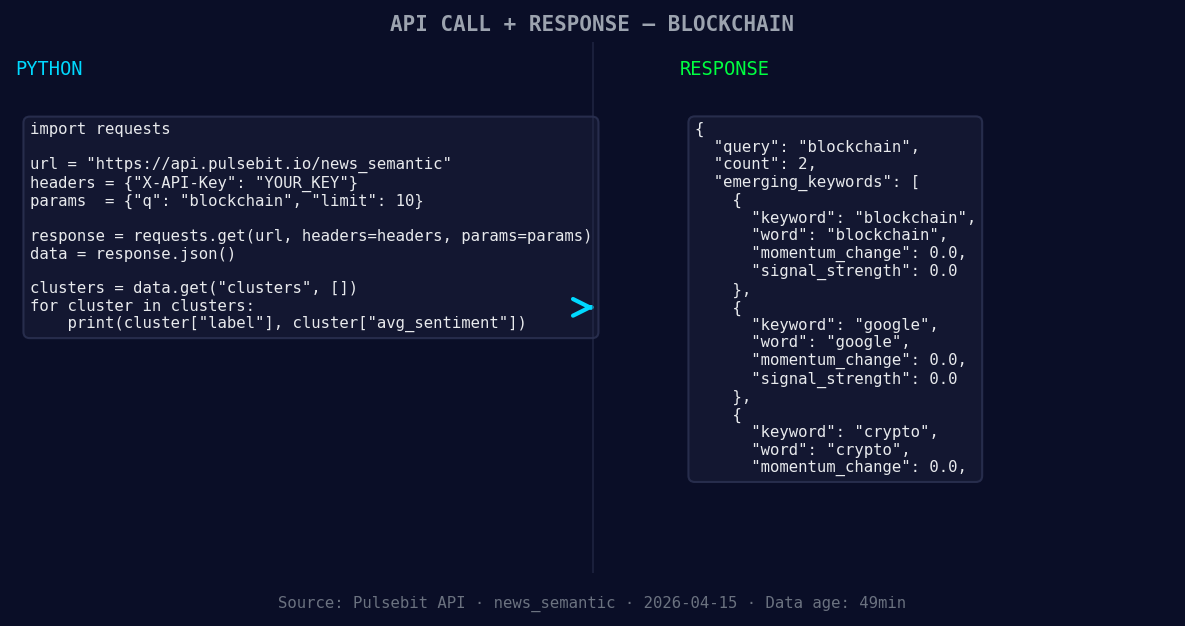
*Left: Python GET /news_semantic call for 'blockchain'. Right: returned JSON response structure (clusters: 3). Source: Pulsebit /news_semantic.*
# Make the API call to fetch the sentiment data
response = requests.get("https://api.pulsebit.com/v1/sentiment", params=params)
# Check the response
if response.status_code == 200:
data = response.json()
print("Sentiment Data:", data)
else:
print("Error:", response.status_code)
Next, we want to dive deeper into the narrative framing of our cluster by running a meta-sentiment check. This helps us score the themes from the articles, providing further context that can be crucial for understanding the overall sentiment landscape.
# Define the narrative framing for our meta-sentiment
meta_sentiment_input = "Clustered by shared themes: uses, blockchain, steal, everything, omnistealer."

# Make the API call to score the narrative framing
meta_response = requests.post("https://api.pulsebit.com/v1/sentiment", json={"text": meta_sentiment_input})

# Check the response
if meta_response.status_code == 200:
    meta_data = meta_response.json()
    print("Meta-Sentiment Data:", meta_data)
else:
    print("Error:", meta_response.status_code)
Now that we have the tools to catch this spike, let’s consider three specific builds that can leverage this newfound insight:
Geo-Filtered Alert System: Set up an alert for sentiment changes in blockchain articles, specifically filtering for English-language articles from the US. Trigger alerts when the momentum exceeds a threshold of +0.300.
Meta-Sentiment Scoring on Clusters: Use the meta-sentiment loop to assess the framing of emerging themes every hour. If the sentiment score exceeds +0.700, create a report summarizing the narrative, highlighting potential investment opportunities.
Cross-Topic Analysis: Monitor related topics such as 'crypto' and 'google' with a focus on sentiment divergence from mainstream themes. If sentiment in blockchain is rising while mainstream themes like 'steal' are stagnant, this could indicate an opportunity to pivot strategies.
With these implementations, you can stay ahead of the curve and catch sentiment leads as they emerge.
For more on how to get started, check out our documentation. You can copy-paste the code above and run it in under 10 minutes. Don’t let your pipeline stay 29.2 hours behind — start leveraging these insights now!

Geographic detection output for blockchain. France leads with 1 articles and sentiment +0.75. Source: Pulsebit /news_recent geographic fields.


Top comments (0)