

Your Pipeline Is 29.2h Behind: Catching Health Sentiment Leads with Pulsebit
We recently stumbled upon an intriguing anomaly: a 24h momentum spike of -0.812 in health sentiment. This sharp decline, led by English press articles, suggests a shift in public discourse that our existing pipelines might easily overlook. In this case, the leading language was English, with a notable lag of 29.2 hours. If your model isn’t tuned to catch these nuances, you might have missed critical insights that can shape your strategies.
But here's the catch: your model missed this by a staggering 29.2 hours. In a fast-paced environment, such a delay can mean the difference between capitalizing on trends and being left behind. With the leading language being English, the dominant narrative revolves around health, public sentiment, and activism. Ignoring multilingual origin or entity dominance can create significant structural gaps in your insights and decision-making processes.

English coverage led by 29.2 hours. Da at T+29.2h. Confidence scores: English 0.85, French 0.85, Spanish 0.85 Source: Pulsebit /sentiment_by_lang.
To catch these nuances, let’s dive into the code. Here’s how you can leverage our API to address this 29.2-hour gap and extract relevant sentiment data.
import requests
# Define parameters for the API call
base_url = "https://api.pulsebit.com/v1/sentiment"
params = {
"topic": "health",
"lang": "en" # Querying in English
}
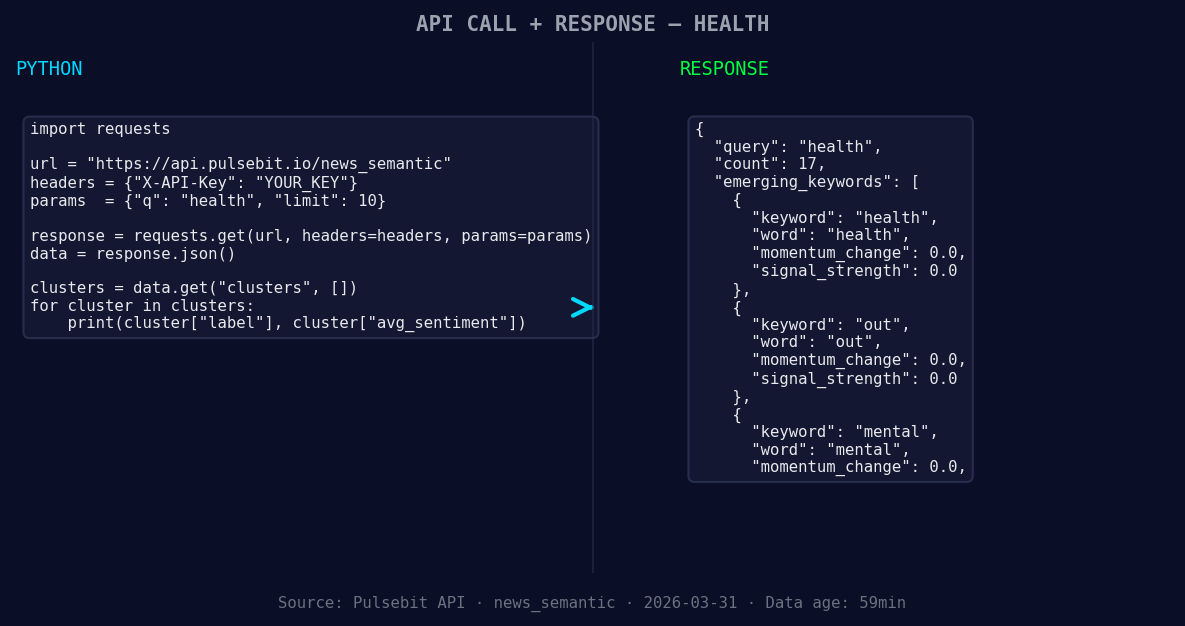
*Left: Python GET /news_semantic call for 'health'. Right: returned JSON response structure (clusters: 3). Source: Pulsebit /news_semantic.*
# Make the API call
response = requests.get(base_url, params=params)
data = response.json()
# Print response data for debugging
print(data)
Next, we want to score the narrative framing itself. We'll take the cluster reason string and run it through our sentiment endpoint to evaluate how the themes align with the observed sentiment.
# Define the meta-sentiment input
meta_sentiment_input = "Clustered by shared themes: public, health, activist, ekbal, nutritious."

# Make a POST request to score the narrative
meta_response = requests.post(base_url, json={"text": meta_sentiment_input})
meta_data = meta_response.json()

# Print the meta-sentiment score
print("Meta-Sentiment Score:", meta_data)
Now that we have the tools to catch anomalies like the health sentiment momentum spike, let’s explore three specific builds you can implement right away:
Geo-Filtered Alerts: Set a signal strength threshold of 0.879. Create an alert system that triggers when the health sentiment momentum drops below -0.5 in English-speaking regions. This ensures that you’re staying ahead of negative trends.
Meta-Sentiment Analysis: Use the meta-sentiment loop to monitor the narrative around health activism. Anytime the sentiment score from the cluster reason string is below -0.025, you'll want to investigate further. This allows for a deeper understanding of public sentiment and its implications.
Forming Theme Tracker: Build a tracker for emerging themes like health, mental health, and public activism. If any of these themes show a momentum shift greater than +0.00, initiate a deep dive into related articles and discussions to proactively address potential impacts on your strategies.
By implementing these strategies, you can effectively bridge the gap caused by delayed sentiment insights.
To get started with our API and explore these capabilities, head over to pulsebit.lojenterprise.com/docs. You can copy-paste and run the provided code snippets in under 10 minutes, making it easy to integrate these insights into your workflow.

Geographic detection output for health. India leads with 12 articles and sentiment +0.17. Source: Pulsebit /news_recent geographic fields.


Top comments (0)