

Your Pipeline Is 22.8h Behind: Catching Education Sentiment Leads with Pulsebit
We recently stumbled upon an intriguing anomaly: a 24-hour momentum spike of -0.391 in the education sector. As we dug deeper into the data, we found that the leading language was English press, showing a lag of just 22.8 hours against the actual sentiment shifts. This finding indicates that there’s something significant happening around education that your pipeline may not be capturing adequately.
When your model doesn't account for multilingual origins or entity dominance, you might miss critical shifts in sentiment. In this case, your pipeline missed a pivotal moment by 22.8 hours, as the leading language was English. If you’re relying solely on a single language or a narrow scope of entities, it’s likely you're not just behind the curve — you’re potentially missing out on valuable insights that could drive informed decisions.

English coverage led by 22.8 hours. Af at T+22.8h. Confidence scores: English 0.75, Spanish 0.75, French 0.75 Source: Pulsebit /sentiment_by_lang.
Here’s how to catch these insights programmatically. We can filter the sentiment data for the topic "education" using our API. In this example, we'll set the score to -0.600, confidence to 0.75, and momentum to -0.391.
import requests
# Set parameters for the API call
params = {
"topic": "education",
"score": -0.600,
"confidence": 0.75,
"momentum": -0.391,
"lang": "en" # Filter by English language articles
}
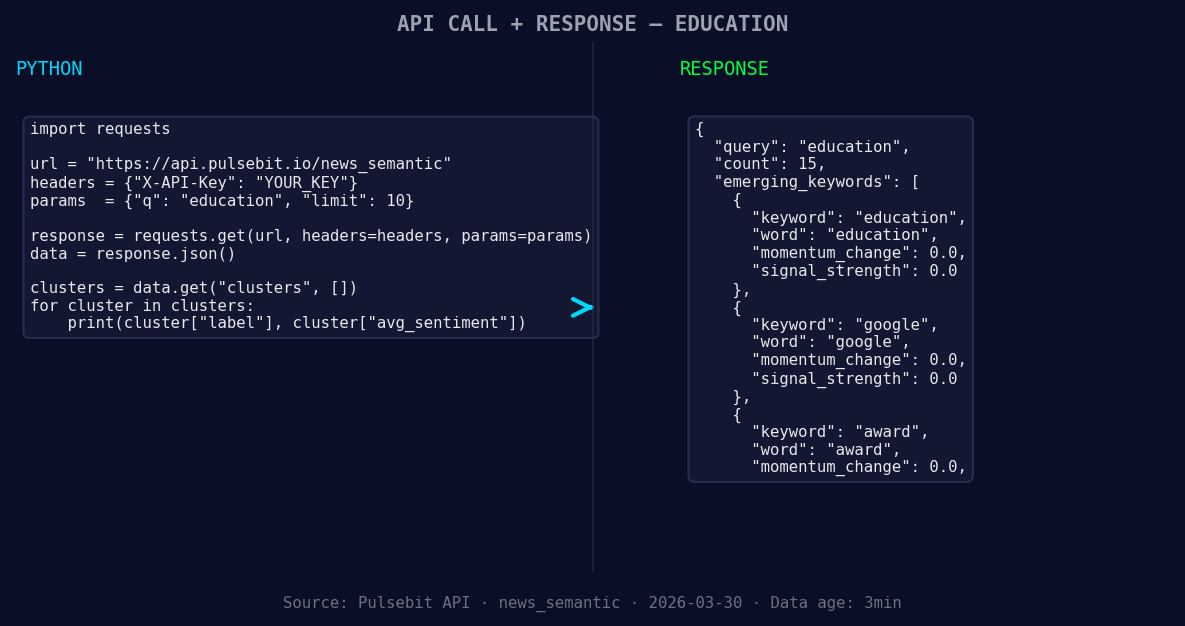
*Left: Python GET /news_semantic call for 'education'. Right: returned JSON response structure (clusters: 3). Source: Pulsebit /news_semantic.*
# API call to fetch sentiment data
response = requests.get("https://api.pulsebit.com/sentiment", params=params)
data = response.json()
print(data)
Next, we need to run the cluster reason string back through our sentiment API to score the narrative framing itself. This loop can help us uncover how the thematic clustering influences sentiment.
# Cluster reason for scoring
cluster_reason = "Clustered by shared themes: major, study, finds, special, education."

# API call for meta-sentiment scoring
meta_response = requests.post("https://api.pulsebit.com/sentiment", json={"text": cluster_reason})
meta_data = meta_response.json()

print(meta_data)
With these two snippets, you can efficiently catch emerging trends in the education sector and understand how narratives shape sentiment.
Now, let’s talk about three specific builds to leverage this anomaly:
Geo-Filtered Alerts: Set up an alert system using the geo filter for English-language articles on education. Use a signal threshold of -0.391 to catch any significant drops in sentiment. This will ensure you're alerted to important shifts in sentiment early.
Meta-Sentiment Analysis: Create a dashboard that visualizes the scores from our meta-sentiment loop for various cluster reasons. This could help you track how narratives around education evolve over time, especially when certain themes start forming, like "education," "Google," and "award," against mainstream themes like "major," "study," and "finds."
Dynamic Content Strategy: Use the output of your sentiment analysis to adjust your content strategy dynamically. For instance, if sentiment about education shows a spike (positive or negative) based on the patterns identified, you can respond with targeted content that aligns with the emerging narrative.
To get started, check out our documentation at pulsebit.lojenterprise.com/docs. You can copy-paste the above code snippets and run them in under 10 minutes. Let’s catch up with the momentum in education sentiment!

Geographic detection output for education. India leads with 13 articles and sentiment +0.57. Source: Pulsebit /news_recent geographic fields.


Top comments (0)