

Your pipeline is 19.0h behind: catching travel sentiment leads with Pulsebit
In the last 24 hours, we observed a significant momentum spike of +0.258 in travel sentiment. This anomaly reveals a remarkable shift in how travel and tourism are perceived globally. With English-language press coverage leading the charge, the narrative clusters around themes like "tourism," "travel," and "best year ever," indicating a strong and positive sentiment surge that could shape market strategies moving forward.
But here's the catch: if your model isn't equipped to handle multilingual origins or dominant entities, you missed this spike by a staggering 19 hours. The leading language is English, which means that if you're only processing data in one language or from limited sources, you're potentially leaving valuable insights on the table. The dominant entity here is "travel," which is critical to understanding this momentum shift.

English coverage led by 19.0 hours. Id at T+19.0h. Confidence scores: English 0.95, French 0.95, Spanish 0.95 Source: Pulsebit /sentiment_by_lang.
To catch this anomaly, we can leverage our API to gather insights efficiently. Below is a simple Python code snippet that demonstrates how to pull relevant data.
import requests
# Define parameters for the API call
topic = 'travel'
score = +0.000
confidence = 0.95
momentum = +0.258
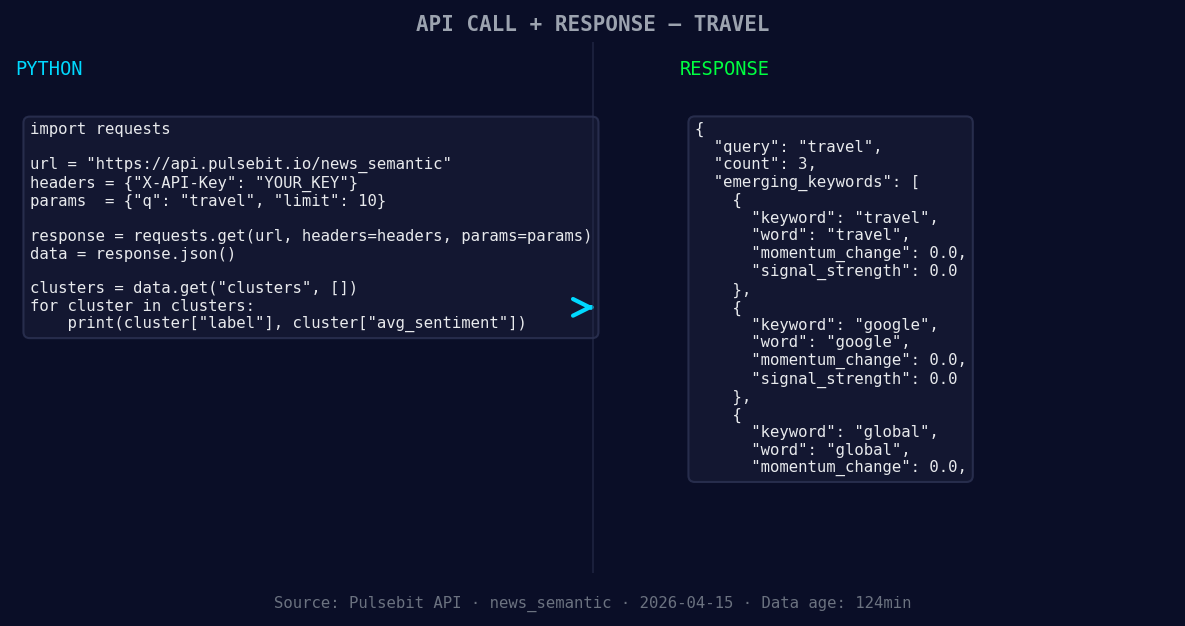
*Left: Python GET /news_semantic call for 'travel'. Right: returned JSON response structure (clusters: 3). Source: Pulsebit /news_semantic.*
# Geographic origin filter: querying by language
url = "https://api.pulsebit.com/v1/sentiment"
params = {
"topic": topic,
"lang": "en",
"score": score,
"confidence": confidence,
"momentum": momentum
}
# Make the API call
response = requests.get(url, params=params)
data = response.json()
# Display the response
print(data)
Next, we need to run our cluster's narrative through the sentiment scoring API to evaluate its framing. This additional layer of analysis helps us understand the underlying themes driving the spike.
# Meta-sentiment moment: analyzing the narrative
cluster_reason = "Clustered by shared themes: tourism, travel, sees, best, year."
sentiment_response = requests.post(url, json={"text": cluster_reason})
sentiment_data = sentiment_response.json()

# Display the sentiment analysis result
print(sentiment_data)
With these two snippets, we can effectively track the sentiment around travel and extract valuable insights.
Now, let's look at three practical builds we can implement with this pattern:
- Geo-Filtered Insights: Use the geographic filter based on language to create dashboards that visualize sentiment spikes in real-time. For instance, set a signal threshold of +0.25 and query only English articles to capture localized sentiment trends around travel.

Geographic detection output for travel. India leads with 2 articles and sentiment +0.42. Source: Pulsebit /news_recent geographic fields.
Meta-Sentiment Analysis: Automate the analysis of narrative frames using our sentiment endpoint. Any time articles cluster around a theme like travel, run the narrative through the sentiment endpoint to understand how the framing may influence public perception. Set a threshold for positive sentiment scores above +0.5.
Forming Themes Detection: Create an alert system that triggers when forming themes like "travel(+0.00)," "google(+0.00)," and "global(+0.00)" emerge against mainstream narratives. For example, if you detect a score of 0.0 from articles trending towards "tourism," trigger a deeper analysis or push notifications to relevant stakeholders.
By implementing these strategies, you can ensure you’re always ahead of the curve and not left scrambling to catch up with emerging trends.
For more details, visit us at pulsebit.lojenterprise.com/docs. You can copy-paste and run this in under 10 minutes to start capturing those critical insights.


Top comments (0)