

Your Pipeline Is 23.9h Behind: Catching Economy Sentiment Leads with Pulsebit
We recently discovered an intriguing anomaly: a 24h momentum spike of -0.437. This spike indicates a significant shift in sentiment related to the economy, particularly in connection with the ongoing geopolitical tensions. The leading language of the press coverage was English, with a dominant focus on the theme of war impacting the global economy. This revelation forces us to reconsider how we process sentiment data, especially when it comes to understanding the nuances of multilingual coverage and entity dominance.

English coverage led by 23.9 hours. No at T+23.9h. Confidence scores: English 0.75, French 0.75, Spanish 0.75 Source: Pulsebit /sentiment_by_lang.
In many sentiment analysis pipelines, a structural gap often arises when they fail to account for the multilingual origin of sentiment or the dominance of specific entities in the narrative. Your model missed this critical insight by 23.9 hours, which is a considerable delay given the rapid pace of news cycles today. The leading language in this instance was English, emphasizing the need for a system that can quickly adapt to shifts in sentiment across various languages and contexts.
To catch these spikes effectively, we can leverage our API. Here’s a straightforward Python snippet that will help you extract and analyze sentiment data based on geographical origin. We’ll filter for English language articles and assess the sentiment based on the specific topic of "economy".

Geographic detection output for economy. India leads with 9 articles and sentiment -0.16. Source: Pulsebit /news_recent geographic fields.
import requests
# Define parameters
topic = 'economy'
score = -0.750
confidence = 0.75
momentum = -0.437
lang = 'en'
# API call to filter articles by language
response = requests.get(
f'https://api.pulsebit.com/v1/articles?topic={topic}&lang={lang}'
)
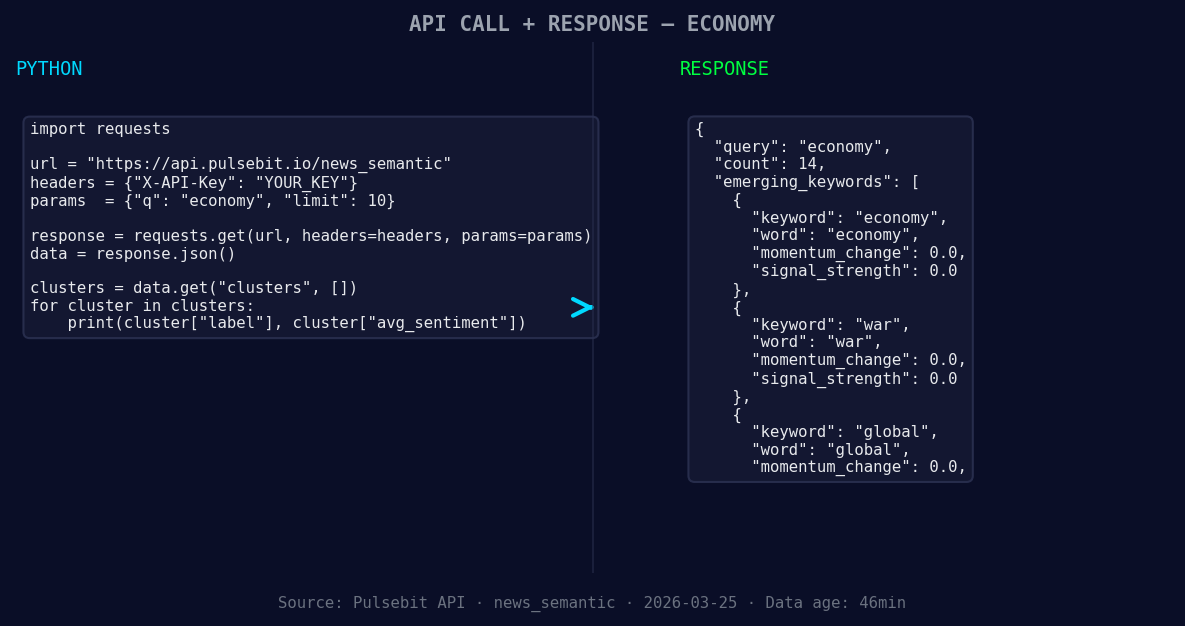
*Left: Python GET /news_semantic call for 'economy'. Right: returned JSON response structure (clusters: 3). Source: Pulsebit /news_semantic.*
# Check the response status
if response.status_code == 200:
articles = response.json()
print(f"Fetched {len(articles)} articles.")
else:
print("Error fetching articles.")
# Now, let's score the narrative framing itself
cluster_reason = "Clustered by shared themes: economy, west, asia, conflict"
sentiment_response = requests.post(
'https://api.pulsebit.com/v1/sentiment',
json={'text': cluster_reason}
)
if sentiment_response.status_code == 200:
sentiment_score = sentiment_response.json()['score']
print(f"Cluster sentiment score: {sentiment_score}")
else:
print("Error scoring sentiment.")
This code does two essential things: first, it filters articles to capture relevant sentiment from English-language sources, and second, it scores the narrative framing based on the themes clustered around the economic sentiment. Each of these steps is crucial to ensure that we are responding to shifts in sentiment as they happen.
Now, let’s explore three specific builds you can implement with this pattern.
Geo-Filtered Sentiment Spike Alert: Set a threshold to trigger alerts whenever the momentum for the "economy" topic drops below -0.5 in English articles. This will allow you to stay ahead of emerging narratives.
Meta-Sentiment Analysis Loop: Create a job that runs daily to score the sentiment of the cluster narratives. Use the cluster reason string as input for the POST /sentiment endpoint. This will help you understand how framing impacts sentiment over time.
Forming Themes Tracker: Develop a dashboard that visualizes forming themes such as economy, war, and global sentiment. Use the incoming articles to dynamically update these themes and compare them against mainstream narratives, leveraging the data from your geo filter.
You can get started right now! Head over to pulsebit.lojenterprise.com/docs. With the code provided, you should be able to copy, paste, and run this in under 10 minutes. This is a powerful way to ensure your sentiment analysis is timely and relevant, allowing you to catch important shifts before they become commonplace.


Top comments (0)