

Your Pipeline Is 11.9h Behind: Catching Robotics Sentiment Leads with Pulsebit
We recently uncovered a significant anomaly: a 24h momentum spike of +0.210 in the robotics sector. This spike was driven largely by French press articles, which were leading the charge with a timing of 11.9 hours ahead. The narrative centered around "RoboSense Achieves First-Ever Quarterly Profit", highlighting a clear opportunity for those of us monitoring sentiment around emerging technologies like robotics.
However, if your pipeline doesn't account for multilingual origins or entity dominance, you might have missed this spike entirely. Your model likely lagged 11.9 hours behind the French sentiment, failing to capture the early momentum from this specific language. By neglecting non-English sources, you're potentially leaving valuable insights on the table.

French coverage led by 11.9 hours. No at T+11.9h. Confidence scores: French 0.85, English 0.85, Spanish 0.85 Source: Pulsebit /sentiment_by_lang.
Let’s dive into how we can catch this momentum using our API. First, we’ll want to filter for French articles about robotics. The following Python snippet captures that:
import requests
# Define parameters for the API call
params = {
"topic": "robotics",
"lang": "fr",
"momentum": 0.210,
"score": 0.364,
"confidence": 0.85
}
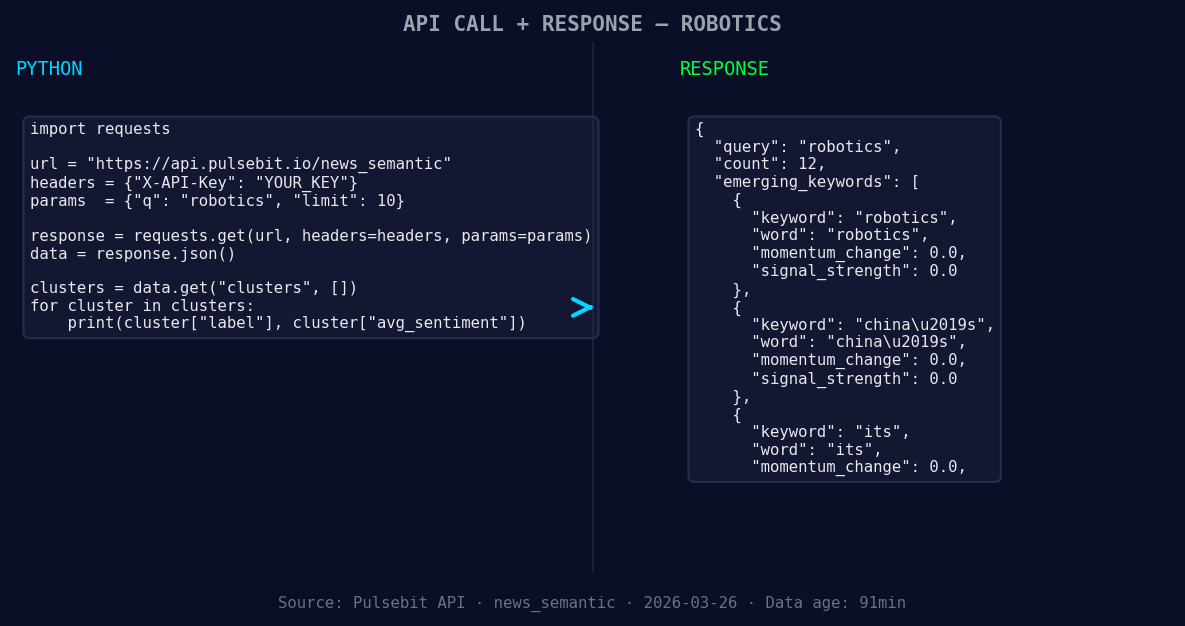
*Left: Python GET /news_semantic call for 'robotics'. Right: returned JSON response structure (clusters: 3). Source: Pulsebit /news_semantic.*
# Make the API call to fetch the relevant data
response = requests.get("https://api.pulsebit.io/v1/articles", params=params)
if response.status_code == 200:
data = response.json()
print(data)
else:
print("Error fetching data")
Next, we need to assess the sentiment around the cluster narrative itself. We can run the cluster reason string through our sentiment analysis endpoint to understand how the framing of this news impacts perception. Here’s how you can do that:
# Cluster reason string we received
cluster_reason = "Clustered by shared themes: its, robosense, expectations, first-ever, quarterly."

# Define the payload for the sentiment analysis
payload = {
    "text": cluster_reason
}

# POST request to analyze sentiment of the cluster reason
sentiment_response = requests.post("https://api.pulsebit.io/v1/sentiment", json=payload)

if sentiment_response.status_code == 200:
    sentiment_data = sentiment_response.json()
    print(sentiment_data)
else:
    print("Error fetching sentiment data")
Now that we have a way to capture and analyze this specific momentum spike, here are three concrete builds you can implement with this pattern:
French Language Filter: Use the language filter to continuously monitor for momentum spikes in French articles. Set a threshold where you trigger alerts for any momentum score above +0.200 for topics like robotics. This helps ensure you're always aware of emerging trends before they hit the mainstream.
Meta-Sentiment Insights: Create a dashboard that visualizes the sentiment of cluster narratives. Use the meta-sentiment loop to track how the framing of stories influences public perception. By establishing a threshold for sentiment scores, you can prioritize which narratives to follow more closely.
Forming Themes Analysis: Set up a signal detection system that captures forming themes such as "robotics" (+0.00), "China’s" (+0.00), and "its" (+0.00). Analyze their momentum relative to mainstream narratives (e.g., "its", "robosense", "expectations"). This allows you to understand not just current sentiment, but also rising trends that may shape future narratives.
If you’re eager to get started, check out our documentation at pulsebit.lojenterprise.com/docs. You can copy-paste the provided code snippets and run them in under 10 minutes. Don’t let your pipeline fall behind—embrace the multilingual landscape of sentiment analysis!

Geographic detection output for robotics. Hong Kong leads with 8 articles and sentiment +0.59. Source: Pulsebit /news_recent geographic fields.


Top comments (0)