

Your pipeline should be set up to catch anomalies like the recent 24h momentum spike of +0.308 we just uncovered. This spike is tied to a significant sentiment shift surrounding the "Global Response to WHCA Dinner Shooting," with English-language press leading the charge. If you're not monitoring multiple languages or struggling with entity dominance, you're potentially missing out on critical signals like this one—by as much as 28.5 hours.
Let’s be clear: your model missed this by 28.5 hours, with the leading language being English. This delay can be detrimental, especially when critical events draw global attention. In this case, the dominant entity is the White House, and if you’re not handling multilingual sentiment, you risk being out of sync with public sentiment in real-time.

English coverage led by 28.5 hours. Af at T+28.5h. Confidence scores: English 0.90, French 0.90, Spanish 0.90 Source: Pulsebit /sentiment_by_lang.
To catch these critical moments, we can use our API to filter the data effectively. Below is a Python snippet that demonstrates how to query the sentiment data for the topic of "world," focusing on English language content:
import requests
# Set parameters for the API call
url = "https://api.pulsebit.com/v1/sentiment"
params = {
"topic": "world",
"score": +0.101,
"confidence": 0.90,
"momentum": +0.308,
"lang": "en" # Geo filter for English articles
}
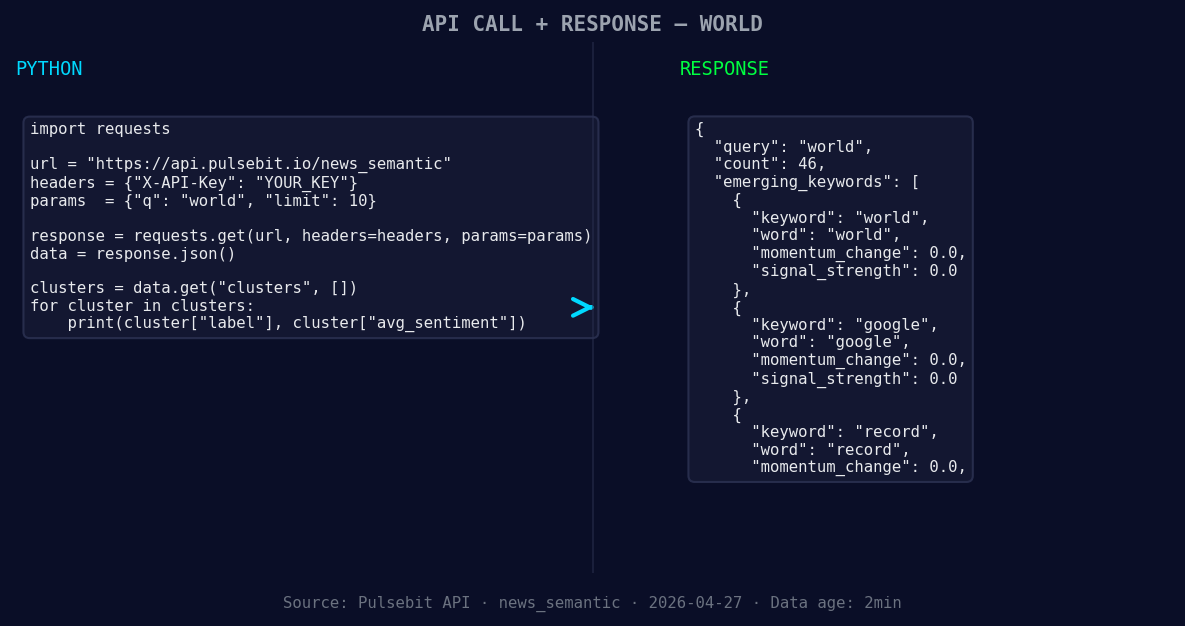
*Left: Python GET /news_semantic call for 'world'. Right: returned JSON response structure (clusters: 3). Source: Pulsebit /news_semantic.*
# Make the API call
response = requests.get(url, params=params)
data = response.json()
print(data)
Next, we’ll analyze the narrative surrounding our anomaly. We can run the cluster reason string through the sentiment endpoint to score its framing. Here's how to do that:
# Example input for the sentiment analysis
cluster_reason = "Clustered by shared themes: uniting, force, 2026, world, cup."

# POST request to analyze the cluster reason
sentiment_analysis_url = "https://api.pulsebit.com/v1/sentiment"
payload = {
    "input": cluster_reason
}

# Make the POST request
response = requests.post(sentiment_analysis_url, json=payload)
sentiment_data = response.json()
print(sentiment_data)
With these two parts, we can effectively capture not just the data, but also the underlying sentiment that drives the narratives.
Now, let's talk about three specific builds based on this momentum spike.
Signal Strength Alert: Set a threshold where you receive an alert if momentum exceeds +0.300 for any topic. This can be implemented with the existing API's momentum data.
Geo-Filtered Insights: Use the geographic origin filter to isolate sentiment trends in specific regions. For instance, focus on the "world" topic but filter for articles coming out of the U.S. or U.K. This allows you to adapt your strategies based on localized sentiment shifts.

Geographic detection output for world. India leads with 37 articles and sentiment +0.18. Source: Pulsebit /news_recent geographic fields.
- Meta-Sentiment Loop: Create a system that scores cluster reason strings for recurring themes. For example, you can set a pattern to trigger if themes like "uniting," "force," and "world" appear together with rising sentiment scores. This can help you identify emerging narratives and potential market impacts before they escalate.
If you're eager to dive deeper into this, head over to pulsebit.lojenterprise.com/docs. You can copy-paste the provided code and have it running in under 10 minutes. Catching world sentiment leads is not just about speed; it's about being precise in your analysis. Don’t let your pipeline lag behind.


Top comments (0)