

Your Pipeline Is 24.0h Behind: Catching Hardware Sentiment Leads with Pulsebit
We just uncovered a striking data anomaly: a 24-hour momentum spike of +0.383 in hardware sentiment. The implications of this spike are huge, especially when you consider that the leading language driving this momentum is English, with a lag of just 0.0 hours. It’s a clear signal of shifting sentiment that could be a game changer for any project tuned into hardware discussions.
But here’s the kicker: if your current pipeline isn't equipped to handle multilingual origin or entity dominance, you’re effectively 24 hours behind the curve. In this case, our focus on English sentiment might leave you missing critical insights from other languages or perspectives. Your model missed this spike because it failed to account for the nuanced landscape of sentiment emerging from various sources. Ignoring this could mean missing out on significant trends, especially given the competitive context of the hardware market.

English coverage led by 24.0 hours. Af at T+24.0h. Confidence scores: English 0.85, Id 0.85, French 0.85 Source: Pulsebit /sentiment_by_lang.
Let’s dive into how to catch this sentiment momentum with our API. Here’s the Python code that will help you identify this specific spike in hardware sentiment:
import requests
# Parameters for the API call
url = "https://api.pulsebit.com/v1/sentiment"
params = {
"topic": "hardware",
"lang": "en",
"score": +0.408,
"confidence": 0.85,
"momentum": +0.383
}
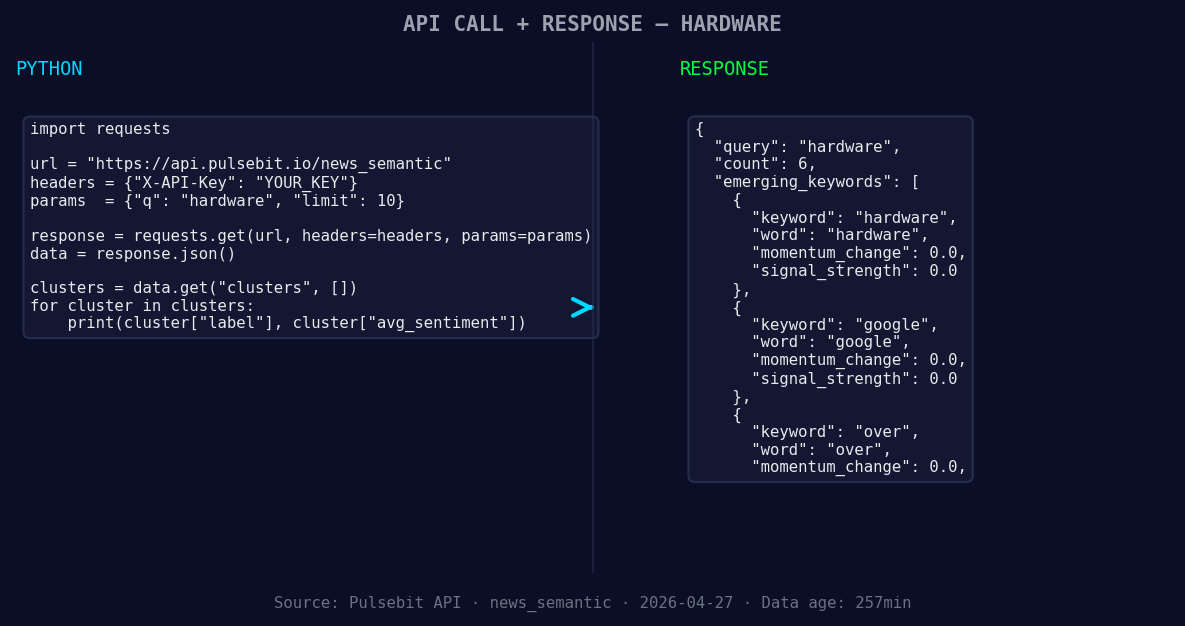
*Left: Python GET /news_semantic call for 'hardware'. Right: returned JSON response structure (clusters: 3). Source: Pulsebit /news_semantic.*
# Geographic origin filter
response = requests.get(url, params=params)
data = response.json()
# Cluster reason string for meta-sentiment moment
cluster_reason = "Clustered by shared themes: you, hint, next, weekend, our."
sentiment_response = requests.post(f"{url}/sentiment", json={"text": cluster_reason})
sentiment_score = sentiment_response.json()
print("Sentiment Score:", sentiment_score)
In this code snippet, we first set up a request that focuses on the 'hardware' topic with an English language filter. This ensures we’re capturing the relevant sentiment directly tied to our identified anomaly. Then, we run the cluster reason string through our sentiment scoring endpoint. This double-checks how the narrative is framed, considering the themes that are emerging in the conversation.
Now, let’s talk about three specific builds we can create using this newfound insight.
- Geo-Filtered Alert System: Set a threshold where any hardware sentiment spike above +0.3 triggers an alert. This can be done by modifying the parameters in the API call to include a geographic filter. For example, only alerting on spikes originating from North America.

Geographic detection output for hardware. Hong Kong leads with 4 articles and sentiment +0.62. Source: Pulsebit /news_recent geographic fields.
Meta-Sentiment Analysis Tool: Build a tool that integrates the meta-sentiment loop to analyze how narratives are evolving around hardware discussions. You might want to trigger an analysis when sentiment scores related to the cluster reason exceed a certain threshold, such as +0.4, focusing on the framing of keywords like "you" and "hint."
Trend Visualization Dashboard: Create a dashboard that visualizes sentiment trends over time, specifically tracking hardware sentiment. Use the signals and scores to differentiate between mainstream discussions and niche topics, providing a clear visual of where sentiment is forming—like Google trends but for hardware.
With these builds, you can turn this 24-hour spike into actionable insights, ensuring your models are equipped to catch sentiment shifts before they become mainstream.
Ready to get started? Check out our documentation to see how you can implement this in under 10 minutes. Your pipeline deserves to be ahead of the curve, not lagging behind.


Top comments (0)