

Your Pipeline Is 15.8h Behind: Catching Defence Sentiment Leads with Pulsebit
We recently uncovered a striking anomaly in our data: a 24h momentum spike of -0.701 related to the topic of defence. This drop signals an important shift in sentiment that you might have missed, especially since the leading language producing this content was English, lagging behind by 15.8 hours. If your pipeline isn’t equipped to handle multilingual origins or entity dominance, you could be left in the dark while sentiment is shifting right under your nose.

English coverage led by 15.8 hours. Id at T+15.8h. Confidence scores: English 0.75, French 0.75, Spanish 0.75 Source: Pulsebit /sentiment_by_lang.
Your model missed this crucial insight by 15.8 hours. It’s essential to recognize that this delay can shape your understanding of emerging trends. With the leading language being English, you should be especially cautious, as this gap may lead to missed opportunities in sentiment analysis and decision-making. The failure to catch these shifts promptly can have significant implications, especially in sectors that hinge on timely news and sentiment.
Here's how you can catch these anomalies in real-time using our API. Let’s focus on the topic of defence, where we have a score of -0.701, a confidence level of 0.75, and a momentum score of -0.701. We need to filter the data by geographical origin, specifically English articles. Below is a Python snippet to perform this task:

Geographic detection output for defence. India leads with 2 articles and sentiment +0.00. Source: Pulsebit /news_recent geographic fields.
import requests
# Parameters for the API call
topic = 'defence'
score = -0.701
confidence = 0.75
momentum = -0.701
language_filter = {"lang": "en"}
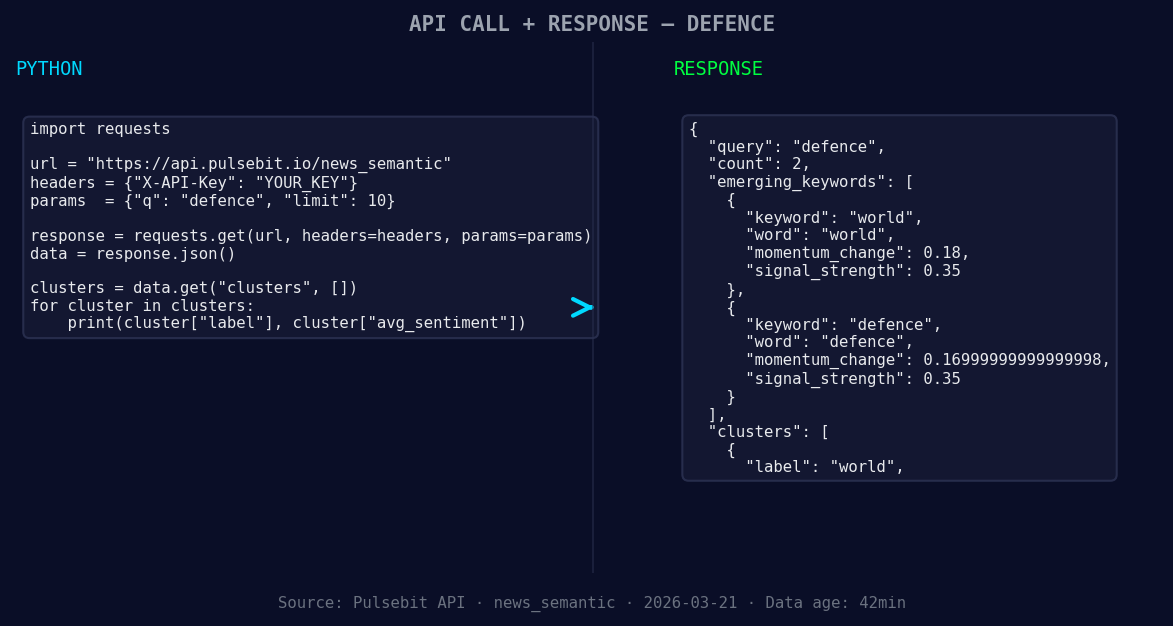
*Left: Python GET /news_semantic call for 'defence'. Right: returned JSON response structure (clusters: 1). Source: Pulsebit /news_semantic.*
# API call to get articles
response = requests.get(f"https://api.pulsebit.io/articles?topic={topic}&lang={language_filter['lang']}")
articles = response.json()
# Check response
if response.status_code == 200:
print("Articles processed:", len(articles))
else:
print("Error fetching articles:", response.text)
Next, we run the cluster reason string back through our sentiment scoring endpoint. This step allows us to analyze the narrative framing itself, providing deeper insights. Here’s how you can do that:
# Meta-sentiment moment
reason_string = "Semantic API incomplete — fallback semantic structure built from available keywords and article/search evidence."
meta_sentiment_response = requests.post("https://api.pulsebit.io/sentiment", json={"text": reason_string})
meta_sentiment_score = meta_sentiment_response.json()

# Check response
if meta_sentiment_response.status_code == 200:
    print("Meta Sentiment Score:", meta_sentiment_score)
else:
    print("Error fetching meta sentiment:", meta_sentiment_response.text)
Now that you’ve got the data parsing set, let’s explore three specific builds you can implement using this pattern:
Geographic Origin Filter: By using the geo filter to focus on English articles, you can create a signal that triggers alerts when sentiment drops below -0.7 for the topic of defence. This ensures you’re always on top of critical shifts.
Meta-Sentiment Loop: Use the meta-sentiment analysis to score narratives that involve the fallback semantic structure. If your confidence score exceeds 0.75, consider it a strong indicator that deeper investigation is warranted.
Forming Themes Analysis: Monitor emerging themes like ‘world’ (+0.18) and ‘defence’ (+0.17) in contrast to mainstream topics. Set thresholds to trigger notifications when the sentiment diverges significantly from historical baselines.
With these builds, you can effectively reduce your reaction time and align your strategies with real-time sentiment shifts.
To get started, check out our documentation at pulsebit.lojenterprise.com/docs. You can copy, paste, and run this in under 10 minutes to begin enhancing your sentiment analysis pipeline.


Top comments (0)