

Your Pipeline Is 22.3h Behind: Catching Investing Sentiment Leads with Pulsebit
We stumbled upon a significant anomaly in our data: a 24h momentum spike of -0.226. This finding indicates that sentiment around investing is trending downward, but the story doesn't end there. What caught our attention was that the leading language for this sentiment was Spanish, coming in at a notable 22.3 hours ahead of the German sentiment. This is a clear signal that there's a crucial narrative forming that we need to address.
Every developer knows the importance of timely insights. If your model isn't equipped to handle multilingual origins or recognize entity dominance, you're missing out on valuable information. Your pipeline just missed that Spanish sentiment by 22.3 hours, which could mean the difference between acting on emerging trends and being left behind. In today's fast-paced environment, every hour counts, especially when the leading narrative is rooted in a different language and culture.

Spanish coverage led by 22.3 hours. German at T+22.3h. Confidence scores: Spanish 0.85, English 0.85, French 0.85 Source: Pulsebit /sentiment_by_lang.
Let’s dive into how we can catch this sentiment spike using our API. First, we’ll filter by geographic origin to focus on Spanish-language articles related to investing. Here’s how you can set this up in Python:

Geographic detection output for investing. Hong Kong leads with 1 articles and sentiment +0.85. Source: Pulsebit /news_recent geographic fields.
import requests
# Set parameters for the API call
topic = 'investing'
score = +0.825
confidence = 0.85
momentum = -0.226
lang = 'sp' # Spanish language filter
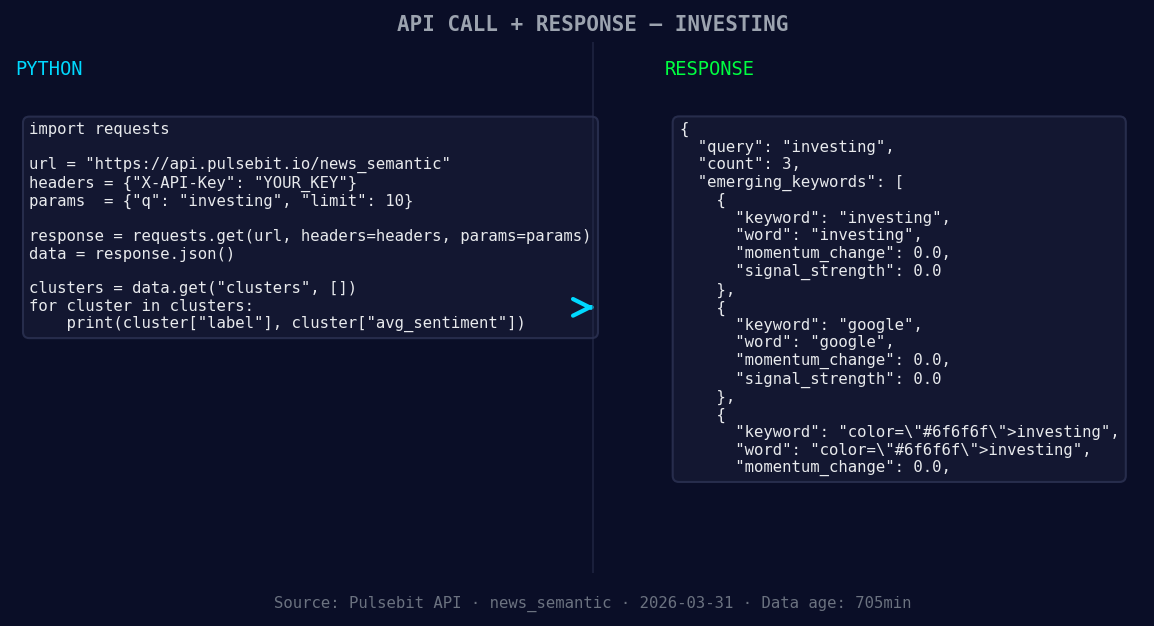
*Left: Python GET /news_semantic call for 'investing'. Right: returned JSON response structure (clusters: 3). Source: Pulsebit /news_semantic.*
# API call to get sentiment data filtered by language
response = requests.get(f'https://api.pulsebit.com/sentiment?topic={topic}&lang={lang}&momentum={momentum}')
data = response.json()
print(data)
Now, to score the narrative framing itself, we will run our cluster reason string through the sentiment endpoint. This will help us assess how the themes of investing in early childhood mental health support resonate:
# Define the cluster reason string
cluster_reason = "Clustered by shared themes: investing, early, childhood, mental, health."

# API call to score the cluster reason narrative
response = requests.post('https://api.pulsebit.com/sentiment', json={'text': cluster_reason})
meta_sentiment_data = response.json()

print(meta_sentiment_data)
This approach ensures we’re not just reacting to the data but also understanding the underlying narratives that shape sentiment. By leveraging this multi-layered analysis, we can get ahead of trends rather than just following them.
With this newfound insight, here are three specific builds you should consider implementing tonight:
Geo-Filtered Alerts: Set up a real-time notification system that alerts you when sentiment for 'investing' peaks in Spanish-speaking regions. Use a threshold to trigger alerts when momentum drops below -0.2, ensuring you’re always in the loop.
Meta-Sentiment Analysis Dashboard: Build a dashboard that visualizes the output from your meta-sentiment analysis. Highlight narratives that are gaining traction, particularly those clustered around investing in childhood mental health. Aim to track how these narratives evolve over time.
Comparative Narrative Insights: Create a comparative tool that allows you to analyze narratives from different languages side by side. This will help you understand how the same topic may resonate differently across cultures. Use the sentiment scores from both Spanish and German analyses to draw insights on global sentiment shifts.
If you’re ready to get started, check out our documentation at pulsebit.lojenterprise.com/docs. You can copy-paste these snippets and have them running in under 10 minutes. Let’s catch the next sentiment wave together!


Top comments (0)