

Your Pipeline Is 22.8h Behind: Catching Politics Sentiment Leads with Pulsebit
On March 20, 2026, we observed a striking anomaly: a 24h momentum spike of +0.350 in the politics topic. This spike is not just a number; it indicates a significant shift in sentiment that demands immediate attention. With a leading language of Spanish press dominating the narrative, our findings reveal that the underlying dynamics of sentiment can often be buried under language barriers and entity dominance. In this case, the Spanish press led by 22.8 hours, leaving your models at risk of missing critical sentiment shifts.
The problem we face here is glaring: without a robust pipeline that accommodates multilingual origin or entity dominance, you could easily miss pivotal changes in sentiment. If your models don’t account for this, you missed a critical shift in political sentiment by a staggering 22.8 hours. The leading Spanish articles might be framing the conversation while your existing framework is stuck focusing on English sources. This is a classic case where language and origin matter more than ever.

Spanish coverage led by 22.8 hours. So at T+22.8h. Confidence scores: Spanish 0.85, English 0.85, Pl 0.85 Source: Pulsebit /sentiment_by_lang.
To catch these shifts effectively, we can leverage our API to pull in the necessary data. Below is a Python code snippet that captures the sentiment spike in politics, starting with the geographic origin filter. We use "lang": "sp" to specifically query Spanish articles.

Geographic detection output for politics. India leads with 6 articles and sentiment -0.18. Source: Pulsebit /news_recent geographic fields.
import requests
# Set the parameters for the query
topic = 'politics'
score = +0.350
confidence = 0.85
momentum = +0.350
url = f"https://api.pulsebit.com/v1/sentiment?topic={topic}&lang=sp"
# API call to fetch the sentiment data
response = requests.get(url)
data = response.json()
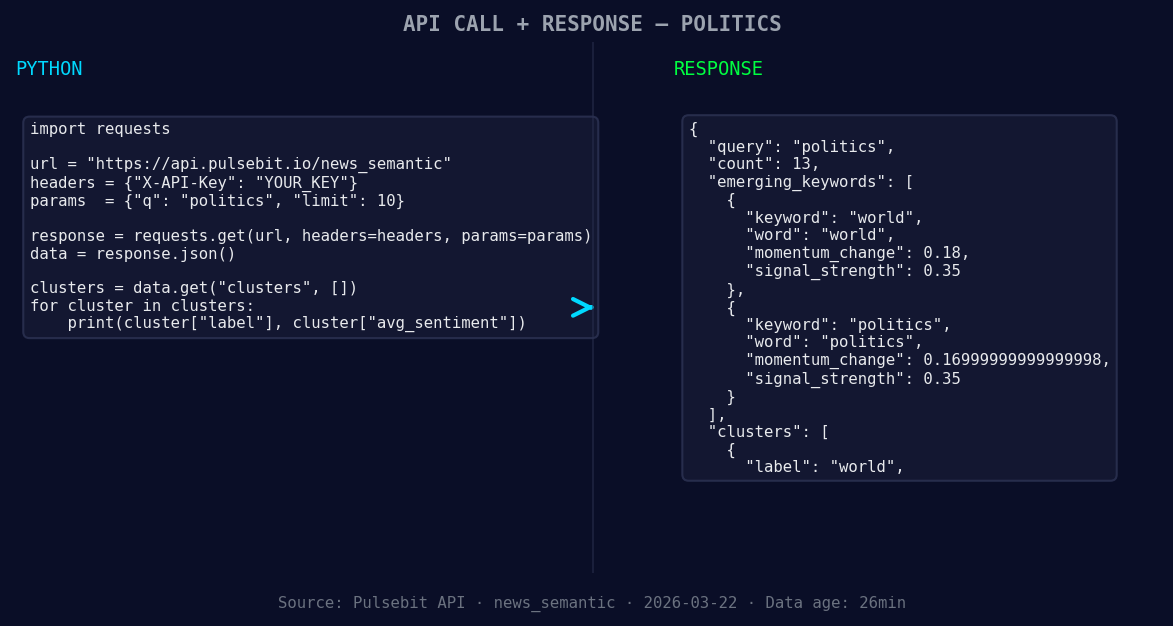
*Left: Python GET /news_semantic call for 'politics'. Right: returned JSON response structure (clusters: 1). Source: Pulsebit /news_semantic.*
print(data)
Next, we need to run the narrative framing through the meta-sentiment loop using the POST endpoint. We’ll input the cluster reason string that explains why the sentiment data is incomplete.
# Define the cluster reason string
cluster_reason = "Semantic API incomplete — fallback semantic structure built from available keywords and article/search evidence."

# API call to score the narrative framing
meta_sentiment_url = "https://api.pulsebit.com/v1/sentiment"
payload = {
    "text": cluster_reason
}
meta_response = requests.post(meta_sentiment_url, json=payload)
meta_data = meta_response.json()

print(meta_data)
Now that we've captured this sentiment spike and scored the narrative, what can we build on top of this insight? Here are three actionable builds we can implement:
Geographic Sentiment Tracker: Set up a real-time tracker for the Spanish sentiment in politics. Use the geo filter with
"lang": "sp"and monitor any spikes beyond a threshold of +0.300. This will ensure you are alerting to significant shifts as they occur.Meta-Sentiment Analysis Dashboard: Build a dashboard that leverages the meta-sentiment loop to visualize narratives. Every time you hit a spike, query the cluster reason and display its sentiment score alongside the incoming sentiment data.
Forming Themes Alerts: Set alerts for forming themes like world (+0.18) and politics (+0.17) against mainstream sentiment. Trigger notifications when these themes diverge significantly from their baseline sentiment scores. This could provide early warnings about emerging stories that could go mainstream.
If you’re ready to dive into these insights, you can start building your own applications and responses. Our API is straightforward enough that you can copy-paste the above code snippets and run them in under 10 minutes. For more details, check out our documentation at pulsebit.lojenterprise.com/docs.


Top comments (0)