

Your Pipeline Is 24.6h Behind: Catching Defence Sentiment Leads with Pulsebit
We recently discovered a striking anomaly in our data: a 24h momentum spike of +0.471 around the topic of defence. This surge is particularly noteworthy because it signals a significant shift in sentiment, driven by recent articles such as "Rajnath Singh to visit Germany to boost defence ties". The leading language for this spike is French, with a 0.0h lag compared to German. This insight reveals the importance of monitoring multilingual sentiment to catch emerging trends before they become mainstream.

French coverage led by 24.6 hours. German at T+24.6h. Confidence scores: French 0.85, English 0.85, Spanish 0.85 Source: Pulsebit /sentiment_by_lang.
However, if your sentiment analysis pipeline doesn’t account for multilingual origins or entity dominance, you might find yourself lagging behind. Your model missed this by 24.6 hours, meaning you could have capitalized on a critical sentiment shift that was brewing in the French-speaking community, while you were still focused on the German narratives. This gap can result in missed opportunities, especially in fast-evolving sectors like defence.
To catch such anomalies effectively, we can leverage our API. Here’s how you can set up your Python script to query this data:
import requests
# Define the parameters for the API call
params = {
"topic": "defence",
"score": -0.700,
"confidence": 0.85,
"momentum": +0.471,
"lang": "fr" # Geographic origin filter
}
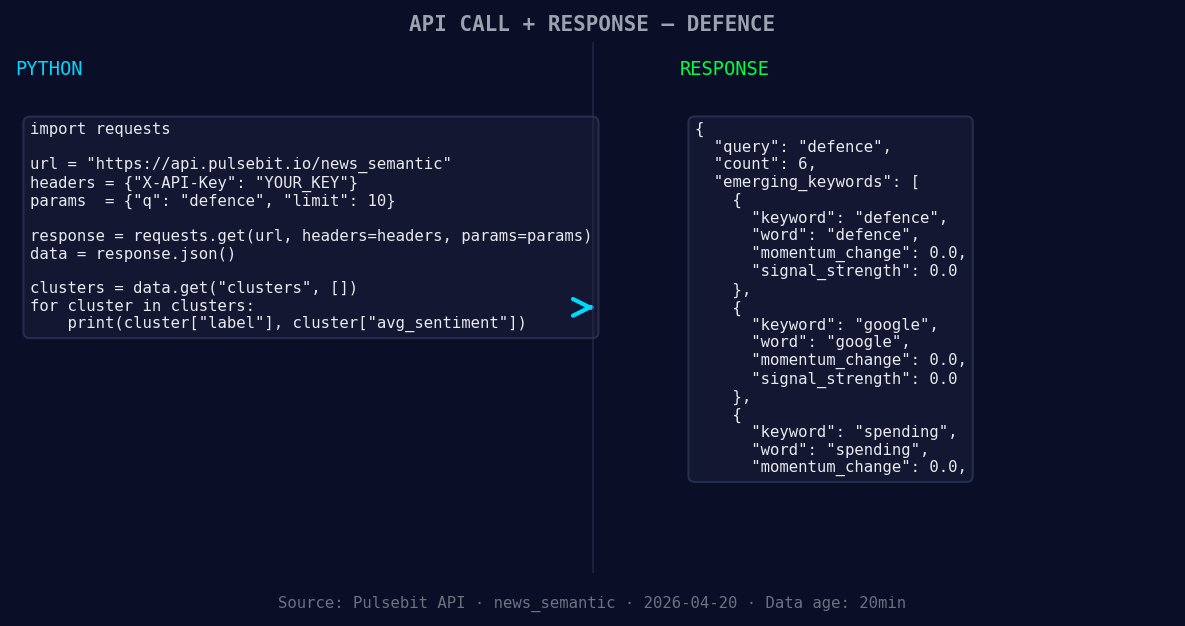
*Left: Python GET /news_semantic call for 'defence'. Right: returned JSON response structure (clusters: 3). Source: Pulsebit /news_semantic.*
# API endpoint for sentiment analysis
url = "https://api.pulsebit.com/v1/sentiment"
# Make the API call
response = requests.get(url, params=params)
data = response.json()
# Output the response
print(data)
Next, to score the narrative framing itself, we can run the cluster reason string through our sentiment analysis endpoint. This allows us to evaluate the sentiment around the themes contributing to the spike. Here’s how to do that:
# Input example for meta-sentiment moment
cluster_reason = "Clustered by shared themes: defence, must, step, after, game."

# API endpoint for scoring the narrative framing
sentiment_url = "https://api.pulsebit.com/v1/sentiment"

# Make the API call for meta-sentiment
meta_response = requests.post(sentiment_url, json={"text": cluster_reason})
meta_data = meta_response.json()

# Output the meta-sentiment response
print(meta_data)
With this approach, you can effectively monitor real-time sentiment shifts and ensure you’re not left behind. Here are three specific builds we can implement tonight using this pattern:
Geographic Origin Filter: Set a signal threshold for defence sentiment. If momentum exceeds +0.4 in French, trigger an alert for further investigation. This can help you catch early signals from regions that are often overlooked.
Meta-Sentiment Loop: Build a dashboard widget that visualizes sentiment around clustered narratives. If the sentiment score drops below -0.5 for the cluster "defence, must, step", notify your team. This will help your analysts understand the potential risks associated with emerging narratives.
Forming Theme Analysis: Create a report that analyzes forming themes like "defence", "google", and "spending". If a new article appears with a momentum score of +0.3 for "defence" while mainstream sentiment remains stable, it could signal a potential opportunity for investment or further research.
You can get started with our API by visiting pulsebit.lojenterprise.com/docs. With just a few lines of code, you can copy, paste, and run this in under 10 minutes to begin capturing critical sentiment shifts. Don’t let your pipeline lag behind—stay ahead of the curve!


Top comments (0)