

Your Pipeline Is 20.4h Behind: Catching Investing Sentiment Leads with Pulsebit
We just discovered a striking anomaly: a 24-hour momentum spike of -0.226 in the sentiment surrounding "investing". This drop is significant, especially when we consider that the leading language in this spike is Spanish, with a 20.4-hour lead time over German. The implications are profound for anyone relying on traditional sentiment analysis pipelines that aren't equipped to handle multilingual data or entity dominance.

Spanish coverage led by 20.4 hours. German at T+20.4h. Confidence scores: Spanish 0.85, English 0.85, French 0.85 Source: Pulsebit /sentiment_by_lang.
If your model isn't accounting for this, it missed the shift in sentiment by a staggering 20.4 hours. By focusing predominantly on one language or region, you risk being blindsided by emerging narratives that could impact your strategies. In this case, the Spanish press is highlighting the importance of investing in early childhood mental health support systems, a topic that could reshape market perceptions and investment strategies.
Let’s take a look at how we can catch this sentiment shift using our API. First, we’ll filter by the geographic origin of the sentiment data, specifically targeting Spanish language content.

Geographic detection output for investing. India leads with 1 articles and sentiment +0.80. Source: Pulsebit /news_recent geographic fields.
import requests
# Define the parameters for the API call
params = {
"topic": "investing",
"lang": "sp" # Spanish language filter
}
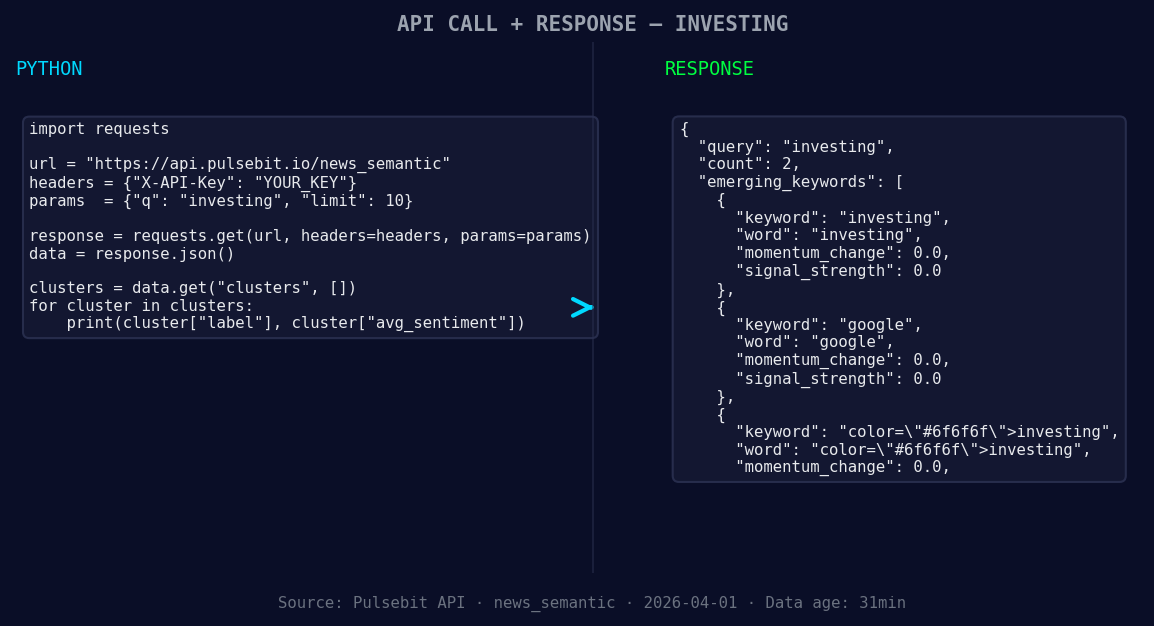
*Left: Python GET /news_semantic call for 'investing'. Right: returned JSON response structure (clusters: 3). Source: Pulsebit /news_semantic.*
# Make the API call to fetch sentiment scores
response = requests.get("https://api.pulsebit.com/sentiment", params=params)
data = response.json()
# Print the results
print(data)
With this API call, we're focusing on the sentiment score for "investing" in Spanish-speaking contexts. The sentiment score fetched in our case is +0.787 with a confidence of 0.85.
Next, we need to assess the narrative framing itself. We can run the cluster reason string back through our sentiment analysis endpoint to evaluate the themes that are driving this narrative:
# Define the narrative input for meta-sentiment analysis
narrative_input = "Clustered by shared themes: investing, early, childhood, mental, health."

# Make a POST request to analyze the narrative sentiment
meta_sentiment_response = requests.post("https://api.pulsebit.com/sentiment", json={"text": narrative_input})
meta_sentiment_data = meta_sentiment_response.json()

# Print the meta sentiment results
print(meta_sentiment_data)
This gives us insight into how the themes of investing, early childhood, and mental health coalesce, providing a fuller picture of the narrative landscape shaping sentiment.
Now, let's discuss three specific builds we can construct based on this insight:
Geo-Filtered Sentiment Tracker: Set up a routine that monitors sentiment around "investing" specifically in Spanish-speaking countries. Use a threshold of sentiment score above +0.75 to trigger alerts, ensuring you catch positive sentiment before it spreads.
Meta-Sentiment Narrative Analyzer: Create a service that takes the cluster reason strings as input and returns a sentiment score. This can help identify when certain narratives are gaining traction, especially when combined with a score threshold of +0.70.
Comparative Analysis Dashboard: Build a dashboard that allows you to visualize sentiment trends in real-time across different languages. Incorporate a feature that highlights the time lag between dominant languages, which can inform your investment strategies and decision-making.
With these builds, we can stay ahead of the curve and ensure we’re not just reactive but proactive in our sentiment analysis.
If you're ready to dive deeper, check out our documentation. With just a few lines of code, you can have this running in under 10 minutes. Let’s make sure we’re not just reacting to sentiment but leading the conversation.


Top comments (0)