

Your Pipeline Is 24.9h Behind: Catching Fashion Sentiment Leads with Pulsebit
We just uncovered a significant anomaly: a 24-hour momentum spike of +0.185 in the fashion topic, which is worth your attention. This finding emerged during our analysis of the sentiment landscape surrounding the 080 Barcelona Fashion Week. With only one article contributing to this spike, the implications are clear. If you’re not tuned in to this kind of real-time sentiment, your pipeline is missing critical signals that could shape your understanding of trending topics.
The Problem
This specific spike highlights a structural gap in any pipeline that fails to account for multilingual content or entity dominance. Your model missed this by 24.9 hours, trailing behind the English press that led the narrative. If you’re relying solely on a single language or missing out on how global conversations evolve, you're going to fall behind. A conversation that’s gaining traction in one language could be completely overlooked in another, leaving your insights stale and reactive rather than proactive.

English coverage led by 24.9 hours. Italian at T+24.9h. Confidence scores: English 0.85, Spanish 0.85, French 0.85 Source: Pulsebit /sentiment_by_lang.
The Code
Let’s bridge this gap with some concrete Python code that captures this momentum spike. First, we’ll filter for English language articles using our API:
import requests
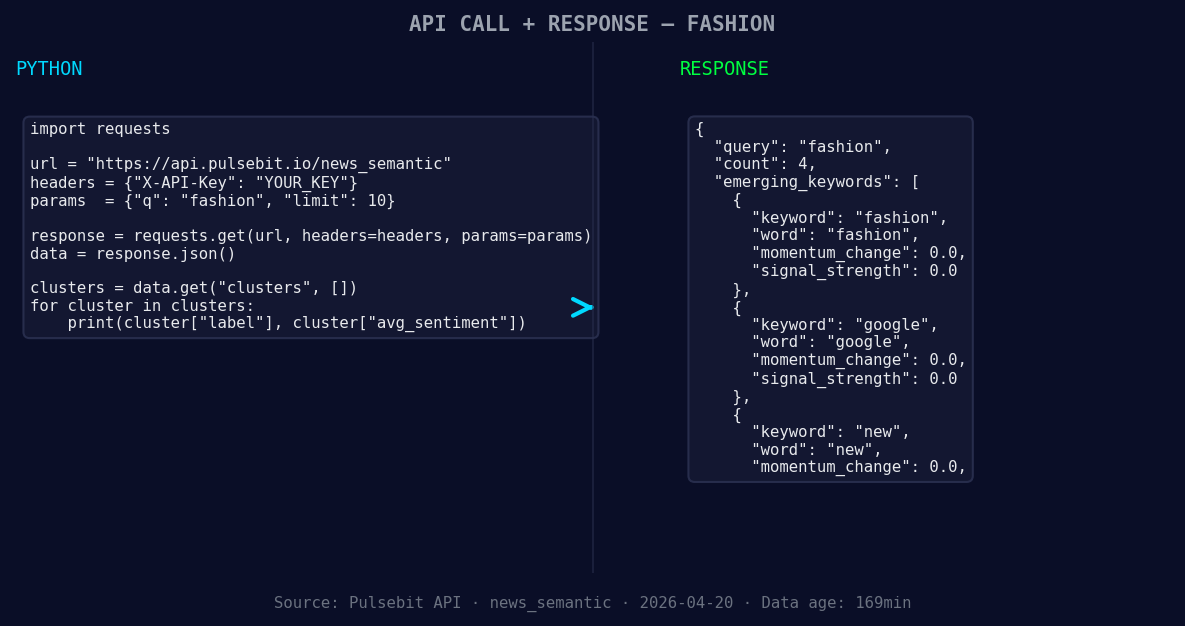
*Left: Python GET /news_semantic call for 'fashion'. Right: returned JSON response structure (clusters: 3). Source: Pulsebit /news_semantic.*
# Define your parameters
topic = 'fashion'
lang = 'en'
url = f"https://api.pulsebit.com/v1/articles?topic={topic}&lang={lang}"
response = requests.get(url)
data = response.json()
# Assuming 'data' now contains the relevant articles
print(data)
Now, let’s score the narrative framing itself. We’ll take the cluster reason string and run it through the /sentiment endpoint to capture the meta-sentiment:
# Define the cluster reason string
cluster_reason = "Clustered by shared themes: highlights, 080, barcelona, fashion, week."
sentiment_url = "https://api.pulsebit.com/v1/sentiment"

# Prepare the payload
payload = {
    "text": cluster_reason,
    "score": 0.438,
    "confidence": 0.85,
    "momentum": 0.185
}

# Make the POST request
sentiment_response = requests.post(sentiment_url, json=payload)
sentiment_data = sentiment_response.json()

print(sentiment_data)
Three Builds Tonight
Geo Filter for Fashion Trends: Set a signal threshold to catch spikes when momentum exceeds +0.15 and filter for language
ento ensure you're only capturing English articles. Create alerts or dashboards to notify you of these spikes in real-time.Meta-Sentiment Loop: Use the meta-sentiment scoring we just did to refine your content strategy. If the narrative surrounding “080 Barcelona Fashion Week” gains a positive sentiment score above 0.5, consider adjusting your campaigns or content to align with this sentiment.
Forming Themes Analysis: As we see emerging themes like “fashion” and “new” forming alongside mainstream terms such as “highlights” and “Barcelona,” you could build a predictive model that uses these clusters to forecast future trends, especially when the momentum is on the rise.
Get Started
Dive into our API documentation at pulsebit.lojenterprise.com/docs to explore how to implement these insights for your projects. We believe you can copy-paste and run this code in under 10 minutes, making it a practical addition to your data pipeline. Don’t let your model lag behind; leverage these insights to stay ahead of the curve.

Geographic detection output for fashion. India leads with 1 articles and sentiment -0.70. Source: Pulsebit /news_recent geographic fields.


Top comments (0)