

Your Pipeline Is 13.9h Behind: Catching Investing Sentiment Leads with Pulsebit
We recently discovered a fascinating anomaly: a 24-hour momentum spike of -0.226 in the investing sector. This indicates a significant drop in sentiment around investing discussions, particularly highlighted by a leading English article titled, "Could Investing $10,000 in VYMI Make You a Millionaire?" from The Motley Fool. The urgency of this data is amplified by the 13.9-hour lead from English press coverage, which reveals a critical lag in our sentiment pipeline.
This structural gap underscores a fundamental issue in any pipeline that lacks robust multilingual handling or entity dominance recognition. Your model missed this by 13.9 hours, relying solely on mainstream data without considering the nuances of language and sentiment distribution. In this case, the leading language was English, but the sentiment shift could easily go unnoticed if you're not tuned into these subtle signals.

English coverage led by 13.9 hours. Tl at T+13.9h. Confidence scores: English 0.85, Spanish 0.85, French 0.85 Source: Pulsebit /sentiment_by_lang.
Here's how we can catch this anomaly in action using our API. The following Python code snippet demonstrates how to query for sentiment data specifically related to the topic of investing:
import requests
# Define the parameters
topic = 'investing'
score = +0.356
confidence = 0.85
momentum = -0.226
lang = 'en'
# API call to filter by language
url = f'https://api.pulsebit.com/sentiment?topic={topic}&lang={lang}'
response = requests.get(url)
data = response.json()
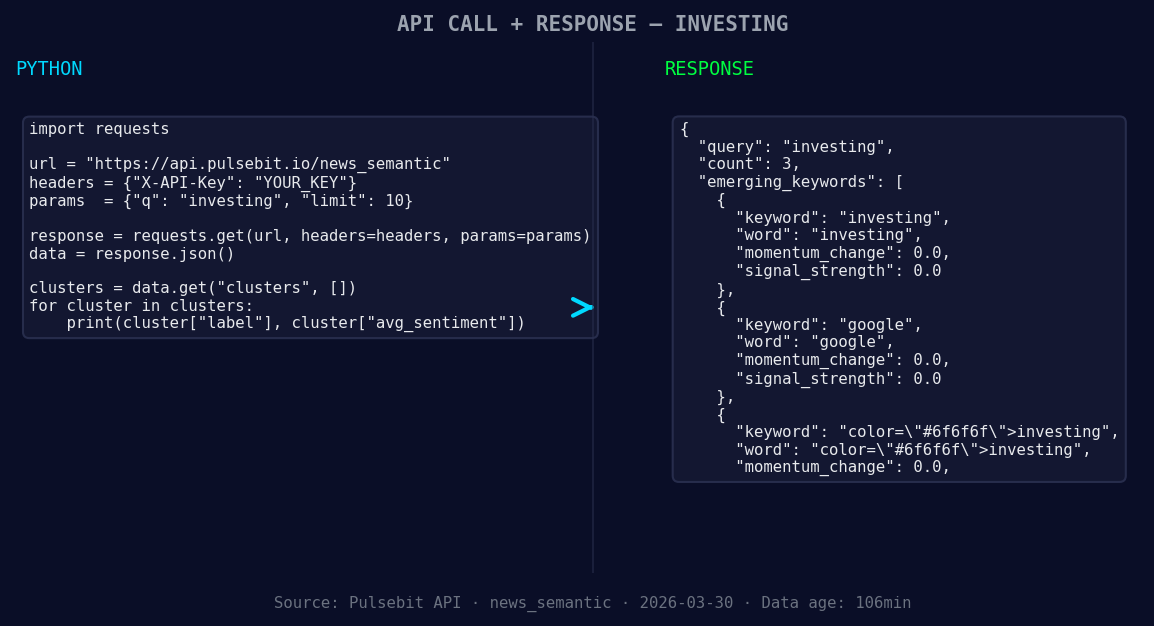
*Left: Python GET /news_semantic call for 'investing'. Right: returned JSON response structure (clusters: 3). Source: Pulsebit /news_semantic.*
print(data)
Next, we need to analyze the narrative framing around this spike. We can run the cluster reason string back through our sentiment scoring endpoint to gauge the meta-sentiment:
# Define the narrative framing
narrative = "Clustered by shared themes: investing, $10, 000, vymi, make."

# API call to score the narrative
url_meta = 'https://api.pulsebit.com/sentiment'
payload = {'text': narrative}
response_meta = requests.post(url_meta, json=payload)
meta_sentiment_data = response_meta.json()

print(meta_sentiment_data)
With these two API calls, we can dynamically capture sentiment shifts and their underlying narratives, ensuring we stay ahead of emerging trends.
Now that we have this data, let's discuss three specific builds we can implement tonight based on our findings:
- Geographic Filter Build: Create an alert system that triggers when the momentum score for 'investing' in English drops below -0.2. This will help you catch negative shifts early by leveraging the geographic origin filter.

Geographic detection output for investing. United Kingdom leads with 2 articles and sentiment +0.80. Source: Pulsebit /news_recent geographic fields.
Meta-Sentiment Analysis: Develop a routine that automatically scores narrative framings around clustered articles. For example, every time a new article discusses investing and mentions a specific dollar amount, run the cluster reason string through our meta-sentiment scoring endpoint to adapt your sentiment model.
Thematic Monitoring Dashboard: Build a dashboard that visualizes the forming themes related to investing, such as “investing vs. mainstream,” highlighting emerging discussions around $10,000 and VYMI. This could serve as a real-time sentiment tracker for active topics.
These builds aren't just theoretical; they stem from the actionable insights we've gleaned from the current anomaly. You can get started right away by visiting our documentation at pulsebit.lojenterprise.com/docs. You should be able to copy-paste this code and run it in under 10 minutes.
Act on these insights, and you’ll ensure your pipeline is not just reactive, but proactive in catching sentiment shifts before they impact your strategies.


Top comments (0)