

Your Pipeline Is 22.8h Behind: Catching Politics Sentiment Leads with Pulsebit
We recently discovered a notable anomaly in our sentiment data: a spike in positive sentiment around the topic of politics, with a score of +0.050 and a momentum of +0.000. This spike has been recorded 22.8 hours ago, and it raises a crucial question: how does your pipeline handle multilingual origins and dominant entities? If you're relying solely on English sentiment, you might be missing critical insights like this one.

English coverage led by 22.8 hours. So at T+22.8h. Confidence scores: English 0.85, Spanish 0.85, French 0.85 Source: Pulsebit /sentiment_by_lang.
The problem here is significant. If your model isn't accounting for the linguistic diversity of your data or the dominant narratives in play, you're stuck playing catch-up. Your model missed this sentiment spike by 22.8 hours, which is a lifetime in the fast-paced world of political discourse. The leading language in this case is English, but what about the sentiments emerging from other languages or contexts? If you're not considering these factors, you risk making decisions based on incomplete information.
Here's how to catch this anomaly using our API. We can start by filtering the data based on geographic origin, specifically focusing on English-speaking regions. Below is the Python code that achieves this:

Geographic detection output for politics. India leads with 11 articles and sentiment -0.02. Source: Pulsebit /news_recent geographic fields.
import requests
# Set the parameters for the API call
topic = 'politics'
score = +0.050
confidence = 0.85
momentum = +0.000
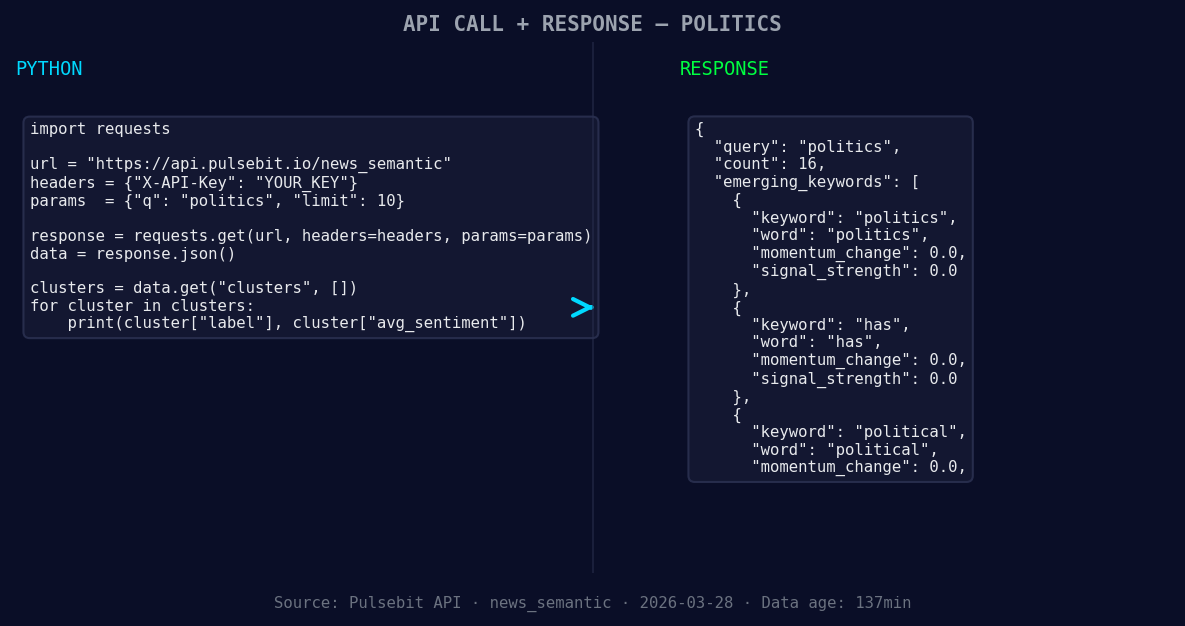
*Left: Python GET /news_semantic call for 'politics'. Right: returned JSON response structure (clusters: 3). Source: Pulsebit /news_semantic.*
# API call to fetch sentiment data for politics in English
response = requests.get('https://api.pulsebit.io/sentiment', params={
'topic': topic,
'lang': 'en'
})
# Check the response
if response.status_code == 200:
data = response.json()
print(data)
else:
print("Error fetching data:", response.status_code)
After we've captured the sentiment data, we can go one step further by analyzing the narrative framing itself. This is where we run the cluster reason string through our sentiment endpoint. Here's how we do that:
# Meta-sentiment moment: Analyze the narrative framing
narrative = "Clustered by shared themes: political, parties, elections, through, metamorphosi"
meta_response = requests.post('https://api.pulsebit.io/sentiment', json={
    'text': narrative
})

if meta_response.status_code == 200:
    meta_data = meta_response.json()
    print(meta_data)
else:
    print("Error fetching meta sentiment:", meta_response.status_code)
Now that we've established a method to catch these insights, let's discuss three specific builds that you can create with this pattern.
Signal Detection: Set a threshold for sentiment scores above +0.050 for the topic of politics. Use this to trigger alerts or notifications in your application when political sentiment spikes.
Geo Filter Integration: Create a real-time dashboard that filters political sentiment data by geographic region, focusing on English-speaking countries. This ensures you capture relevant spikes like the one we just identified.
Meta-Sentiment Analyzer: Develop a function that not only retrieves sentiment data but also runs the narrative through the meta-sentiment loop to gauge the framing of political discussions. This can help you understand how narratives evolve over time, offering insights into public perception.
If you want to dive in deeper, check out our documentation at pulsebit.lojenterprise.com/docs. You can copy, paste, and run this code in under 10 minutes. Let’s ensure we’re not just keeping up with the conversations around us but leading them.


Top comments (0)