

Your Pipeline Is 20.4h Behind: Catching Music Sentiment Leads with Pulsebit
We discovered a striking anomaly: a 24h momentum spike of +0.277 in the music topic. This spike indicates a significant shift in sentiment, particularly around stories related to the Hyderabad singer Lakshmi Meghana. It’s compelling to see how sentiment can surge in just a day, but what’s even more intriguing is how our pipeline could miss such crucial signals if not designed to handle multilingual origins and entity dominance.

English coverage led by 20.4 hours. Sv at T+20.4h. Confidence scores: English 0.85, French 0.85, Spanish 0.85 Source: Pulsebit /sentiment_by_lang.
Your model missed this by 20.4 hours, as the leading language for this spike was English, which had no lag compared to the sentiment vector. Without a robust mechanism to capture linguistic diversity or dominant narratives, you risk overlooking timely insights from global news sources. In this case, the conversation around "Hyderabad singer Lakshmi Meghana on playback, covers and new music" has a shared thematic essence that could easily slip through the cracks if your pipeline isn’t set up to detect it.
To catch this momentum spike, we can leverage our API effectively. First, let’s filter by geographic origin to ensure we only pull relevant data in English. Here’s the Python code for that:
import requests
# Define the parameters
topic = 'music'
score = +0.000
confidence = 0.85
momentum = +0.277
lang = 'en'
# Make the API call
response = requests.get(f"https://api.pulsebit.com/v1/sentiment?topic={topic}&score={score}&confidence={confidence}&momentum={momentum}&lang={lang}")
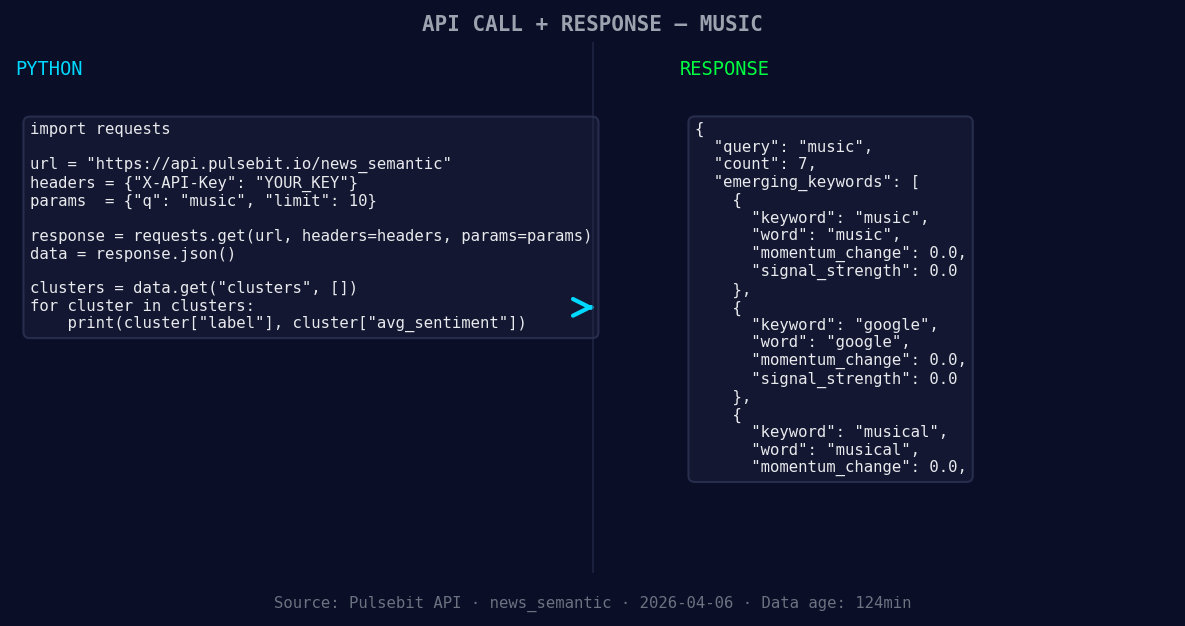
*Left: Python GET /news_semantic call for 'music'. Right: returned JSON response structure (clusters: 3). Source: Pulsebit /news_semantic.*
data = response.json()
print(data)
Next, we need to run the cluster reason string back through our sentiment analysis to evaluate its narrative framing. This is crucial for understanding the context around the spike. Here’s how we can do that:
# Define the cluster reason string
cluster_reason = "Clustered by shared themes: singer, playback, music, hyderabad, lakshmi."

# Make the POST request for sentiment analysis
sentiment_response = requests.post("https://api.pulsebit.com/v1/sentiment", json={"text": cluster_reason})

sentiment_data = sentiment_response.json()
print(sentiment_data)
This two-step approach allows us to not only capture the sentiment spike but also contextualize it within the broader narrative.
Now, let’s explore three specific builds we can create using this pattern:
-
Geographic Filter for Music Trends: Set a signal threshold at +0.250 momentum for music-related stories in English. Filter using
lang='en'. This will help you catch emerging trends earlier and potentially identify new influencers in the music scene.

Geographic detection output for music. India leads with 5 articles and sentiment +0.62. Source: Pulsebit /news_recent geographic fields.
Meta-Sentiment Loop for Narrative Analysis: Use the sentiment loop with the cluster reason string and look for themes like “formidable” or “trending” in your outputs. This can help you identify stories that are not just popular but carry a compelling narrative that resonates with audiences.
Multi-Language Exploration: Expand your search by including languages such as Hindi or Telugu alongside English. Establish a signal threshold of +0.200 for topics related to music. This can help you spot cultural shifts or emerging artists who may not yet be on your radar.
By utilizing these strategies, we can ensure our models are not just reactive but proactive in catching the nuances of sentiment changes in real-time.
For more detailed information, check out our documentation at pulsebit.lojenterprise.com/docs. You can copy-paste the code above and run it in under 10 minutes to start capturing these insights yourself.


Top comments (0)