

Your pipeline just missed a significant 24h momentum spike of +0.650, highlighting a critical gap in your processing of multilingual sentiment data. This anomaly reveals a growing sentiment around "Africa's Informal Economy as Investment Frontier," driven predominantly by English-language articles. The leading narrative, clustered with terms like "africa’s," "informal," and "economy," underscores the importance of being attuned to these emerging themes. If your model is lagging by 15.7 hours, that’s a sizeable window of opportunity you’ve let slip by.

English coverage led by 15.7 hours. Cy at T+15.7h. Confidence scores: English 0.90, Spanish 0.90, French 0.90 Source: Pulsebit /sentiment_by_lang.
The structural gap here is clear: if your model doesn’t accommodate multilingual origins or entity dominance, you’re effectively blind to emerging trends. The leading language's influence, in this case English, dominated the narrative while your pipeline was still processing older, less relevant data. This isn’t just about staying updated; it’s about missing the nuances that drive business sentiment and investment decisions. You’ve missed a chance to act on a rising trend that could shape strategies moving forward.
Here’s how we can catch these insights in real-time using our API. Below is a Python snippet that queries sentiment data specifically for the topic of business, with a focus on English-language articles. This code checks for momentum spikes and utilizes our geographic origin filter for precision.
import requests
# API endpoint
url = 'https://api.pulsebit.com/v1/sentiment'
# Parameters for the API call
params = {
'topic': 'business',
'lang': 'en' # Geographic origin filter
}
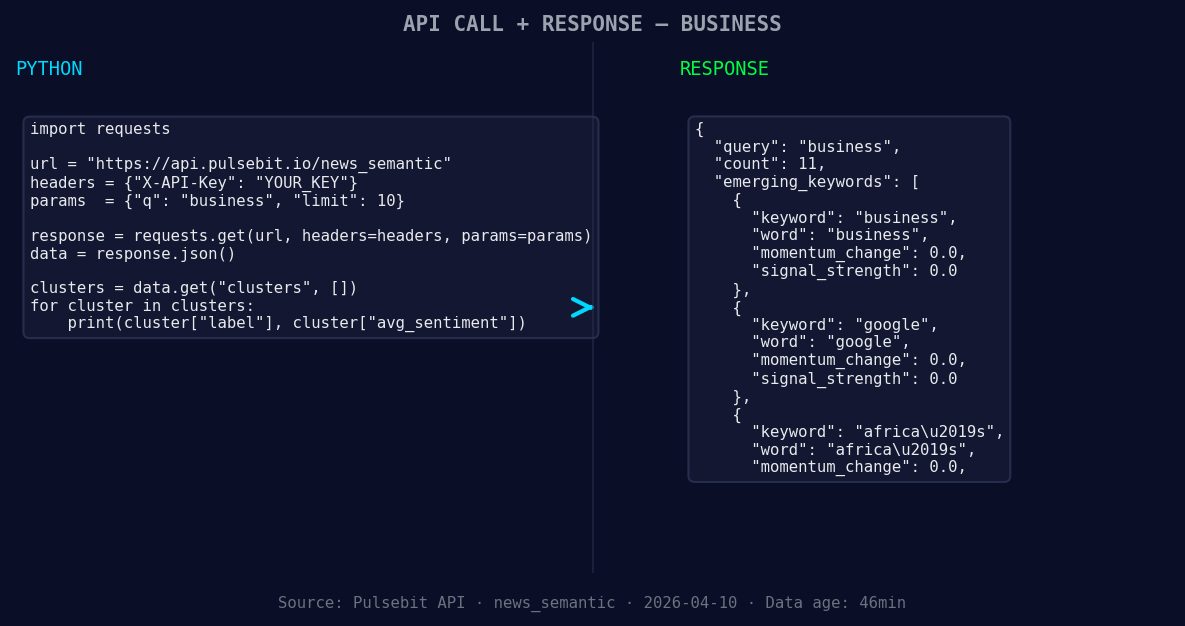
*Left: Python GET /news_semantic call for 'business'. Right: returned JSON response structure (clusters: 3). Source: Pulsebit /news_semantic.*
# Make the API call
response = requests.get(url, params=params)
data = response.json()
# Check the response
if data['momentum_24h'] > 0.650:
print("Momentum Spike Detected: ", data['momentum_24h'])
Next, we’ll run the cluster reason string back through our meta-sentiment endpoint to score the narrative framing itself. This is crucial for understanding how the sentiment around "malaysian, hurt, backlash, wider, work-from-home" influences the broader conversation.
# Meta-sentiment analysis
meta_sentiment_input = "Clustered by shared themes: malaysian, hurt, backlash, wider, work-from-home."

# Make the POST request for meta sentiment
meta_response = requests.post(url, json={'text': meta_sentiment_input})
meta_data = meta_response.json()

print("Meta Sentiment Score: ", meta_data['sentiment_score'])
With this process, we can build out three specific applications of this pattern:
- Anomaly Detection: Build a threshold alert system that triggers when momentum exceeds +0.650 for specific topics like "business." Use the geographic filter to ensure you're only catching relevant signals in English.

Geographic detection output for business. India leads with 5 articles and sentiment +0.82. Source: Pulsebit /news_recent geographic fields.
Meta-Sentiment Insights: Create a dashboard that visualizes meta-sentiment scores. This will help you see how emerging themes like "africa’s" or "business" are framed in relation to traditional narratives such as "malaysian, hurt, backlash."
Dynamic Reporting: Develop a reporting mechanism that automatically generates insights on emerging trends in real-time. This can include forming themes around "business" and "google," allowing you to pivot your strategy swiftly.
By leveraging our API effectively, you can catch these critical signals before they become mainstream, giving you a competitive edge.
To get started, check out our documentation at pulsebit.lojenterprise.com/docs. You can copy-paste the code snippets above and run them in under 10 minutes. Let’s ensure your pipeline is always ahead of the curve!


Top comments (0)