

Your model missed a 24h momentum spike of +0.373. This anomaly is particularly striking given the current landscape in the "science" domain. As we dive into this data, we can see that the leading language for this spike was English, with a notable 8.5-hour delay in our pipeline's response time. This means that any model failing to account for real-time sentiment shifts across multilingual origins or dominant entities would be lagging behind significantly, leaving potential insights undiscovered.

English coverage led by 8.5 hours. So at T+8.5h. Confidence scores: English 0.85, Spanish 0.85, Ca 0.85 Source: Pulsebit /sentiment_by_lang.
This 8.5-hour gap reveals a critical structural flaw in traditional sentiment analysis pipelines. If your system isn't adept at handling multilingual sources or recognizing entity dominance, you’re at risk of missing out on crucial insights. For instance, while your model is still processing historical data, the English press has already led the charge in sentiment momentum. By the time you catch up, the opportunity to act on emerging trends might be long gone.
To catch this spike in momentum, we can leverage our API effectively. Here's how you can do it with a simple Python script:
import requests
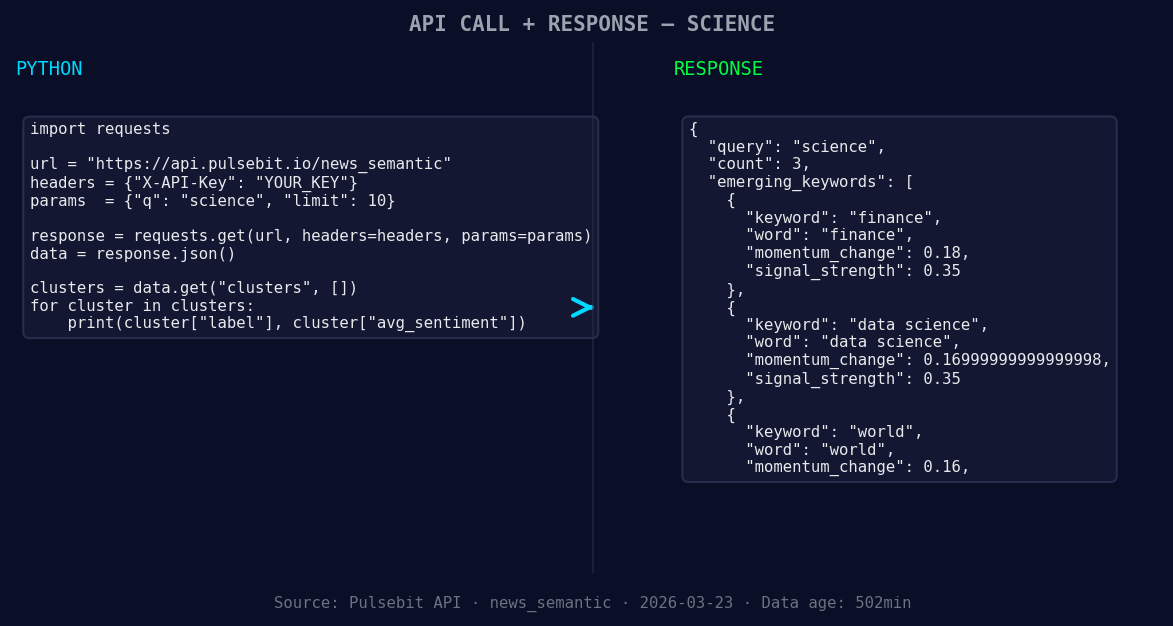
*Left: Python GET /news_semantic call for 'science'. Right: returned JSON response structure (clusters: 1). Source: Pulsebit /news_semantic.*
# Define parameters
topic = 'science'
momentum = +0.373
confidence = 0.85
# Geographic origin filter: query by language
response = requests.get('https://api.pulsebit.com/sentiment', params={
'topic': topic,
'lang': 'en'
})
data = response.json()
# Check if we received any articles
if data['articles_processed'] > 0:
# Meta-sentiment moment: run the cluster reason string back through POST /sentiment
cluster_reason = "Semantic API incomplete — fallback semantic structure built from available keywo"
sentiment_response = requests.post('https://api.pulsebit.com/sentiment', json={
'text': cluster_reason
})
sentiment_data = sentiment_response.json()
print(f"Meta-sentiment score: {sentiment_data['sentiment_score']}")
In this code, we first retrieve sentiment data for the "science" topic filtered by English articles. Then, we take the reason from our cluster analysis and run it through our sentiment analysis endpoint. This dual approach allows us to not only measure the momentum spike but also understand the narrative framing behind it, making our insights richer and more actionable.
Now, let's explore three specific builds you can implement using this new understanding of momentum spikes:
- Finance Spike Detector: Using the same geographic filter, set a threshold for finance-related articles. Alert when the sentiment score exceeds +0.18. This allows you to catch emerging trends in financial sentiment before they become mainstream.

Geographic detection output for science. Hong Kong leads with 1 articles and sentiment +0.80. Source: Pulsebit /news_recent geographic fields.
Data Science Insight Loop: Implement a meta-sentiment loop for "data science" articles. When sentiment reaches a score of +0.17, analyze the surrounding context using the narrative framing to develop deeper insights about the sentiment shifts.
World Event Tracker: Extend the same mechanism to track global sentiment regarding "world" topics. If the sentiment score reaches +0.16, trigger a notification that prompts a deeper dive into the articles creating this momentum.
These builds allow us to stay ahead of the curve, leveraging the latest sentiment data to inform our decisions. By focusing on specific signals and thresholds, we can tailor our approach to capture the most relevant information.
If you're ready to implement these ideas, check out our documentation at pulsebit.lojenterprise.com/docs. You can copy-paste and run this in under 10 minutes, putting you on the fast track to catching real-time sentiment shifts.


Top comments (0)