

Your Pipeline Is 22.1h Behind: Catching Finance Sentiment Leads with Pulsebit
We recently encountered a significant anomaly in our data: a 24-hour momentum spike of +0.315 in the finance topic. This spike is particularly compelling given that it emerged against the backdrop of a cluster story about the Middle East conflict affecting Africa's financial landscape. The leading language of the sentiment was Danish, with a time lag of merely 0.0 hours. This presents an intriguing opportunity for developers like us who are keen on leveraging sentiment data to stay ahead of the curve.
But here’s the catch: if your pipeline isn’t equipped to handle multilingual origins or capture entity dominance effectively, you might have missed this critical insight by a staggering 22.1 hours. Imagine if your model was set to only process English or failed to accommodate the nuances of a topic like finance in diverse linguistic contexts. The leading language here is Danish, and if your pipeline isn’t multilingual, you’ve effectively delayed your decision-making process.

Da coverage led by 22.1 hours. Et at T+22.1h. Confidence scores: Da 0.90, English 0.90, Spanish 0.90 Source: Pulsebit /sentiment_by_lang.
To catch this momentum spike, we can utilize our API to filter sentiment data by geographic origin. Here’s how to do it in Python:

Geographic detection output for finance. France leads with 1 articles and sentiment -0.60. Source: Pulsebit /news_recent geographic fields.
import requests
# Define the parameters for the API call
params = {
"topic": "finance",
"score": +0.136,
"confidence": 0.90,
"momentum": +0.315,
"lang": "da" # Filtering by Danish language
}
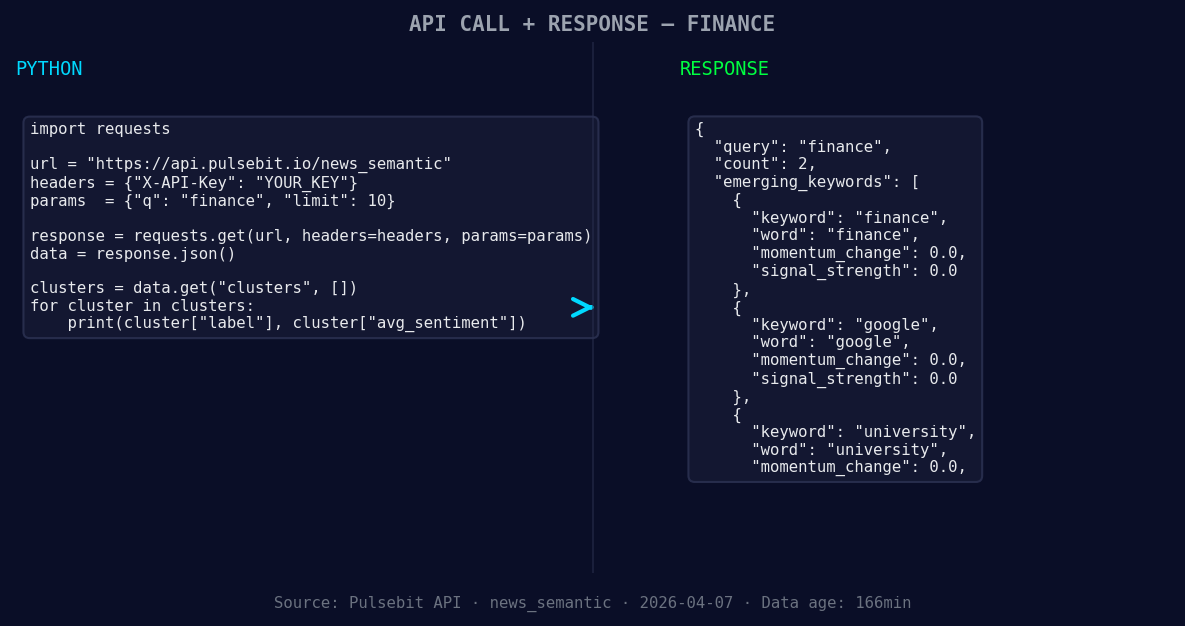
*Left: Python GET /news_semantic call for 'finance'. Right: returned JSON response structure (clusters: 3). Source: Pulsebit /news_semantic.*
# Make the API call to get sentiment data
response = requests.get('https://api.pulsebit.com/sentiment', params=params)
data = response.json()
print(data)
Next, we will run the cluster reason string through our sentiment API to score the narrative framing itself. This is crucial as it allows us to assess how the surrounding context influences the sentiment around our topic.
# Define the cluster reason string
cluster_reason = "Clustered by shared themes: africa, finance, breif:, middle, east."

# Make the API call to score the narrative
sentiment_response = requests.post('https://api.pulsebit.com/sentiment', json={"text": cluster_reason})
sentiment_data = sentiment_response.json()

print(sentiment_data)
Now that we have the data, let’s talk about three builds you can implement to capitalize on this pattern:
Geo-Filtered Alerts: Create a signal that triggers an alert when sentiment for the finance topic in regions where Danish is spoken spikes above a certain threshold, say +0.15. This can help you stay updated in real-time as events unfold.
Meta-Sentiment Analysis: Build a dashboard that continuously analyzes the cluster story narratives surrounding finance. Set a threshold of +0.1 for sentiment scores on these narratives to automatically flag them for deeper analysis.
Forming Theme Tracker: Implement an endpoint that tracks forming themes, particularly those like finance(+0.00), google(+0.00), and university(+0.00) against mainstream discussions like africa, finance, and breif. Set a signal threshold of +0.05 to alert when these themes converge, providing you with actionable insights.
If you’re ready to dive in, check out our docs at pulsebit.lojenterprise.com/docs. You can copy and paste the provided code snippets to get up and running in under 10 minutes. This is the kind of powerful insight you can harness when you leverage the full capabilities of our API. Let’s not let valuable sentiment insights slip through the cracks by staying in our silos.


Top comments (0)